Squarewave vs. squarewave on digital and analog 'scopes

Thread Starter

13hm13

Joined Jun 1, 2023
75
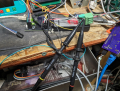
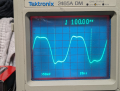
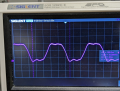
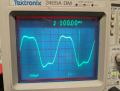
I am using Siglent SDS 1202x-E and Tek 465 as my main o-scopes. Same x10 probe used.

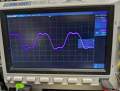
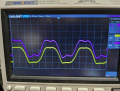
The two waveforms are from the exact same 11.289mhz ckt I built, powered by 4.0 vdc. See photos.

My main question is ... why that spike on the Siglent?
(Note: the Siglent is 200 Mhz vs Tek 100 Mhz, but even if I reduce v/div on the Siglent, the spike is still very apparent )


 

MrChips

Joined Oct 2, 2009
34,628
One difference is the bandwidth of each oscilloscope. One is 200MHz and the other is 100MHz.
Do not connect the ground clip at the power supply. Connect it at the ground of your circuit. They are not the same.
 

MrChips

Joined Oct 2, 2009
34,628
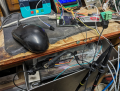
In my ckt, they are the same. And, yes, tried gnding Siglent both as PS and on ckt pins. No difference. Note the green wire in the photo.
In theory, the voltage at the two ends of the green wire are not the same.
The green wire feeds current to the circuit. Hence, every time the circuit switches, there will be a current pulse in the green wire.
You don't want the oscilloscope reference (GND clip) to be measuring this current pulse.
 

Thread Starter

13hm13

Joined Jun 1, 2023
75
I did switch to a different probe (Velleman), and played with the compensation screw. No difference, other than variation in amplitude. I can reduce the spike somewhat if I physically hold the probe end with bare fingers ( at that buffering 100R at the blue wire).
 

WBahn

Joined Mar 31, 2012
32,703
Your pulse appears to have a period of about 20 ns, making the fundamental 50 Mhz. Thus both scopes pick up the fundamental and the second harmonic, but the 100 MHz scope is going to attenuate higher harmonics pretty strongly, while the 200 MHz scope is going to get the third and fourth harmonics pretty well. A lot of the amplitude of the pulse is going to be in these higher harmonics.
 

WBahn

Joined Mar 31, 2012
32,703
That's the spectrum of the entire waveform and it is going to be dominated by the fundamental, which is just over 10 MHz, and it's harmonics (particularly the odd harmonics).

What we are talking about is the smaller waveform that is riding on top of this at the transitions. It is much smaller in amplitude and much higher in frequency.
 

nsaspook

Joined Aug 27, 2009
16,250
Signal comparison with one of the best classic analog scopes ever made.
1687670318467.png
10MHz cpu clock, both grounded to the same RJ-45 shield body that's connected to the clock chip and PCB ground plane.
1687670389656.png
350Mhz
1687670424713.png
200Mhz

Look pretty much the same other than digital artifacts on the DSO. Likely ground related inductance (green wire to your PCB) is causing your DSO spikes.


Signal ground reconnected to probe grounds using a 1ft jumper.
1687671370690.png
Bad signal probing practice.
1687671394010.png
Extra spike seen on the TEK.

1687671527059.png
Don't see as much change here with the crappy signal ground.
 
Last edited:

nsaspook

Joined Aug 27, 2009
16,250
https://download.tek.com/document/02_ABCs-of-Probes-Primer.pdf
Ground Lead Issues Ground lead issues continue to appear in oscilloscope measurements because of the difficulty in determining and establishing a true ground reference point for measurements. This difficulty arises from the fact that ground leads, whether on a probe or in a circuit, have inductance and become circuits of their own as signal frequency increases. One effect of this was discussed and illustrated earlier, where a long ground lead caused ringing to appear on a pulse. In addition to being the source of ringing and other waveform aberrations, the ground lead can also act as an antenna for noise. Suspicion is the first defense against ground-lead problems. Always be suspicious of any noise or aberrations being observed on an oscilloscope display of a signal. The noise or aberrations may be part of the signal, or they may be the result of the measurement process. The following discussion provides information and guidelines for determining if aberrations are part of the measurement process and, if so, how to address the problem.
Same signal, same scope, different scope probe grounds.
You guess which one was the better probe ground. o_O
1687674232513.png
 
Last edited:

Thread Starter

13hm13

Joined Jun 1, 2023
75
What we are talking about is the smaller waveform that is riding on top of this at the transitions. It is much smaller in amplitude and much higher in frequency.
I don't know what this means or how it relates to the spike I see in the Siglent.

I can expand the range of the SA, and show the decay of harmonics. Are you, perhaps, suggesting the spike is the result of an integration effect (a summation) -- all high-freq peaks?


----------


Even if so, not sure why a mere 100 Mhz (Siglent 200 Mhz; Tek 100 Mhz) makes such a huge difference?

I suspect the spike is due to sloppy A/D conversion in the SDS1202X-E; alas a low-$ 'scope, and not a better digital like, say, R&S.
 
Last edited:

AnalogKid

Joined Aug 1, 2013
12,043
In my ckt, they are the same.
At 11 MHz, nothing is the same. Among other things, the ground wire on a scope probe is two things: 1, An inductor; 2, A loop antenna.

In your case, it looks like the lead inductance, coupled with a few inches of green ground wire and combined with the scope's input capacitance, could be the problem.

Another thing to check is the probe compensation adjustment.

ak
 

nsaspook

Joined Aug 27, 2009
16,250
...

I suspect the spike is due to sloppy A/D conversion in the SDS1202X-E; alas a low-$ 'scope, and not a better digital like, say, R&S.
Look at my images above, please.

Nope, that's not the reason why, a better scope like my analog 2465A shows the spike better than the SDS1202X-E. You are simply seeing electromagnetic fields in action as it moves around the conductors. The spike field energy the probe is seeing and the scope displaying is a real artifact of both the probe and PCB connection. Your circuit floating is space with random lengths of wires to a power supply, resistor, etc ... is generating reflections, phase shifts from reactance (stored field energy) that reinforce and cancel as the main signal propagates across space.
 
Last edited:

BobTPH

Joined Jun 5, 2013
11,463
Try looking at the signal with both probes at the same time. They may look more alike, when they are displaying the same signal.
 

Thread Starter

13hm13

Joined Jun 1, 2023
75
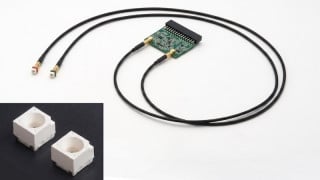
The spike behavior on Siglent is similar on a 4-pin Tent Labs "Low Jitter" 27Mhz osc.
I used same PSU (but at 3.00vdc), same probes, same 'scopes.
Because of Tek 465's 100MHz limit, my horiz setting was maxed to 0.05uS. Vert.: 0.2 V/Div.
Since many of you probably have 4-pin osc's in your kit, and at least one of you has the same Siglent 'scope as mine, try to replicate my experiment. My specific SDS 1202X-E -- which I purch'd new from Amazon in July 2020 - - might have some defects, which I just discovered? Dunno ?????.


Last edited:

nsaspook

Joined Aug 27, 2009
16,250
The spike behavior on Siglent is similar on a 4-pin Tent Labs "Low Jitter" 27Mhz osc.
I used same PSU (but at 3.00vdc), same probes, same 'scopes.
Because of Tek 465's 100MHz limit, my horiz setting was maxed to 0.05uS. Vert.: 0.2 V/Div.
Since many of you probably have 4-pin osc's in your kit, and at least one of you has the same Siglent 'scope as mine, try to replicate my experiment. My specific SDS 1202X-E -- which I purch'd new from Amazon in July 2020 - - might have some defects, which I just discovered? Dunno ?????.
Not surprised you have ringing signals with that flying in air setup. Tent labs seem to sell to the audio universe instead to the real world of actual engineering.
https://www.tentlabs.com/Components/cdupgrade/xo2xo3/index.html
Purpose
XO2.2 and XO3.2 are designed to be applied as an upgrade in CD and DVD players. They generate a very low jitter clock, which in turn clocks the DAC chips. This in turn leads to lower distortion in the audio spectrum. It pays off and results in:
• Lower grain
• More resolution
• Better transparency
• Cleaner sound
• Better bass

Most commercially available CD players contain standard clock generator circuits, producing typical jitter values up to, and over 100 ps. XO 2.2 / 3.2 output jitter is below 3ps, integrated over the whole bandwidth starting from 10Hz. Now guess how that distortion is reduced….
 
Top