Technics SU-VX800 amplifier

Thread Starter

Marius83

Joined Dec 28, 2017
423
Q503 E TO Q515 B : 2.2 ohms
Now, at 25C the thermistor called for in the service manual would typically be 100 kohms.

That color code could be 100k brown-black-yellow.

I think we should check the x5 left channel before ordering. are you feeling up to it?

If so .....


Left Channel


Let me know when your done.

Once that is done, with no transistors in the x5 section, we will fire it up .... make sure everything is working up to the X5 subsection.

I'll have that test procedure for you before we do it.
About the termistors, i guess they could be around 10 degrees at that time.

Of course i'm up, here are the measurements
:)

.... you mentioned two points to measure, twice, perhaps you meant another transistor?
Marked out in blue.
There are some components out at channel LEFT as you might know, like Q503, Q505,

Also, the 21W bulbs at R505 and R506, i removed these, leaving R505 and R506 open.
My measurements in RED:


Q501 E to Q501 C : Tested: 3.6 Kohm

Q503 E TO Q507 B : 2.2 ohms : Tested: No reading OL.
Q503 E TO Q515 B : 2.2 ohms : 2.3 ohm
Q503 C TO Q505 B: 680 ohms : Tested: No reading OL.
Q503 E TO Q507 B: 680 ohms : Tested: No reading OL.

Q503 E TO Q507 B : 2.2 ohms : Tested: No reading OL.
Q503 E TO Q515 B : 2.2 ohms: Tested: No reading OL.

Q505 E TO Q509 B : 2.2 ohms: Tested: No reading OL.
Q505 E TO Q517 B : 2.2 ohms: Tested: No reading OL.

TP501-2 (assuming the emitter resistor is good, otherwise use TP502-1) to Q512 E - 270.33 ohms + (L501 DC resistance)
Tested: No reading OL. Tried both
TP501-2 (assuming the emitter resistor is good, otherwise use TP502-1) to Q512 B - 0.44 ohms + (L501 and L503 DC resistance)
Tested: No reading OL. Tried both

Q511 B to relay 503 contact ... 180 ohms : Tested: 170 ohm
Q511 B to relay 502 contact ... 0 ohms : Tested: 0 ohm
Q511 B to relay 501 contact ... 0 ohms: Tested: 0 ohm
Q511 B to IC501 pin 1 ... 47k ( + L504 dc resistance) Tested: 31.7 Kohm

Q511 C to D504 anode ... 15k : Tested 14.69 Kohm

Relay 501 common contact to L CH B Speaker + : 0 ohms + (L552 dc resistance) Tested: 0 ohm
Relay 502 common contact to L CH A Speaker + : 0 ohms + (L551 dc resistance) Tested: 0 ohm
Relay 503 common contact to L CH headphones + : 150 ohms : Tested: 0.6 ohm
 

JoeJester

Joined Apr 26, 2005
4,390
Yeah .... if I put R505 and R506 ... it was in error.

Q503 E TO Q507 B : 2.2 ohms : Tested: No reading OL.
Q503 E TO Q515 B : 2.2 ohms: Tested: No reading OL.

Q505 E TO Q509 B : 2.2 ohms: Tested: No reading OL.
Q505 E TO Q517 B : 2.2 ohms: Tested: No reading OL.
The two Q50x E readings go to two different transistors .... Look at the schematic and pretend you selected those points and what were you measuring. If your reading OL ... then there is a problem.

TP501-2 (assuming the emitter resistor is good, otherwise use TP502-1) to Q512 E - 270.33 ohms + (L501 DC resistance)
Tested: No reading OL. Tried both
TP501-2 (assuming the emitter resistor is good, otherwise use TP502-1) to Q512 B - 0.44 ohms + (L501 and L503 DC resistance)
Tested: No reading OL. Tried both
You may want to do that original test like we did on the right channel .... checking those emitter resistors .....


Q511 B to IC501 pin 1 ... 47k ( + L504 dc resistance) Tested: 31.7 Kohm
This is the equvalent test where you found that 56k resistor at 35k. R535 I believe is the resistor.

If you have any questions .... let me know. Write down the plan you are using to test the emitter resistors around TP501.

p.s. remember no transistors in the circuits .....
 
Last edited:

Thread Starter

Marius83

Joined Dec 28, 2017
423
Yeah .... if I put R505 and R506 ... it was in error.


The two Q50x E readings go to two different transistors .... Look at the schematic and pretend you selected those points and what were you measuring. If your reading OL ... then there is a problem.


You may want to do that original test like we did on the right channel .... checking those emitter resistors .....


This is the equvalent test where you found that 56k resistor at 35k. R535 I believe is the resistor.

If you have any questions .... let me know. Write down the plan you are using to test the emitter resistors around TP501.

p.s. remember no transistors in the circuits .....
Looking at the schematic...and emittor resistors and what i plan to check, i wrote in red

Q503 E TO Q507 B : 2.2 ohms : Tested: No reading OL. Check R515
Q503 E TO Q515 B : 2.2 ohms: Tested: No reading OL. Check R565

Q505 E TO Q509 B : 2.2 ohms: Tested: No reading OL. Check R517
Q505 E TO Q517 B : 2.2 ohms: Tested: No reading OL. Check R567

I will check them later

True, we're not measuring through any transistor so Q505 and Q506 not beeing in circuit doesn't matter... i understand
 
Last edited:

JoeJester

Joined Apr 26, 2005
4,390
TP501-2 (assuming the emitter resistor is good, otherwise use TP502-1) to Q512 E - 270.33 ohms + (L501 DC resistance)
Tested: No reading OL. Tried both
TP501-2 (assuming the emitter resistor is good, otherwise use TP502-1) to Q512 B - 0.44 ohms + (L501 and L503 DC resistance)
Tested: No reading OL. Tried both
To eliminate some of the circuit .... do this test .... results should be 0.44 except the direct connections.


TP501 + to Qxxx E tests:
Q507 E - tests the connenction
Q509 E - tests R547 and R549
Q515 E - tests R547 and R569
Q517 E - tests R547 and R571

TP501 - to Qxxx E tests:
Q507 E - tests R549 and R549
Q509 E - tests the connenction
Q515 E - tests R549 and R569
Q517 E - tests R549 and R571

It is very odd that you had numerous resistors open or really far out of tolerance. But, neither you nor I know the whole history of the unit.

After the faults on the X5 left side have been identified, I'll identify some more tests for you to do on a powered up unit, to help you get familiar with your oscilloscope. If you have adapters to go from computer to the CD input, we should be able to lower the volume to "pretend" it's a CD and you can generate some tones. Not tunes, tones. These will be lower level functional tests to eliminate at more of the circuits, so you can finally place the order.
 
Last edited:

Thread Starter

Marius83

Joined Dec 28, 2017
423
To eliminate some of the circuit .... do this test .... results should be 0.44 except the direct connections.


TP501 + to Qxxx E tests:
Q507 E - tests the connenction
Q509 E - tests R547 and R549
Q515 E - tests R547 and R569
Q517 E - tests R547 and R571

TP501 - to Qxxx E tests:
Q507 E - tests R549 and R549
Q509 E - tests the connenction
Q515 E - tests R549 and R569
Q517 E - tests R549 and R571

It is very odd that you had numerous resistors open or really far out of tolerance. But, neither you nor I know the whole history of the unit.

After the faults on the X5 left side have been identified, I'll identify some more tests for you to do on a powered up unit, to help you get familiar with your oscilloscope. If you have adapters to go from computer to the CD input, we should be able to lower the volume to "pretend" it's a CD and you can generate some tones. Not tunes, tones. These will be lower level functional tests to eliminate at more of the circuits, so you can finally place the order.
Tested the emitter resistors as mentioned above:

R515: No reading, OL.
R565: 2.3 ohm
R517: No reading OL.
R567: No reading OL.

TP501 + to Qxxx E tests:
Q507 E - tests the connection: 0 ohm
Q509 E - tests R547 and R549: No reading OL.
Q515 E - tests R547 and R569: No reading OL.
Q517 E - tests R547 and R571 No reading OL.

TP501 - to Qxxx E tests:
Q507 E - tests R549 and R549: No reading OL.
Q509 E - tests the connenction : 0 ohm
Q515 E - tests R549 and R569 : No reading OL.
Q517 E - tests R549 and R571 : 0.5 ohm

I just tested every cheramic resistor 0.22 ohm, i see we're testing some of them above, but i'm just including it.
I guess not every is relevant for your tests, but i need to check them to make an order anyway.

R547:
No reading OL.
R549: 0.3 ohm
R569: No reading OL.
R571: 0.3 ohm
R555: 0.2 ohm
R521: 0.2 ohm
R570: No reading OL.
R572: 0.3 ohm
R556: 0.2 ohm
R522: 0.2 ohm
R524: 0.2 ohm
R558: 0.2 ohm
R548: No reading OL.
R550: 0.3 ohm
R529: 0.2 ohm
R557: 0.2 ohm


You wrote this in last post to check this again i guess?

TP501-2 (assuming the emitter resistor is good, otherwise use TP502-1) to Q512 E - 270.33 ohms + (L501 DC resistance)
Tested: No reading OL. Tried both
TP501-2 (assuming the emitter resistor is good, otherwise use TP502-1) to Q512 B - 0.44 ohms + (L501 and L503 DC resistance)
Tested: No reading OL. Tried both
To eliminate some of the circuit .... do this test .... results should be 0.44 except the direct connections.
So i tested again:
TP501-2 to Q512E: No reading OL.
TP502-1 to Q512E: No reading OL.

TP502-1 to Q512B: No reading OL.
TP502-1 to Q5512B: No reading OL.

So i don't know...
 

JoeJester

Joined Apr 26, 2005
4,390
tp501-2 goes to Q511 B .... not Q512. that is my failure to catch that.

The second misprint was the

TP501 - to Qxxx E tests:
Q507 E - tests R549 and R549: No reading OL.
as that should have said

TP501 - to Qxxx E tests:
Q507 E - tests R549 and R547:

But you got the correct reading as R547 is open from the other test TP501 +

I just tested every cheramic resistor 0.22 ohm, i see we're testing some of them above, but i'm just including it.
I guess not every is relevant for your tests, but i need to check them to make an order anyway.
You didn't test them because you needed to anyway .... the TEST gave you an idea of which were bad, causing you to investigate it further.

We test to confirm or deny large chunks of circuits are operating normally. In the case of this amplifier, once the initial problem is solved, we check to see what else could have caused the problem. Look how many times you replaced a transistor .... only to not have it solved.

I kept thinking this needed a different approach .... checking to eliminate chunks of circuits, and identifying components to eliminate and which to buy. In fact, you found a problem, the thermistors, where we have no idea of when that first failed.

The power-up check will be a functional one .... testing chunks of circuits. The secondary benefit of those tests is getting you comfortable with the schematic and using your test equipment. We are on our 30 page and you made considerable progress in the last few pages in my opinion. You had some successes and some failures. Some based on my typing skills and some based on your electrical skills. That is my assessment of the last few pages. Yes, tests were repeated, to confirm. I was not going to ask you every component, as it could have been a waste of time. You ended up testing a lot of components because you had indicators that led you in that direction.

I'm going to point you to a webpage on troubleshooting. It was written a long time ago, in the 1960s, but it illustrated a purposeful procedure used in electronic systems. Also on that page is an old game of Hi-Lo, a numbers guessing game where the only responses given is high, low, or correct. Using the procedure, called half-splitting, you should guess the number in 9 tries. You can do the same in the any type of troubleshooting once you get past the visual inspection and testing the integrity of a connection (wiggling wires).

The six-step troubleshooting procedure is very useful.
 
Last edited:

JoeJester

Joined Apr 26, 2005
4,390
I mentioned the thermistors in the previous post.

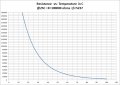
Let me show you a graph of a NTC thermistor. Negative Temperature Compensation ... meaning the resistance decreases as the temperature increases.

NTC-thermistor.jpg

the reference at a temperature of 25C of 100k, and I kinda doubt your workspace is heated to 55C at the time of your test .... so that was the key to my questioning the reading of Q501 C-B and Q502 C-B readings of about 18k. NTC thermistors are in vehicles monitoring motor temperatures. An auto mechanic, ASE certified Master Mechanic, and I were discussing them. He ended up measuring the cold resistance of a few of them and came up with an average value, so when he suspected a sensor, he would substitute a resistor, so he could do a quick check.

My extremes calculation just assumed a resistance of 100k and a resistance of 1. That is how I came up with the extremes and when you were on the lower end .... it raised a flag to inspect that circuit closer.
 

Thread Starter

Marius83

Joined Dec 28, 2017
423
Well, i'm trying to learn,i need to look more at the schematics.... but the real job is being done by you guys, i would not have a chance to approach this without your guidance. I'm understanding a bit more as we go how things work together...
I might read that six step troubleshooting, cool

I actually thought about the TP501-2 to Q512B being wrong.. but didn't write it being unsure.. hehe

So you wan't to do a power up test without replacing any resistors? Or after?
No problem to use the computer for an audio signal.

There was not 55 degrees in my workshop, you are correct about that.... more like 10 degrees at that moment.

So looking back at the posts now, we've discovered some open, or out of value resistors that need replacement.
Have i forgotten any?

R451
R547
R569
R450
R548
R570
R504
R536
R505
R505
R506
R515
R517
R567
TH501
TH502
 

JoeJester

Joined Apr 26, 2005
4,390
I actually thought about the TP501-2 to Q512B being wrong.. but didn't write it being unsure.. hehe
Never worry about being unsure. Some of the readings you were reporting had me wondering what was going on. That's why we can question one another, no matter what ... Look how many typo's I had the last three days ...... shame on me. LOL

If X4 section is complete, assuming you have those resistors in stock (R450 and R451 ,,, 2.2 ohms) .... we can do a power up test to functionally check things out .... while leaving the X5 empty. This will allow you to practice reading the schematic, and using your oscilloscope. You will be ready to place the order right after the functional test. That way if there is anything else you need, you will know about it.

I'm shocked over the number of components that were out of tolerance. Well, you have done well the past couple of days. I thing you will get more comfortable as this exercise continues.

As long as you have the adapters to go from the 3.5mm computer output to both L/R RCA inputs, and you can set the volume to the level specified, and you have a 1 kHz tone of about 30 sec .... yeah, we will do some testing. The very first test is to ensure all the power supplies are operating normally. We will look at the DC voltage as well as the AC ripple. Once those are complete ... and operating properly, we will move onward.

The functional testing I envision, but haven't written it up, is based on Step 2 of the Six Step Troubleshooting process. Step one is recognizing there is a problem, and just the let you know, you might not have recognized that thermistor problem as a problem. I know I wouldn't have, but with all the unknowns, it was time to go very basic and start checking things closely.

Step to is elaborating on the problem. A no output problem could be anywhere from the INPUT to the Speakers. But you have multiple inputs, so, you would check each of them to see if they produced an output from the speaker. Well, since we don't have speakers installed, we will look at the signals on the oscilloscope at a few test points to ensure they are of sufficient signal strength.

Here's the basics of my thoughts ....

Test the Record switch ....

We will test each position and combination allowed. I have to trace all the combinations out to tell you what to measure, We will not be testing the phono, unless you have a phonograph. We are only doing the oscilloscope observations ....

After the record switch, we will test the Input switch connections, The test points will consist of the input to X2, the input to X3, the input to X4, and the input to X5, which is the output of X4.

So this adventure will be taking you throughout the major signal path.

So, to prepare for this trip, gather the transistors for the X4 section, Q4xx, test them, then install known good transistors. Install the two open resistors R450 and R451.

Take good notes ....

We will leave the lamps in the power supply till we are completely successful and everything tests ok.

Are you getting psyched up for the adventure.
 

Thread Starter

Marius83

Joined Dec 28, 2017
423
Good explaining, i need that.
Yes i'm psyched for further adventure... hehe...

I do have cable from jack computer to signal in, and i also have 1 khz tone, so that's no problem.
Also, i have many 2.2 ohm resistors in stock now.

X4 section at RIGHT channel seems complete to me, and we had no power draw last time we fired up... do you want me to test all those small transistors in the circuit or should we make a go, since it looked promising last time?
I do have some spares of the transistors now.
But i don't have the Q512/511 type, should i test it or should we hope it's okay?

So i will now replace R451 and 450 2.2 ohm 1/4w
 

JoeJester

Joined Apr 26, 2005
4,390
With all the duplicate faults we had in the past, I'm on the side of measuring everything to see if it's basically ok.

You replaced a lot of things in the past ... only to have them fail.

In fact, we might want to inspect the whole X4 circuits prior to proceeding. They can be in circuit checks of the transistors that are installed. Just make a list and then check them in circuit with your little tester. If you get a wierd reading .... make a not of it and take a picture. We can use that as a starting point to see if further investigation is warranted.

By the time you get this thing finished, you will be comfortable using all your test equipment.

So, look at the schematic, make a list of things you want to check. Check them and record your results. You don't have to take any pictures unless you think you want to discuss that test later.

You have that tester. You know the two currents should be zero ... no leakage. You can jump back on here at any time you have a question.

All of the tests you design to check X4, if you have a question, ask. I will ask what you tested, how you tested it, and will want to see the results in question. After your done and posted your results, I'll look them over to see if I have any questions to clarify what you've done. If you have enough parts to fully install in X4, both sides, do so. X5 will wait until after the parts order.

Here's our sequence:

- Reinstall all the X4 components you've taken out. Replace those you found bad. Hopefully X4 would be complete.
- Leave the transistors out of X5 ....
- You do all the testing you want to on X4 and X3. Make your plan and execute it. Just make a record of the test points and the results.
- Post what you have done and I'll review. We can talk about anything unusual.
- Followup troubleshooting if necessary
- Do some oscilloscope testing with the power off. (I'll be working on that and posting it while you are doing the X4 stuff)
- Power up
- Measure all power supplies .... Voltage and Ripple.
- Investigate any abnormal behavior
- Functional testing of the circuits from the input at X2 to the output of X4. X1 is the phono preamp.
- investigate any abnormal behavior.
- Order all replacement parts
- wait for parts

-- Make the plan for post parts arrival.

You are Testing X3 because it also uses the two sixty volt supplies.

To help you on the plan ... think about point to point resistances, testing the transistors, FETs, electrolytic capacitors, and diodes with your tester. This is a two-fold purpose ...

1. Your reading the schematic and correlating it to the board.
2. Your becoming more familiar with your test equipment and placing probes where you want them and not bridging them causing a short. We don't want that to happen when the power is energized.

Good luck and I'll be checking in once a day to see if you posted anything, questions or results.

Keep track of any defective components you find. If they are not in stock, the order will be placed before proceed to powered tests. Don't rule out a component defective on the point to point resistances until you check all the components you thought you were testing. Remember the Q501/Q502 tests. Both led you to checking into the string. By all means ask if you find something odd .... so we can address it quickly.

The object is for you to fix your amplifier. I'm a mere assistant in the process, helping you.
 
Last edited:

Thread Starter

Marius83

Joined Dec 28, 2017
423
Okey @JoeJester, thanks for the plan, you might think too good of me, but i'll try...... hehe i'm not so good on the point to point testing, don't know exactly what points i should focus on... so i'm just going through the schematic, starting on X4 circuit on RIGHT channel.
It is not possible to test the small transistors in circuit, i only get a faulty reading, but I've tested the resistors, and diodes.
What is a proper way to test those diodes ?
I know if it's zener's it guess i would have needed to check actual voltage passing?
I have a diode sign on my DMM, using that, i got a reading only one way.. and by that i say it's ok. Is that ok ?
All diodes in RIGHT channel seems fine in this way.

About the small capacitors, how would i check them? Don't think i can with my ESR tester..
EDIT: looks like i can... between the DUT probes right.
Tried on some in circuit.. how would i know if it's faulty.. showed a bit higher uf than the capacitor is.. because it's in circuit i guess...

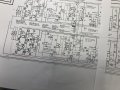
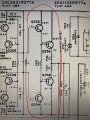
Picture of schematic i've tested. As said the transistors needs to be taken out to check them all.
Do you thinks it's needed?
I have a lot of new ones in that area, from earlier on.

Most of resistors measured ok.
But there is a lot being out of tolerance...

R428(2.2k) : 1.94 K ohm
R430(2.2k): 1.94 K ohm
R438(560): 411 ohm
R434(3.3k): 2.65 K ohm
R440(22k): 15.5 K ohm
R460(3.3k): 2.69 K ohm
R472(10): 5.2 ohm
R462(3.3k): 2.6 K ohm
R466(1k): 941 ohm
R474(10): 5.2 ohm
R404(220k): 560 ohm


My plan is to check the same at LEFT channel now.
I have removed Q407, Q415, D411, C409 and R415 which were toast.
Also removed Q413, looked fine, but it was defective as well.


IMG_4303.JPGIMG_4304.JPG
 
Last edited:

Thread Starter

Marius83

Joined Dec 28, 2017
423
So i moved further on LEFT channel...

At first i removed defective components found:
Q407
Q415
Q413
C409
D411
R415

Took out the small transistors for testing.
Q403,Q411,Q409,Q401,Q405,, these were ok.

Resistors out of tolerance:

R403(220k): 553 ohm
R427(2.2k): 1.94 K ohm
R433(3.3k): 2.71 K ohm
R437(680): 652 ohm
R429(2.2k): 1.95 K ohm
R439(22k): 15.3 K ohm
R445(100): 98.3 ohm (enough?)
R441(22k): 15.4 K ohm
R473(100): 4.7 ohm
R455(120): 104.5 ohm
R453(680): 673 ohm (enough?)
R457(120): 133.5 ohm
R473(10): 5.2 ohm
R459(3.3k): 2.71 K ohm
R461(3.3k): 2.71 K ohm
R465(1k): 935 ohm
R449(2.2): 2 ohm (enough?)

Diodes:
Measures ok the way i explained in last post, all except:

D411: out of circuit
D409: This measures 0.3 ohm both ways...


So i guess this has been taken some beating...hehe
 

Thread Starter

Marius83

Joined Dec 28, 2017
423
X3 circuit.... in the front panel.
I took out the pcb now, found two locations that's been hot.
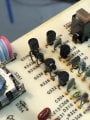
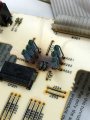
Burned resistors in one place, guess it was were the smoke came from, very early in this thread... the solder on the pcb has melted under Q336...
The other place seems to have been hot too.... need further investigation...
IMG_4305.JPGIMG_4306.JPG
 

JoeJester

Joined Apr 26, 2005
4,390
OK .... are you removing a leg on the resistor when you check them? If not there could be a parallel path to explain a wierd reading.

The reason for the testing is all the circuits associated with the + and - 60 volts so when we start bringing up the power, we can do it in stages KNOWING the components are good in lieu of replacing some only to find a problem exists.

Point to point means .... qxxx E to qyyy b or however there is a path between the circuits.

I know this seems like wasting time, but I've looked at 30 pages of a problem. Would one pay some repair shop for this repair .... probably not. In fact, once it hits over 50% of a new unit, people start thinking throw away and buy new.

I'd rather minimize the powered testing in favor of testing the higher powered sections.


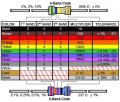
You had a couple of questions about resistor tolerance. a 100 ohm resistor at 10% tolerance can be 90-110 ohms, while a 2% tolerance can be 98 to 102. The color of the fourth band typically identifies the tolerance.

Here is a color code chart for your reference.

For instance if you went from CP202 pin 6 to either Q335 E or Q337 E, you would be reading the emitter resistor on the associated transistor. Yes, that signal ultimately goes to the X4 input, but one can't find other parallel paths.

Testing points to ground can have parallel paths and that is why most shy away from resistance checks today. The manuals I worked with, ages ago, all had resistance checks, till the 1990s.

I'll assume you just checked across the resistors you posted and I'll look to see if I can confirm or deny the value as reasonable.

Yes, I am having some faith in you, assuming you will learn from all the other tests you performed, even if you didn't look over the schematic to see what you were measuring.

The absolute tolerance test is up to you. If you have a 2% 100 ohm resistor and it reads 97.8 ... you may not want to replace it. Your meter is about 0.8% tolerance +4 digits .... so that 97.8 could be as low as 97.4 then -1%.

I have no idea of the last time your meter went to a calibration lab, so I'm assuming it meets the specifications outlined in the manual.

I seriously doubt that would cause a significant degradation of your amplifier performance, but you might have golden ears and can discriminate between multiple sounds in each of the audio bands ....... while I have shit ears and loss of frequencies above 1000 Hz so bad that the sh and ch sounds are lost. I'll look at all you done. You can continue doing more gaining some expertise in your amplifier.

While your testing, ask your self would you rather find some errors not or wait and keep letting the logistic delays from parts order to parts arrival delay you listening to your amplifier?

I'm asking myself what the hell happen to cause so many problems. Maybe the previous own rocked the house.

Rest assured, you will check those out of tolerance components again prior to the order by removing one leg of the resistor and measuring across them or measuring the transistors out of circuit.

We can only do a power test as far as we have completed circuits. The rest would be delayed by logistics and repair.

I should have told you this wasn't going to be "quick".
 

Attachments

Thread Starter

Marius83

Joined Dec 28, 2017
423
I have checked the resistors in circuit.. i see all 10 ohm resistors are 5.2
OK .... are you removing a leg on the resistor when you check them? If not there could be a parallel path to explain a wierd reading.

I have checked them in circuit.
I see some equal resistors have the same deviaton at both sides.... so you may be right about the parallel path's...


The reason for the testing is all the circuits associated with the + and - 60 volts so when we start bringing up the power, we can do it in stages KNOWING the components are good in lieu of replacing some only to find a problem exists.
Point to point means .... qxxx E to qyyy b or however there is a path between the circuits.

I do understand what you mean with poin to point measuring, and i manage to understand the schematic in some way.. but i don't know what path's to check if you understand... i don't see this as you do. My main problem is, i don't really know how this thing works... i know basics of a transistor.. current in at C, apply a little current at B controls the output at E... but there's a ton of them connected together through resistors and diodes.. and i can't always see the context.

If we look the little circuit Q332,Q334,Q336 and Q338, me trying to understand..
Q336 is melted....and R328, R330, R332
If i see in the schematics, Base is fed from Q332, we have +60Volt in at C, and R330 out in series with R332 going to Q338 Emitter.
And Q338 has -60Volt in at C .. in my head when Q338 and Q336 got power from Q332 and Q334 at their base, they would burn R332 and R330 because they put -60Volt and +60Volt together....

And also, why has some transistor icons, the Emitter arrow at the edge of the circle, and some have the arrow pointing in at that line? Is it showing the flow.... or transistor types.. npn,pnp..? what is the difference, i can't see what's coming out of Q336 and Q338 Emitter connected together with those two resistors...

As now you might understand how limited my knowledge is, but if you could explain this to me i might understand the circuits better.... but my head might not be big enough for this. hehehe

My experience with schematics from the car workshop is limited and are easier to read, +12V and - 12V(ground)
But in this amp we have +60V -60V and ground ?
This is clearly basics for you.... but i just need to ask......


I know this seems like wasting time, but I've looked at 30 pages of a problem. Would one pay some repair shop for this repair .... probably not. In fact, once it hits over 50% of a new unit, people start thinking throw away and buy new.

Don't think of the costs, i doesn't matter, i have many amps working, don't need this in particular.
I just want to try to fix i like a project, to learn and it would be an great accomplishment for me if i could make it work again.


I'd rather minimize the powered testing in favor of testing the higher powered sections.


You had a couple of questions about resistor tolerance. a 100 ohm resistor at 10% tolerance can be 90-110 ohms, while a 2% tolerance can be 98 to 102. The color of the fourth band typically identifies the tolerance.

Here is a color code chart for your reference.

For instance if you went from CP202 pin 6 to either Q335 E or Q337 E, you would be reading the emitter resistor on the associated transistor. Yes, that signal ultimately goes to the X4 input, but one can't find other parallel paths.
Why is is better to read the resistors through point rather than measure just on it?
Because of the parallel path problems?


Testing points to ground can have parallel paths and that is why most shy away from resistance checks today. The manuals I worked with, ages ago, all had resistance checks, till the 1990s.

I'll assume you just checked across the resistors you posted and I'll look to see if I can confirm or deny the value as reasonable.
yes..

Yes, I am having some faith in you, assuming you will learn from all the other tests you performed, even if you didn't look over the schematic to see what you were measuring.

The absolute tolerance test is up to you. If you have a 2% 100 ohm resistor and it reads 97.8 ... you may not want to replace it. Your meter is about 0.8% tolerance +4 digits .... so that 97.8 could be as low as 97.4 then -1%.

I have no idea of the last time your meter went to a calibration lab, so I'm assuming it meets the specifications outlined in the manual.
I has never been calibrated since it was new.

I seriously doubt that would cause a significant degradation of your amplifier performance, but you might have golden ears and can discriminate between multiple sounds in each of the audio bands ....... while I have shit ears and loss of frequencies above 1000 Hz so bad that the sh and ch sounds are lost. I'll look at all you done. You can continue doing more gaining some expertise in your amplifier.
hehe.. i hope i will perform as it should

While your testing, ask your self would you rather find some errors not or wait and keep letting the logistic delays from parts order to parts arrival delay you listening to your amplifier?
Rather try to find the components i need..

I'm asking myself what the hell happen to cause so many problems. Maybe the previous own rocked the house.
Can't all my replacing of components, have done some damage? I have burned a lot of components... also in the start we had not turned down the VR's.. if that could matter..... also the first big fault i did right in the beginning, "measuring" voltage with the probe in the Ampere hole..... could have done some damage..?

Rest assured, you will check those out of tolerance components again prior to the order by removing one leg of the resistor and measuring across them or measuring the transistors out of circuit.
Okey. So check the resistors out of tolerance with one leg lifted...

We can only do a power test as far as we have completed circuits. The rest would be delayed by logistics and repair.
I do have many parts to the X4 circuit, but miss some resistors with correct value, will see if that changes when i lift one leg of them.

I should have told you this wasn't going to be "quick".
I never though it was :D
 

Attachments

JoeJester

Joined Apr 26, 2005
4,390
One quick check to see if there is external influences is reversing the meter leads. You recall if you check a diode and reverse the leads one way is lower and the other is considerably higher.

Now, the other thing is if you think there are external influences that you don't readily see, lift one end of the component off the board and retest. Only suspected readings get the "extra" treatment.

Now, to your specifics ....
If we look the little circuit Q332,Q334,Q336 and Q338, me trying to understand..
Q336 is melted....and R328, R330, R332
If i see in the schematics, Base is fed from Q332, we have +60Volt in at C, and R330 out in series with R332 going to Q338 Emitter.
And Q338 has -60Volt in at C .. in my head when Q338 and Q336 got power from Q332 and Q334 at their base, they would burn R332 and R330 because they put -60Volt and +60Volt together....
We need to consider (measure) to ensure Q338 is not shorted C-E. In the case of the melt down, all we know is at one moment in time, there was excessive current. As far as the emitter resistor not blowing up, the time of that excess was short. If we averaged that current over time, it would be below the sustained current required to blow that resistor. Here's a tidbit, they say the median lightning strike it 50,000 amps peak and last a few microseconds (millionths of a second). People have be known to tie knots in their TV power line, creating an inductance to chock off any effects from that lightning. In earlier times, an inductor was called a choke because it opposed a changing current.

In the case of Q336 blowing up ... it bodes well if the investigation is extensive towards the possibilities. It acted more like a fuse in that instant.

As now you might understand how limited my knowledge is, but if you could explain this to me i might understand the circuits better.... but my head might not be big enough for this. hehehe
The differences is the one pointing in is called a PNP transistor while the other is a NPN transistor. Essentially the polarities are reversed. In the world of electron flow, the flow is against the arrow, and going from the more negative to the more positive. You will notices. In this amplifier, you want to amplify both the positive and negative waves of the audio signal.

My experience with schematics from the car workshop is limited and are easier to read, +12V and - 12V(ground)
But in this amp we have +60V -60V and ground ?
This is clearly basics for you.... but i just need to ask......
There is a ground, it's just not in the symbol you are familar with. Look at the diode (LED) D552 just to the right .... one end connects to a resistor (anode end) and the other is connected to ground (cathode end). If you trace the signal from the emitters of that circuit, you will end up at the X4 input of the same channel, and there is a resistance that connects to ground. Your familarity with reading this type of schematic failed you in this new circuitry. You rely on conventional current flow in the automotive business. Even electrical prints can differ. I had a problem at my unit once with a generator not automatically starting. My tech called me down, and we both were electronics technicians, so we had to decipher how that print the relays were drawn ... eneergized or not. Anyway, after a couple of hours we tracked the problem down to a relay socket. The ground connection wasn't inserted all the way and there was NO contact for current to flow through the relay to start that engine. It just took us time to aquaint ourselves with the prints to follow the logical sequence. You will be gaining confidence as we work through this. Good question though. Trace from the emitters of Q336 to where it finally meets ground. Let me know the resistor that actually is connected to ground. Enjoy the search. Don't be confused if you go back towards the volume control as that is the feedback .... the output goes forward.

Don't think of the costs, i doesn't matter, i have many amps working, don't need this in particular.
I just want to try to fix i like a project, to learn and it would be an great accomplishment for me if i could make it work again.
I just made that statement. I know you want the accomplishment. That is my goal as well, sorta of, as my goal is more about helping you.

Rather try to find the components i need..
Me too. That is when we tested the other X4 and X5 circuits we tested various points and only further investigates those that not what we expected. Remember that first test..... TP501-1 and TP501-2 to the transistor emitters. TP501 showed all opens. TP502 showed two opens. So we knew which two were good and when knew for sure which one was open fron the TP501-1 tests. You could have only tested one resistor to find that second one .... and you would have KNOWN which one to test. You made quite a few tests to confirm chunks of that circuitry as normal. Are we doing extra stuff ... sure.

Can't all my replacing of components, have done some damage? I have burned a lot of components... also in the start we had not turned down the VR's.. if that could matter..... also the first big fault i did right in the beginning, "measuring" voltage with the probe in the Ampere hole..... could have done some damage..?
That is certainly a possiblility. Measuring a voltage on a current probe is essentially placing a short at the point you were measuring. Turning down the VRs should not have caused a problem, but it certainly is questionable.

Installing components incorrectly also could have contributed. One thing about troubleshooting is that it should be complete. If you have a blown component, fully investigate how that could have happened. I want you to have the best chance. Why it failed is important else the the replacement could fail.

I'm assuming here, but one would expect a ASE master certificate holder doesn't just replaced known failure items and call it good. They use their diagnostic tools to guide them towards a solution. ATE (automatic test equipment) always does a fully functional test. In the auto world, a Check Engine like covers a multitude of likely suspects. The ATE narrows it down. Like all repairs there are easy ones and tough dogs. How this one migrated can be debated. Even after repair, the ATE confirms the problem as solved.

In this case, you have replaced the ATE.

Okey. So check the resistors out of tolerance with one leg lifted...
Yes, that would be prudent. Only those with suspected problems deserve the "extra" attention.

I hope I satisfied your curiosity so far in this process.

Once you finish up with your current testing .... let me know and we can start the last of the non-powered tests with an audio source and your oscilloscope.
 

JoeJester

Joined Apr 26, 2005
4,390
Here is the first no power functional test.


FUNCTIONAL TEST number 1 - POWER NOT APPLIED.

RECORD FUNCTION SWITCH

1 - AUX INPUT
2 - PHONE PREAMP OUT
3 - TUNER
4 - CD
5 - TAPE 1 RECORDING TO TAPE 2
6 - TAPE 2 RECORDING TO TAPE 1

The COMMON terminals of S102

There are four wafer switches on S102, each wafer goes to a RECORD Output L & R to either tape 1 or tape 2

Functional Testing 1:

- Inject a 1000 Hz tone into the L and R jacks of the Inputs Adjust as necessary for a 400 mV peak to peak signal.
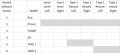
- Measure the associated output at the tape 1 record out and the tape 2 record output jacks see attached graphic.
- Progress through the record function switch from 1 to 6, skipping 2, the phono record.

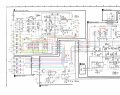
Attached is the schematic I used, as well as an output matrix.

To ease the reading, I went back to kinder garden and colored the lines.

FunctionalTest-1.jpg


FUNTIONAL-TEST-1A.jpg


We are testing to ensure those functions work. If they don't we will identify any problem. I want you to know that when we are done, you have tested the unit completely and know all the functions work.

I will outline what you will need to do to test the phono section. You will have to build an INVERSE RIAA circuit so the constant level audio input will appear to be comparable levels of a vinyl record. That of course, if you wish to do that. In the end, you can plot the response curve of your amplifier .... if your comfortable using excel, you can graph it easily on a log scale.
 
Last edited:

MrChips

Joined Oct 2, 2009
34,866
I have been trying to keep up with the ongoing testing. I still have a couple of pages to catch up.

I guess the plan here is to test as much as possible so that you will have replacement parts at hand.

I am not sure how you are testing resistances. Are you aware that testing resistors while in-circuit has limited value?
While testing in-circuit, if the measured resistance is much higher (say 10% or more higher) than the expected value then the resistor is out of spec and must be replaced. If the measured resistance is lower than the expected value this does not identify the resistor as bad. Other components in the circuit could very well contribute to lower readings.

Testing capacitors in-circuit is also problematic. Most of the capacitors in this section are relatively low capacitance values (less than 100μF). For now, just do a simple resistance check across the capacitor. If you get a low resistance value (less than 100Ω) you need to look at the circuit schematic and analyze the circuit. If the resistance measured is less than 10Ω this would certainly call for further investigation.

I would be concerned about lifting every component to make a test. PCB traces can take only so much abuse before they start to peel away from the board. Once we remove the high current/power components off the board we should be able to do voltage tests to find bad components. Of course, power transistors that short across the power rails are not a good thing as you have very well experienced.
 

Thread Starter

Marius83

Joined Dec 28, 2017
423
I have been trying to keep up with the ongoing testing. I still have a couple of pages to catch up.

I guess the plan here is to test as much as possible so that you will have replacement parts at hand.

I am not sure how you are testing resistances. Are you aware that testing resistors while in-circuit has limited value?
While testing in-circuit, if the measured resistance is much higher (say 10% or more higher) than the expected value then the resistor is out of spec and must be replaced. If the measured resistance is lower than the expected value this does not identify the resistor as bad. Other components in the circuit could very well contribute to lower readings.

Testing capacitors in-circuit is also problematic. Most of the capacitors in this section are relatively low capacitance values (less than 100μF). For now, just do a simple resistance check across the capacitor. If you get a low resistance value (less than 100Ω) you need to look at the circuit schematic and analyze the circuit. If the resistance measured is less than 10Ω this would certainly call for further investigation.

I would be concerned about lifting every component to make a test. PCB traces can take only so much abuse before they start to peel away from the board. Once we remove the high current/power components off the board we should be able to do voltage tests to find bad components. Of course, power transistors that short across the power rails are not a good thing as you have very well experienced.
Yes, plan was to check as much as possible due to replacement..

I understand the problem with measuring resistors in circuit now.
That is what i have done, and by that listing the resistors out of value.

But, I have now lifted the legs at every resistor i measured out of value at LEFT channel, went fine, and just one at the RIGHT.
Every were in specs with the leg lifted, i have looked at the schematics and looked at the same/opposite resistors being out of tolerance in circuit at RIGHT channel, so by that i claim all resistors out of value in the X4 circuit earlier listed, being OK.:D


Also at RIGHT channel, we had no smoke or power draw and that section is almost complete, so i'm not lifting all the small transistors to check them... Agree ?


But my concern to diode D409 in LEFT channel measuring 0.3 ohm both ways, if i look at same circuit at RIGHT channel, D410 measured fine only one way, then D409 most likely have a problem?
Q413 was also defective and it's connected right to that diode at BASE leg.
 
Last edited:
Top