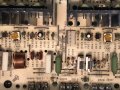
Technics SU-VX800 amplifier

MrChips

Joined Oct 2, 2009
34,838
Good. Now are all transistors in place?
If so, go back and attempt to do the VR401, VR402, VR403, VR404 adjustments.
Follow this with music test at low volume.
 

Thread Starter

Marius83

Joined Dec 28, 2017
423
Unfortunately i'm still waiting for replacement for Q515, ordered a while ago, but with this corona situation, shipping seem to take some time..
 

MrChips

Joined Oct 2, 2009
34,838
Congratulations!

Now before you get carried away in a state of euphoria, go back and do the basic tests that you did before.
Use your IR camera and look for hot spots. Touch and feel for unusually high temperatures.
I don't want to suggest taking more voltage readings in case you slip and short out something.
However, if you can be very careful, it would be instructive to record the test voltages that were not close to those documented in the circuit schematics.

For starters, the voltage at
IC401 pin-1
IC401 pin-4
IC401 pin-7
IC401 pin-8

IC402 pin-1
IC402 pin-4
IC402 pin-7
IC402 pin-8

Are the load lamps still in place?
Are all components in place except for Q515 and Q517?
 

Thread Starter

Marius83

Joined Dec 28, 2017
423
hehe... no euphoria here, we were this close earlier too remember.. :D

All three load lamps are still in place. (R505/R506) + 100W dim light bulb.
All components are in, except Q515 and Q517

I'm being very careful:D

Measuring:

IC401:
Pin1: -0.15 V
Pin4: -7.10 V
Pin7: +1 V
Pin8: +7 V

IC402:
Pin1: +1 V
Pin4: -7.65 V
Pin7: +1.1 V
Pin8: +7.67 V
 

MrChips

Joined Oct 2, 2009
34,838
Good. Here are your steps going forward. Do not proceed to the next step before verifying that everything is ok (no blown components, no over heating, no out of spec voltages.

Step 1. Install remaining transistors.
Step 2. Power ON and test voltages at TP401, TP501, TP502.
Step 3. Conduct music test at low volume.
Step 4. Remove small lamps and install R505 and R506, 6.8Ω.
Step 5. Remove load lamp.
Step 6. Adjust VR401, VR402, VR403, VR404 according to Service Manual.
Step 7. Conduct music test at low/medium/high levels and check temperature with IR camera.
Step 8. Crack open a cold beer and enjoy!
Step 9. Sit back, relax, and enjoy some muzak!
 

Thread Starter

Marius83

Joined Dec 28, 2017
423
well........ i don't think we are any further than we were earlier when i was adjusting the VR's
I have now removed all load lamps, and it seems stable to be plugged in the wall socket.. but i still need to turn VR401(LEFT) to max to almost reach the correct voltage...(25mV)
VR402(RIGHT) increases voltage much faster and i don't need to turn it to max to get the correct value (25mV)
Similar as earlier.

If i go ahead now.. and turn VR401 to max..... and proceed with the VR403/404 adjusting... i'm afraid i will blow an output transistor again... don't you think it will happen again ?
It still has the same "problem" at LEFT channel....? :rolleyes:
 

MrChips

Joined Oct 2, 2009
34,838
First thing to do is measure some resistances in-circuit with the power OFF.
Turn both VR401 and VR402 fully CCW.
Measure in both directions (meter leads interchanged).

LEFT RIGHT
R433 R434
R437 R438
VR401 VR402 both CCW

Turn both VR401 and VR402 fully CW and repeat measurements.

LEFT RIGHT
R433 R434
R437 R438
VR401 VR402 both CW

Reset both VR401 and VR402 fully CCW.
 

Thread Starter

Marius83

Joined Dec 28, 2017
423
I don't blame you.

Did the right channel adjust properly?
well, i didn't go ahead with further adjustment on VR404 because of the low voltage at LEFT, but i guess it should not have any problems with it.
I adjusted both VR403 and VR404 last time i did this and got the correct values.. but then there was the incident at LEFT with the output transistor and other following components.
 

Thread Starter

Marius83

Joined Dec 28, 2017
423
First thing to do is measure some resistances in-circuit with the power OFF.
Turn both VR401 and VR402 fully CCW.
Measure in both directions (meter leads interchanged).

LEFT RIGHT
R433 R434
R437 R438
VR401 VR402 both CCW

Turn both VR401 and VR402 fully CW and repeat measurements.

LEFT RIGHT
R433 R434
R437 R438
VR401 VR402 both CW

Reset both VR401 and VR402 fully CCW.
I'm not sure if i'm doing this the way you want me to now... but i measured across the resistor, one and one..

Fully CCW both VR401/402:

LEFT:
R433: 2.7 Kohm
R437: 650 ohm

RIGHT:
R434: 2.71 Kohm
R438: 650 ohm

Fully CW both VR401/402:


LEFT:
R433: 2.69 Kohm
R437: 650 ohm

RIGHT:
R434: 2.7 Kohm
R438: 650 ohm

All measurements checked in both directions with the same result.
 

JoeJester

Joined Apr 26, 2005
4,390
VR401(LEFT) to max to almost reach the correct voltage...(25mV)
VR402(RIGHT) increases voltage much faster and i don't need to turn it to max to get the correct value (25mV)
Similar as earlier.
Therein lies the problem currently being addressed. The identical circuit where one resistor needs maximum adjustment and the other needing much less. Can you describe the percentage of the turn for "much less"?
 

JoeJester

Joined Apr 26, 2005
4,390
I think Mr Chips meant interchanging the leads means reversing the pos and negative.

There should be a difference as you could possibly cause the transistor to conduct.

On your little esr meter ... can you measure the voltage on the two leads you would connect on a capacitor?
On your second meter, measure the output voltage of your testing meter in the ohms position, or multiple positions as you are using the 2k scale and the 20k scale when testing the resistors.
 

Thread Starter

Marius83

Joined Dec 28, 2017
423
I will try to show this through images...... :D
Here's both at MINIMUM.
IMG_5363.JPG


Here's both at MAXIMUM.
IMG_5364.JPG


HERE is VR401 at MAX to obtain correct voltage(25mV) and VR402 is set at 25mV.. big difference as you can see
IMG_5366.JPG
 

Attachments

Thread Starter

Marius83

Joined Dec 28, 2017
423
I think Mr Chips meant interchanging the leads means reversing the pos and negative.

There should be a difference as you could possibly cause the transistor to conduct.

On your little esr meter ... can you measure the voltage on the two leads you would connect on a capacitor?
On your second meter, measure the output voltage of your testing meter in the ohms position, or multiple positions as you are using the 2k scale and the 20k scale when testing the resistors.
I did switch side with plus and minus..when measuring on the resistors.... it's what i meant with saying it was measured "both ways" :) I did not get any difference in the readings:rolleyes:


Tested the ESR tester... about 3 volts for a split second.

Tested the GDM354 DMM: 0.24 Volts at both 2K and 20K scale
2.5 Volts at 200 ohm scale.
 

JoeJester

Joined Apr 26, 2005
4,390
Thanks,

I know some meters that put out 1 volt at 1 mA (short circuited) on the resistance scales. The reasoning or that is so you don't overdrive the small signal transistors and diodes when measuring them. Silicon based devices (transistors, diodes, etc) require 0.6 - 0.7 for conduction, You might remember at when you tested using the diode test function of the meter.
 
Top