Tachometer circuit help (self-solved)

MaxHeadRoom

Joined Jul 18, 2013
30,664
The whole circuit looks a little convoluted, to say the least, there have been simpler circuits used from the time of this one to today.
A little detail on the rest of the system would also help! ;)
 

Thread Starter

metermannd

Joined Oct 25, 2020
472
MisterBill: I'd heard that terminology somewhere and I assumed that was an alternate name for that part. I went back and corrected the post.

MaxHeadroom: Oh yeah. As I've said before, I've had at least a few "Now why did they do it like that?!" moments.

As requested, here are full schematics of the controller. These were transcribed and clarified from the original paper schematics. The driver board is bananas. As for the logic, I'm still trying to find an arrangement that works, so it's going to be a bit messy.

Starting the controller is fairly straightforward.

The pins U1...K4 are used to program the speed by inputting the BCD equivalent of the speed desired (active low inputs), then grounding the _RUN line.

The _TTMAINT line enables a low-speed mode where the process tub can be advanced manually to allow it to be loaded or unloaded.

The two output pins back to the controller are Tach (raw speed data from the assembly in question) and _RNG tells the process controller the tub is currently in motion.
 

Attachments

Last edited:

Thread Starter

metermannd

Joined Oct 25, 2020
472
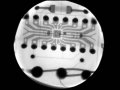
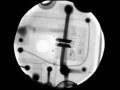
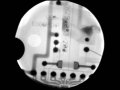
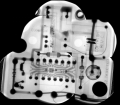
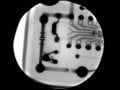
I was really hoping that the zoom on the X-ray would be able to capture the full assembly in one exposure, but it is set a lot closer than I liked. It did reveal a few things. Here are the exposures I took...

What I see so far: The board number was different - I was expecting to see 290036, but evidently there was a change significant enough for them to assign a new assembly number (290083), and instead of the 8-pin DIP I remembered from the 290036, there is a 16-pin DIP. I'm not even sure it is a comparator. Might be stuck. I do know that if it's actually a 'jellybean' IC, it is going to be a 4000 series.

My observations: (with edits now that I've mostly solved this)

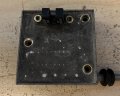
tach1: I see a diode (1N4001), ceramic cap (I'm assuming 0.1uF bypass), tantalum (2.2uF is quite common on the FSI boards). One of the harness pads is also visible. Edit: Part of the opto-interrupter supply.

tach2: The IC in all its glory, along with a metal-film resistor and more of the harness pads. Edit: Most likely a 4049 or similar.

tach3: Further along, showing a resistor and a metal-can component (trimmer pot). The black circle is one of the mounting bushings.

tach4: Going up from the metal can, the 1N6277 TVS.

tach5: Assembly number and pads for alternate opto-interrupter location.

tach6: The optical interrupter, and which is a HOA0971-T51 (Schmitt trigger output) in relation to the alternate location.

Edit: Added a poorly pieced composite.
 

Attachments

Last edited:

Thread Starter

metermannd

Joined Oct 25, 2020
472
It turns out the potting is vulnerable to plain ol' isopropyl alcohol... here it is so far; need to figure out what is the best way to attack the next layer without damaging the traces, given the narrow widths shown in the X-ray.

I also just realized that this version apparently allows two different positions for the optical interrupter for different applications - one is the standard RPM sensing application the other would be the 'indexing' application where a special low-speed motor can advance the tub to a predetermined position. The alternate / second position is below the existing optical sensor.
 

Attachments

Thread Starter

metermannd

Joined Oct 25, 2020
472
And here's the circuit I've worked out now that I've exposed the full solder side.

Any idea what U3 (16-pin DIP) might be? Or how about Q1 (the can in the X-ray)?
 

Attachments

MisterBill2

Joined Jan 23, 2018
27,540
From it's position in the circuit, it may have been a current regulator/limiter for the LEDs in the opto-interrupters. Or maybe a PNP transistor rigged as a diode?The 16 legged device would be a hex buffer or inverter, or a level shifter like the CD4010 or CD4009 or a similar TTL device. It would have had sections in parallel based on the connections. But those are just guesses based on what I see.
 

Thread Starter

metermannd

Joined Oct 25, 2020
472
Thanks for the hint on the IC! I finally noticed the square pad on pin 1 and corrected the IC orientation. Updated / redrawn schematic attached!

The 4049 seems to the most plausible as I know I have seen that on another of their boards, but will make a notation on the other possibilities.

So it just remains to be seen what the values are of D1, D2, and Q1. I'm thinking R1-R4 are all intended to be 470 based on the two that are populated.
 

Attachments

Last edited:
Top