Switching for 3 phase motor converted to 1 phase

MaxHeadRoom

Joined Jul 18, 2013
30,695
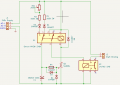
Here is the 240v example copy of the GE 120v cct.
I have not tested it on 240v, the capacitor C1 value will need to be adjusted for 1-2 seconds.
1705432433488.png
 

Thread Starter

tooltalk

Joined Jan 14, 2024
21
Ok, that makes sense. You mentioned that C1 value will need to be adjusted for 1-2 seconds. Is RV1 a potentiometer? In the description of the original circuit it sounds like the pot is used to control the time, or is it just for fine tuning and I would need to try diiferent caps to get the time in the right ballpark?
Thanks.
 
Last edited:
Hi everyone. New member here with my first question. I did search the forums first and found some similar discussions, but I think my situation is somewhat unique. The other threads I found were all more than a year old too and some of the product links were outdated or dead as well.

So here's the situation... I bought a Rockwell 14 inch radial arm saw for woodworking last year. The motor on it was originally 575v 3hp 3 phase, but the previous owner had the motor converted to 220v single phase. I think this was done many years ago before Variable Frequency Drives became so common and affordable. The previous owner's widow sold me the saw and said her husband paid a lot of money to have motor converted.

A start capacitor was added to the motor, but since there was no centrifugal switch a momentary toggle switch was added to manually send power to the start winding. A second toggle switch is used to turn saw on and off.

So to start the saw I have to hold the momentary switch on, flip the on/off switch, then after a couple seconds when the motor is up to speed I release the momentary switch.

This works, but I'd like to upgrade the on/off switch to a proper push button switch with a larger mushroom or paddle style stop switch. For safety reasons I'd also like to eliminate the momentary switch so I can keep one hand on the saw carriage while I turn saw on with the other hand.

I've been doing some research on this and have seen recommendations for potential relays, adjustable timer relays, solid state start switches, etc. However, most these items have many different variations and specs, and I'm really having trouble figuring out what would work best on this particular motor.

I've attached some pics of the motor tag, the existing switches (labels added by me), and a schematic I drew of the wiring.

Sorry for the long post, but I would really appreciate it if anyone can make a recommendation for a specific product that I could use to replace the momentary switch.

Thanks very much.

View attachment 312700View attachment 312701View attachment 312702
No rush at all. Does the project or circuit have a name that I can look up? Just curious to know more about it. Thanks very much for your help.
 
There are basically 3 ways to use a 3 phase motor with single phase power.
All of them reduce the power of the 3 phase motor inorder to work
1.- Using a static converter.
it basically has 2 capacitors, or capacitors banks, to achieve the needed capacitance. and a voltage relay, One of them capacitors, switches in with the voltage relay and shifts the phase in the extra phase to make the motor start rotation, and as soon the rpms rise and the locked rotor current diminishes the voltage increases and the voltage relay relay senses it and disconnects the start capacitor, leaving only the run capacitor which supplies the out of phase voltage in the missing phase, There are several brands of "static phase converters" like Phase-A-Matic.
google them, that is what your actual "conversion" is but without the voltage relay... you pushing the switch, are the relay.
2.- The infamous VFD, The VFD takes the single phase power, ues a rectifier to convert it to DC and then the internal circuitry "generates" the 3 phase power, problem is that most of them it use square waves, and those have high voltage spikes and harmonics that will damage the motor winding insulation (unless the motor is rated for use with vfds, type F insulation), and induce spurious currents in the axles that will damage bearings and break down lubrication.
Another problem is that you can ONLY connect one motor to that 3 phase power.
3.- The so called ROTARY CONVERTER, which is a fairly sizeable 3 phase motor, your load could be half to 3/4 of the converter motor power handling, this motor starts with an internal static phase converter, then 2 out of the 3 motor windings take power to induce the magnetic field in the rotor inside the converter, and then this induced rotor magnetic field, generates the 3rd missing phase voltage by induction, and a capacitor to compensate for the inductance of the extra 3rd winding, this is the closest way to have a pure sinusoidal power to feed your 3 phase motors, an advantage is that the more motors you connect to the rotary converter, they help to generate extra power to the third phase.
American Rotary is one of the companies that manufacture Rotary Phase Converters.

The other part of your request, can be resolved using a motor starter with an extra "retention contact", a motor starter, uses a 3 pole relay, called contactor, that handles the motor power thru its contacts, and has an extra "retention contact" wired in parallel with the START button, (Normally Open) that when you push it feeds power to the relay coil, and as soon as the relay and aux contact closes it keeps feeding the coil, even if the start is already released ( its called a "latch circuit" ) when the STOP button (Normally Closed) is pushed it cuts the power to the coil, the relay and the aux contact opens and everything stops.
 

MaxHeadRoom

Joined Jul 18, 2013
30,695
Ok, that makes sense. You mentioned that C1 value will need to be adjusted for 1-2 seconds. Is RV1 a potentiometer? In the description of the original circuit it sounds like the pot is used to control the time, or is it just for fine tuning and I would need to try diiferent caps to get the time in the right ballpark?

Thanks.
RV1 is a potentiometer for controlling the delay, the original circuit was intended for a 120v light to come on when power was applied and delay off.
Experimenting with Cap values would be needed for the intended motor delay
 

strantor

Joined Oct 3, 2010
6,875
There are basically 3 ways to use a 3 phase motor with single phase power.
All of them reduce the power of the 3 phase motor inorder to work
1.- Using a static converter.
it basically has 2 capacitors, or capacitors banks, to achieve the needed capacitance. and a voltage relay, One of them capacitors, switches in with the voltage relay and shifts the phase in the extra phase to make the motor start rotation, and as soon the rpms rise and the locked rotor current diminishes the voltage increases and the voltage relay relay senses it and disconnects the start capacitor, leaving only the run capacitor which supplies the out of phase voltage in the missing phase, There are several brands of "static phase converters" like Phase-A-Matic.
google them, that is what your actual "conversion" is but without the voltage relay... you pushing the switch, are the relay.
2.- The infamous VFD, The VFD takes the single phase power, ues a rectifier to convert it to DC and then the internal circuitry "generates" the 3 phase power, problem is that most of them it use square waves, and those have high voltage spikes and harmonics that will damage the motor winding insulation (unless the motor is rated for use with vfds, type F insulation), and induce spurious currents in the axles that will damage bearings and break down lubrication.
Another problem is that you can ONLY connect one motor to that 3 phase power.
3.- The so called ROTARY CONVERTER, which is a fairly sizeable 3 phase motor, your load could be half to 3/4 of the converter motor power handling, this motor starts with an internal static phase converter, then 2 out of the 3 motor windings take power to induce the magnetic field in the rotor inside the converter, and then this induced rotor magnetic field, generates the 3rd missing phase voltage by induction, and a capacitor to compensate for the inductance of the extra 3rd winding, this is the closest way to have a pure sinusoidal power to feed your 3 phase motors, an advantage is that the more motors you connect to the rotary converter, they help to generate extra power to the third phase.
American Rotary is one of the companies that manufacture Rotary Phase Converters.

The other part of your request, can be resolved using a motor starter with an extra "retention contact", a motor starter, uses a 3 pole relay, called contactor, that handles the motor power thru its contacts, and has an extra "retention contact" wired in parallel with the START button, (Normally Open) that when you push it feeds power to the relay coil, and as soon as the relay and aux contact closes it keeps feeding the coil, even if the start is already released ( its called a "latch circuit" ) when the STOP button (Normally Closed) is pushed it cuts the power to the coil, the relay and the aux contact opens and everything stops.
There is apparently a 4th option, which the previous owner has already chosen: get the 3 phase motor rewound for single phase.
 

MisterBill2

Joined Jan 23, 2018
27,684
There is apparently a 4th option, which the previous owner has already chosen: get the 3 phase motor rewound for single phase.
What has been clearly stated, although not in the original post, is that the motor has been rewound for single phase service. Only the label remains three phase.
 

Thread Starter

tooltalk

Joined Jan 14, 2024
21
I'm very grateful to LowQCab and MaxHeadRoom for providing some DIY solutions. I honestly wasn't expecting anyone to go to that much trouble and I really appreciate it. I will will take some time to put together parts lists for both circuits and see how the cost and complexity compares.

I do like to consider all my options, so if anyone has any suggestions for an off the shelf item that might work, please let me know as well.

Thanks again.
 

strantor

Joined Oct 3, 2010
6,875
What has been clearly stated, although not in the original post, is that the motor has been rewound for single phase service. Only the label remains three phase.
From post #1:
So here's the situation... I bought a Rockwell 14 inch radial arm saw for woodworking last year. The motor on it was originally 575v 3hp 3 phase, but the previous owner had the motor converted to 220v single phase.
Seems "clearly stated" enough to me...
if anyone has any suggestions for an off the shelf item that might work, please let me know as well.
From Post # 33
Something like this should work. It has a 240V coil so you would just wire it in parallel with the ON switch and run the start winding through the NC contacts.
Seems "off the shelf" enough to me...
 

Thread Starter

tooltalk

Joined Jan 14, 2024
21
From Post # 33

Seems "off the shelf" enough to me...
Sorry, I meant to reply that I looked at that item you suggested, but it is only rated for 10 amps and the motor is 14 amps. So I'm not sure it would be suitable. I did look at other similar items on Grainger and saw a couple that were rated for 20amp, but the time range was only 0.1 to 1.2sec and I'm not sure that's long enough.
 
Last edited:

MisterBill2

Joined Jan 23, 2018
27,684
The yootoob link showed me nothing useful.
Sealed unit refrigeration compressors use a starting relay, and I am thinking that if you found a sealed unit compressor with similar motor ratings that a similar starter relay should work for the saw. Although the compressor has less inertia and so the start might be a shorter time. Certainly a source worth investigating. I will report back after I consult a catalog.
 

strantor

Joined Oct 3, 2010
6,875
Sorry, I meant to reply that I looked at that item you suggested, but it is only rated for 10 amps and the motor is 14 amps. So I'm not sure it would be suitable. I did look at other similar items on Grainger and saw a couple that were rated for 20amp, but the time range was only 0.1 to 1.2sec and I'm not sure that's long enough.
Oh, sorry I should have mentioned that the current of the main winding won't pass through it. Only the current of the start winding, which is much lower. See here:

Screenshot_20240117-213049_Chrome.jpg

I would however encourage you to measure the current of your start winding and verify, because who knows what kind of unorthodox things are going on with it.
 

Thread Starter

tooltalk

Joined Jan 14, 2024
21
I haven't had much time to spend on this, but discovered an issue last night that may complicate the use of any of the devices discussed here, both DIY and off-the-shelf.

I have been using the saw with a 14" blade for some time now. This blade weighs almost 5lbs and I had gotten used to holding the momentary switch on for about two seconds until the motor was up to full speed or very close to it.

Well, last night I switched to a 12" blade that weighs about 2lbs. The saw started so much faster that it caught me off guard and I held the momentary switch on too long. I don't know what this does to the motor, but I assume it's probably not good for it. I can feel it vibrate if the switch is held on for too long.

This got me thinking about other blades that I might use including a very heavy 10" dado stack that weighs about 7lbs. Different blades of differing weights would presumably require a variety of different start times. So any device that uses a fixed timer may not be suitable. I supposed if the timer is adjustable, I could do some testing and tweak it when the blade is changed, but I don't know how practical that is.

Maybe the manual method is the best solution after all.
 

MisterBill2

Joined Jan 23, 2018
27,684
The only issue with the manual start scheme will come when somebody who has no clue of how to start that saw tries to use it.
I have seen clueless folks dumber than broken concrete do a fair amount of damage before they could be stopped.
That is the only possible flaw with the present system that I see.
A current sense relay would be the very best option but it evidently would not be simple or cheap.
 
Top