Switching for 3 phase motor converted to 1 phase

MisterBill2

Joined Jan 23, 2018
27,683
Now for a question: Where is the capacitor connected? Because a capacitor should read close to an open circuit. OR is it left up to the TS to determine where it gets connected??
What I see now is a motor housing that has been rewound as a single phase motor but with no actual information as to what it really is.
It might even be a capacitor-run motor that needs no starting relay. a capacitor-run motor. I have used them in the distant past, And I have a bench grinder that is a permanent capacitor motor. The question now is which winding gets the capacitor.
 

Thread Starter

tooltalk

Joined Jan 14, 2024
21
Now for a question: Where is the capacitor connected? Because a capacitor should read close to an open circuit. OR is it left up to the TS to determine where it gets connected??
What I see now is a motor housing that has been rewound as a single phase motor but with no actual information as to what it really is.
It might even be a capacitor-run motor that needs no starting relay. a capacitor-run motor. I have used them in the distant past, And I have a bench grinder that is a permanent capacitor motor. The question now is which winding gets the capacitor.
Did you see the schematic in my first post? That should explain where capacitor is. It comes after the normally open momentary switch and is connected to lead 5, which I believe is the start winding. To start motor I hold momentary switch closed then flip main power switch which is connected to leads 2 and 8. After motor is up to speed I release momentary switch and motor runs fine.
 
Last edited:

MisterBill2

Joined Jan 23, 2018
27,683
It has been a while since I read that and it slipped my mind. One option then could be a rotary switch of the "Drum Switch" type, with a spring return to the off position and a latch to hold it in the run position. Current operated start relays are common, but I have only seen them used for smaller fractional HP motors.
 

LowQCab

Joined Nov 6, 2012
5,101
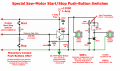
A MOSFET Gate-Driver, which is an On or Off device,
is wired as a "Latch", using Positive-Feedback through a 500-Ohm Resistor.
The Push-Buttons can easily overcome the Resistor, and make the FET-Driver change states.

The FET-Driver's output drives the Inputs of 2 SSR's, one of which has a delayed-Off-Circuit,
The second SSR is strictly for the Start-Winding / Capacitor.

Having Brakes throws a lot of curves into the mix, so I'll have to spend some time on that one.

All the supplied part-numbers are for Through-Hole-Devices,
as I assume that will be more practical for You to build on a common Perf-Board.
.
.
.
 

LowQCab

Joined Nov 6, 2012
5,101
I haven't priced one in a lot of years,
but the last time I did, Contactors were rudely expensive,
especially when You add-in several Auxiliary-Contacts for Latching.

Plus the much heavier-duty Push-Buttons required.

Plus a high-Voltage-Timer.

My Circuit only uses a cheap Wall-Wart type Power-Supply,
a lot of people have a box full of them, just waiting for a new purpose in life.
Also available at Good-Will Thrift-Store for a Dollar.
.
.
.
 

strantor

Joined Oct 3, 2010
6,875
I think my situation is somewhat unique
Most times when people say that on here, they're wrong. But not in this case. This is bizarre.


I did take it to one local motor repair shop, but the guy was really grumpy and was no help at all. He said he had no idea what had been done to motor in the past, or who did it, so he wouldnt even look at it.
I don't condone grumpiness but I do understand the guy's reservation. As a friend, I would help you try to figure this out. But as a vendor I wouldn't touch it because the moment I do, there is liability to consider. Who knows what kind of mystery hackery was done inside that motor? If I make the wrong assumption, tell you the wrong thing, and that motor burns down an orphanage full of nuns, I could find myself in court.

it was originally 575v 3hp 3 phase, but the previous owner had the motor converted to 220v single phase
I may be in the minority here, but I believe this actually happened. I didn't know it was possible, never heard of it being done, but according to the way it is wired (and the fact that it works the way that it's wired), it seems to me an indication that it wasn't simply stamped with new numbers and you have a real single-phase motor on your hands. If I had to guess, I would say they probably put a different stator in it; the stator out of an unknown single phase motor. I would not attempt to put a VFD on it.

Pending the results of the "experimenter's handbook" solution, my next suggestion would be a timer. Something like this should work. It has a 240V coil so you would just wire it in parallel with the ON switch and run the start winding through the NC contacts.
 

MisterBill2

Joined Jan 23, 2018
27,683
Motors can indeed be rewound, but it is certainly a "Big Deal" to do it correctly and get it right.
Rewinding probably made sense because the original motor was in good shape mechanically, 575 volts is a voltage that I am not familiar with. So an investigation of that model number might point toward an interesting ancestry of that particular motor.
My guess is that it was actually built to work with a variable speed drive of some type.
 

Thread Starter

tooltalk

Joined Jan 14, 2024
21
...575 volts is a voltage that I am not familiar with. So an investigation of that model number might point toward an interesting ancestry of that particular motor.
My guess is that it was actually built to work with a variable speed drive of some type.
575 volts is a standard for industrial three phase applications here in Canada. Old machines with 575v or 600v motors are very common on the used market here and it's not unusual to see motors with restamped labels indicating they have been rewound to work on 240v 3 phase power. I thought that's what I had here and was very confused when I got it home and started digging into it. I definitely seem to have found something unique, lol.

The woman I bought my saw from said it had belonged to her late husband's father who used it in a commercial cabinet making shop. She said the saw had sentimental value to her husband and he paid a lot of money to have the motor converted so he could use it in his home shop.
 
Last edited:

Thread Starter

tooltalk

Joined Jan 14, 2024
21
My Circuit only uses a cheap Wall-Wart type Power-Supply,
a lot of people have a box full of them, just waiting for a new purpose in life.
Also available at Good-Will Thrift-Store for a Dollar.
I definitely have lots of Wall Warts around here. So that shouldn't be a problem. I was looking up some of the parts on your drawing and couldn't find the LM431BIZXCT-ND listed anywhere, but I did find LM431BIZXTR-ND on digikey.ca. Was your part number a typo?
 

LowQCab

Joined Nov 6, 2012
5,101
Edit .......
This is the correct part-number for DigiKey-Canada's website ....... LM431BIZXCT-ND
Do a search for "DigiKey-Canada".
Copy and Paste the above number into the DigiKey search-box,
and there it is, ~58,000 of them.

============================================================================

The "TR" in the part-number indicates a "Tape-and-Reel" form of packaging
for manufacturers that order parts by the thousands.

The "CT", in the part number I supplied,
indicates "Cut-Tape", where the part is normally stocked in "Tape-and-Reel" format,
but they have a dedicated "Reel" of that part-number set aside for
customers that only need 1, or 10, or even 100, pieces,
in that case, they will "Cut" off as many pieces as You need from that special "Reel" of parts.

It's possible that DigiKey-Canada doesn't sell this particular part-number in "Bulk", ( by-the-piece ),
but they do sell it in "Tape-and-Reel" format.

It's still the same part, they just want to sell You a thousand at a time, instead of just 2 pieces.

Going on DigiKey's website can certainly have a learning-curve at times.
Do a search for the "Base-Part-Number", which is LM431.
You will probably find that You get as many as 9 different listings, sometimes more.
The differences can be the Device-Package,
( SMD ( Surface-Mount-Device ) in 3 or 4 different versions, and
"Though-Hole" with 3 or 4 different packages, and some with pre-bent legs, some with straight-legs,
and listings that are only for mass-quantity-ordering, with mass-quantity-discounts ),
and sometimes as many as 4 to 5 different manufacturers,
each with their own special tweak to the part-number.

All ( or at least most ) of this can be bypassed by methodically
eliminating every option that You DON'T want,
and then clicking the "Apply-All" Button at the bottom of the page.

DigiKey (US) offers this part-number from 4-different manufacturers, ( don't remove any manufacturers ).
Eliminate the types of Packaging that You don't want first,
You only want ....... Bulk, Cut-Tape, and Tube, but No "Box", No "Digi-Reel" etc.
Then eliminate the Device-Package-Types that You don't want, ( SMD, Though-Hole, etc. ).
Then eliminate more specifications if applicable.

You can do all the boxes in one single shot,
but this will tend to cause mistakes, or miss viable part-numbers,
causing You to think that maybe they don't have what you're looking for.

You may have to completely re-do this search procedure,
3 or 4 times, until You start to really understand what you're looking at, and doing.

READ THE SPEC-SHEET / PDF,
quite often there are subtle differences in the part-number that are only revealed in the Spec-Sheet,
then You can do another Part-Search with a more specific part-number,
this will get You the exact results You need,
hopefully minus any unwelcome surprises when the UPS or Fed-X-man shows-up at your door.

PDFs from different manufacturers may contain different information, or leave some out.
They may also contain different and useful "Circuit-Examples" for using the part.
.
.
.
 

Attachments

Last edited:
Top