Switching 12-15V output, MOSFET choice

Thread Starter

Fyod

Joined Jun 2, 2019
39
Hi everyone,
I have historically been bad at choosing the correct transistors for the job, so I'd appreciate any input/comments.
I would like to switch a 12V/15V output capable of up to 3A current. This is supplied by a USB-C PD source via USB PD controller set to either 12V or 15V (or fallback to 5V). This will be driven with a 3.3V MCU gpio.
The MOSFET I have found is the IRLML6344.

VDSDrain-Source Voltage30V
ID @ TA = 25°CContinuous Drain Current, VGS @ 10V5.0A
ID @ TA = 70°CContinuous Drain Current, VGS @ 10V4.0
IDMPulsed Drain Current25
PD @TA = 25°CMaximum Power Dissipation1.3W
PD @TA = 70°CMaximum Power Dissipation0.8
Linear Derating Factor0.01W/°C
VGSGate-to-Source Voltage± 12V
TJ, TSTGJunction and Storage Temperature Range-55 to+150°C

Will this be a good choice?
 

Thread Starter

Fyod

Joined Jun 2, 2019
39
Optionally, to switch the high-side, which seems more reasonable, the IRLML5203 P-Channel MOSFET.

VDSDrain- Source Voltage-30V
ID @TA =25°CContinuous Drain Current, VGS @ -10V-3.0A
ID @ TA= 70°CContinuous Drain Current, VGS @ -10V-2.4
IDMPulsed Drain Current -24
PD @TA = 25°CPower Dissipation1.25W
PD @TA = 70°CPower Dissipation0.80
Linear Derating Factor10mW/°C
VGSGate-to-Source Voltage± 20V
TJ, TSTGJunction and Storage Temperature Range-55 to+150°
 

crutschow

Joined Mar 14, 2008
38,316
To minimize power dissipation and keep the transistor temperature below it's maximum, the MOSFET on-resistance should be below 50mΩ for switching 3A.
Your selected P-MOSFET's on-resistance is a little high.

For a P-MOSFET high-side switch, the gate volage needs to go from its source supply voltage (off) to ground/common (off).
If the controller can't do that, then you can add an NPN BJT driver.
 
Last edited:

BobTPH

Joined Jun 5, 2013
11,463
Somebody better draw him a circuit, because I suspect he was going to try to switch the high side with an N-channel MOSFET directly driven by the micro.
 

wayneh

Joined Sep 9, 2010
18,087
Personally, I like to go big on the amperage rating, for instance 2X or more. It usually adds next to nothing to the cost although it might impact the physical size if that's an issue. I'm use to using the TO-220 package, so this preference may not work for surface mount packages.
 

Thread Starter

Fyod

Joined Jun 2, 2019
39
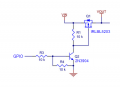
@sghioto If I understand the circuit correctly, this is a default-on configuration? Removing R1 would make it default off?
What is the purpose of R4?

Edit: I now see that R1 pulling the base to the input voltage is necessary to turn the mosfet off, so it is off by default, as is Q2 by being pulled low. When GPIO and Q2 base gets pulled high, the base of Q1 goes low, causing it to conduct.
I think that Q1's symbol is NPN though.

What are the (dis)advantages of using a PNP instead of the NPN in this case?
 
Last edited:

sghioto

Joined Dec 31, 2017
8,633
@sghioto

Edit: I now see that R1 pulling the Gate to the input voltage is necessary to turn the mosfet off, so it is off by default, as is Q2 by being pulled low. When GPIO and Q2 base gets pulled high, the Gate of Q1 goes low, causing it to conduct.
I think that Q1's symbol is P channel though.

What are the (dis)advantages of using a P channel instead of the N channel in this case?
I corrected the wording in your comments to properly describe the operation.
A P channel mosfet is normally used for High side switching and in this particular situation most likely required to power the NUC.
N channel mosfets generally have lower Rdsn and work best switching the Low side for things like LEDs, relays and such.
 

BobTPH

Joined Jun 5, 2013
11,463
To use an N-channel as a high side switch, you need a voltage about 4-5V higher than the voltage you switch. This is why P-channel MOSFETs are used for high side switching.
Same for PNP vs NPN, though the voltage needs to be only about 1V higher.
 

Thread Starter

Fyod

Joined Jun 2, 2019
39
So I've done some more research and it seems that this is standard practice in USB PD in laptops and I've found some purpose-made FETs for USB controllers. Ie. the AONR21321 has a much lower on-resistance (< 16.5mΩ RDS(ON) (at VGS=-10V)) and better thermals.
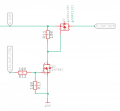
So does this circuit seem alright, considering 3V3 on the control gate?

high-side-switch.png
 

sghioto

Joined Dec 31, 2017
8,633
Not enough voltage to switch Q3 ON with that configuration.
Change R12 to 100 ohms or replace Q3 with a NPN transistor like a 2N3904.
 

sghioto

Joined Dec 31, 2017
8,633
It might and might not as the data sheet suggest with a current of 250ua.
Every 2N7002 will vary somewhere between the min and max voltage listed.
The load current for Q3 is above 1ma so very iffy at even 1.65 volts.
Mosfets are voltage controlled so really no need for R12 but some people insist on a series resistor which doesn't need to be any higher than 100 ohms.
 

Thread Starter

Fyod

Joined Jun 2, 2019
39
Ah gotcha, so somewhere in the range of 1V-2.5V would be the minimum voltage neccessary, but higher (3.3V) is ideal.
I need to watch a crash course on transistors.
Thanks for your help!
 
Top