supercunundrum theorem

Thread Starter

ninjaman

Joined May 18, 2013
341
hello
I have to complete a question on superposition theorem but im stuck
1. I don't know how to work out the currents properly
2. I don't know how to do the formula what so ever!

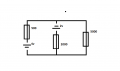
I have two supplies with three resistors. one supply on the left and one in the middle. I cant figure out any of it. I have read through a number of examples and cant get anything right. I have looked at the examples on the lessons page. I cant figure out how the results came about. and there is no description for the circuit I have to solve. please could someone explain how to find voltage and current. my guess is that the supply in the middle give a current flow in clockwise direction only. it supplies two loops. are both loops in the same direction. this is what confuses me. my lecturer isn't very helpful. there are others in the class that feel the same way. I cant find any explanation that makes sense to me. I feel the maths is getting on top of me and that I may quit the course. any help would be really appreciated.
many thanks
simon
 

Thread Starter

ninjaman

Joined May 18, 2013
341
for the first loop with the 4v I got 2mA and 1928 ohms total
for the second loop I got 2v and 0.814ma and 2454 ohms total
I don't understand how to get the proper results
I have done total R of R1 times total current and end up with weird results.
 

Thread Starter

ninjaman

Joined May 18, 2013
341
if anyone could explain how to do the formula as the chapter on superposition is difficult for me to understand. It doesn't say how to get the result it just shows two boxes with answers. I have tried all the combinations I can think of to get reasonable results and have found none. if someone could point me in the right direction I would appreciate it. thanks jester for your help
 

Thread Starter

ninjaman

Joined May 18, 2013
341
I think I have some better results now. im using the "voltage drop across any series resistor" en = et/rt*rn
this is giving me better voltage and current
but im not sure how to go about adding or subtracting. I think I may have made a mistake as im not sure about polaritys on the middle voltage source
 

JoeJester

Joined Apr 26, 2005
4,390
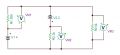
First thing I did was draw your circuit and placed the meters across the resistors. Note the polarity according to electron theory.

Then I followed the superposition theorem and predicted what values would be shown on each meter. First with just the 4 volt source and then with the 2 volt source.

I then added the reading together.

Post all the steps you've done.
 

Attachments

Thread Starter

ninjaman

Joined May 18, 2013
341
for 4v supply
vr1 1.03v ir1 2ma r1 500ohms
vr2 2.96v ir2 1.48ma r2 2000 ohms
vr3 2.96v ir3 0.59ma r3 5000 ohms
vr2+r3 2.96v ir2+r3 2ma r2+r3 1428 ohms
vt 4v it2ma rt1928

2v supply
vt 2v rt 954 ohms it 2ma
vr1 1.04v vr2 0.95v vr3 0.95
ir1 2ma ir2 0.47ma ir3 0.19ma ir2+r3 0.908ma
r2+r3 454 ohms

these are the values that I have
 

JoeJester

Joined Apr 26, 2005
4,390
Well ...

You might want to get consistent on the number of places you choose to round. I chose three significant places in my calculations.

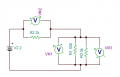
You did not do so well with the 2 volt supply calculations. Look at the diagram I posted and redraw it to show which resistor is in series and which are in parallel.

Pay attention to how the meters are orientated to ensure you have the proper polarity when reporting your numbers.

Don't use multisim. I will tell you I used excel spreadsheet and wrote all the formulae I needed to accomplish the task. All the currents were three significant places in scientific notation.
 

Thread Starter

ninjaman

Joined May 18, 2013
341
would I be right in thinking that R1 and R3 are in parallel across the second source. if not then I have no clue what is going on.
 

Thread Starter

ninjaman

Joined May 18, 2013
341
R2 and R3 are in parallel for the first voltage source, the 4v. but I cant figure out the second. I read somewhere that where it is not clear about the series parallel then show in series. what this means I don't know.
 

JoeJester

Joined Apr 26, 2005
4,390
Your calculations did not reflect that thinking. Redo the 2 volt circuit calculations.

I read somewhere that where it is not clear about the series parallel then show in series. what this means I don't know.
I never heard of a when in doubt ... show in series rule. Follow the current flow using Kirchoff's Current Laws.
 

Thread Starter

ninjaman

Joined May 18, 2013
341
ok I have for R1 and R3 in parallel 2454.54 ohms
2v / 2454.54 ohms = 0.814ma
3ma across the 500 ohm
0.3256ma across the 5000 ohm
 

Thread Starter

ninjaman

Joined May 18, 2013
341
is there something different about the way this circuit is laid out. does the formula change? I don't even know what formula to use. I cant get any reasonable answer from what I have been using. how do I check? so far I have 1.6v across the 2000 ohms, that would leave .4v across the other two as they are in parallel. then I would put .4 over 500 which is 0.8ma and .4v over 5000 which is 0.08ma.
 

Thread Starter

ninjaman

Joined May 18, 2013
341
R1 and R3 in parallel come to 454.54 ohms. add 2k = 2454.54 ohms. 2/2454.54 = 0.814ma
0.814/1000 x 2000 = 1.628v
1.628v / 500ohms = 3.25ma
1.628v / 5000ohms = 0.325ma
 

JoeJester

Joined Apr 26, 2005
4,390
Ohms law formulae doesn't change.

If you showed all your work, it would be easier to identify any errors.

When I redrawn the 2 volt source ... it came out like

You should show all your work for these calculations ... you made some basic errors.
 

Attachments

Top