Facebook
 Google
 GitHub
 Linkedin

I was asked to repair a Sunbeam electric blanket that stopped heating. The controller is labeled STYLE AA85 and connects to the blanket via three conductors.
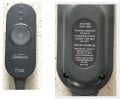
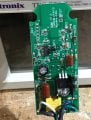
The circuit board of the controller has a processor and a triac to PWM 120VAC to the blanket. There are three heat settings, Low, Med, High.
My tests with an oscilloscope show that the controller appears to be working correctly. There is a pre-heat cycle for 80 seconds and then cycles 20% for Low, 50% Med, 100% High.
The controller connects to the blanket via three cables labelled N, H, BS.
My guess is that the letters stand for Neutral, Hot, Blanket Sense.
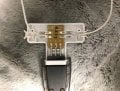
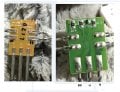
The heater wire in the blanket is connected to four terminals shown on the left and right side of the board.
The top-left is continuous to the top-right connector and reads 16 Ω between top-left and top-right.
Similarly, bottom-left to bottom-right reads 16 Ω.
I have tested that the heater wire is functional by applying 70 VDC across the two heater sections wired in series.
Given that the total resistance increases to about 40 Ω when hot, power output is about 122 W @ 70 VDC.
The problem is, I have no idea how this circuit as shown can possibly work.
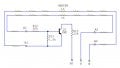
120 VAC comes in at H and returns at N. I cannot see any low resistance path to N.
I can get the blanket to heat up by putting a jumper across A1 and B1. The voltage must be kept below 70 V otherwise the power will exceed the maximum rating of 180 W.
For the blanket to draw 180 W @ 120 VAC, the current has to be 1.5 A (or lower). The heater resistance has to be 80 Ω (or higher).
I came up with the idea that there is a thermal cut-off fuse in the blanket. But this would still exceed the rated power at 120 VAC.
I can get an image of the blanket with an IR imaging camera. I cannot see anything unusual in the blanket. I have cut a slit in the blanket so that I can feel along the heater wire. I cannot feel anything other than the wire itself.
Hence there are three questions remaining:
1) How would the BS signal work and what does it sense?
2) How would sufficient current get to the heating element with the circuit as shown?
3) How would the heater be powered with 120 VAC and not exceed 180 W?
I am stumped.
The circuit board of the controller has a processor and a triac to PWM 120VAC to the blanket. There are three heat settings, Low, Med, High.
My tests with an oscilloscope show that the controller appears to be working correctly. There is a pre-heat cycle for 80 seconds and then cycles 20% for Low, 50% Med, 100% High.
The controller connects to the blanket via three cables labelled N, H, BS.
My guess is that the letters stand for Neutral, Hot, Blanket Sense.
The heater wire in the blanket is connected to four terminals shown on the left and right side of the board.
The top-left is continuous to the top-right connector and reads 16 Ω between top-left and top-right.
Similarly, bottom-left to bottom-right reads 16 Ω.
I have tested that the heater wire is functional by applying 70 VDC across the two heater sections wired in series.
Given that the total resistance increases to about 40 Ω when hot, power output is about 122 W @ 70 VDC.
The problem is, I have no idea how this circuit as shown can possibly work.
120 VAC comes in at H and returns at N. I cannot see any low resistance path to N.
I can get the blanket to heat up by putting a jumper across A1 and B1. The voltage must be kept below 70 V otherwise the power will exceed the maximum rating of 180 W.
For the blanket to draw 180 W @ 120 VAC, the current has to be 1.5 A (or lower). The heater resistance has to be 80 Ω (or higher).
I came up with the idea that there is a thermal cut-off fuse in the blanket. But this would still exceed the rated power at 120 VAC.
I can get an image of the blanket with an IR imaging camera. I cannot see anything unusual in the blanket. I have cut a slit in the blanket so that I can feel along the heater wire. I cannot feel anything other than the wire itself.
Hence there are three questions remaining:
1) How would the BS signal work and what does it sense?
2) How would sufficient current get to the heating element with the circuit as shown?
3) How would the heater be powered with 120 VAC and not exceed 180 W?
I am stumped.