Suggestions in choosing transistors

Thread Starter

Shishka

Joined Feb 4, 2019
7
I needed to get some advice on choosing some transistors. I'm a student, so I don't know what the "common ones" are and, in general, the pieces I base my projects on are the ones I discover in laboratories, but I'm always told they're obsolete. Would someone with a bit more experience suggest me some good and common transistors to keep in my inventory?
I'm mostly interested in digital and low power applications, so I'm basically looking for logic level MOSFETs, with low threshold voltages and without any need to drive more than 1A and survive more than ~10V for VDS. I'd like to make CMOS-like stuff, so it would be nice to know some good MOSFET n&p couples.
Of course BJTs are also needed, and I could also use a couple to buff some logic gate output if I ever need to. Same requirements apply to them, no need to have big Ic or dissipate much power, if I needed more power I'd make a darlington with the bigger ones.

I've never tried to solder SMD stuff, so since I'm a beginner I'd prefer some through-hole transistors to begin with, but sooner or later I'm eager to try, so I'm curious about them as well!

Thanks in advance for your suggestions!
 

djsfantasi

Joined Apr 11, 2010
9,237
As a student, you should have a few standard transistors. PN2222 NPN And it’s complement, PN2907 NPN. Or a PN3904 NPN and PN3906 PNP transistors.

A general use N-channel MOSFET is the 2N7000, an older device, but useful in experimental circuits. The BS170 and BS250 are replacement complementary MOSFETs.

At your current levels, search for N-channel logic level power MOSFETS.
 
Last edited:

dl324

Joined Mar 30, 2015
18,333
Welcome to AAC!
I've never tried to solder SMD stuff, so since I'm a beginner I'd prefer some through-hole transistors to begin with, but sooner or later I'm eager to try, so I'm curious about them as well!
They're relatively straightforward to solder with solder paste and an iron. Apply a small amount of paste to the pads (a stencil helps, but isn't necessary for a small number of pads), place the component, hold it in place and solder a couple points on opposite corners, then do the rest.

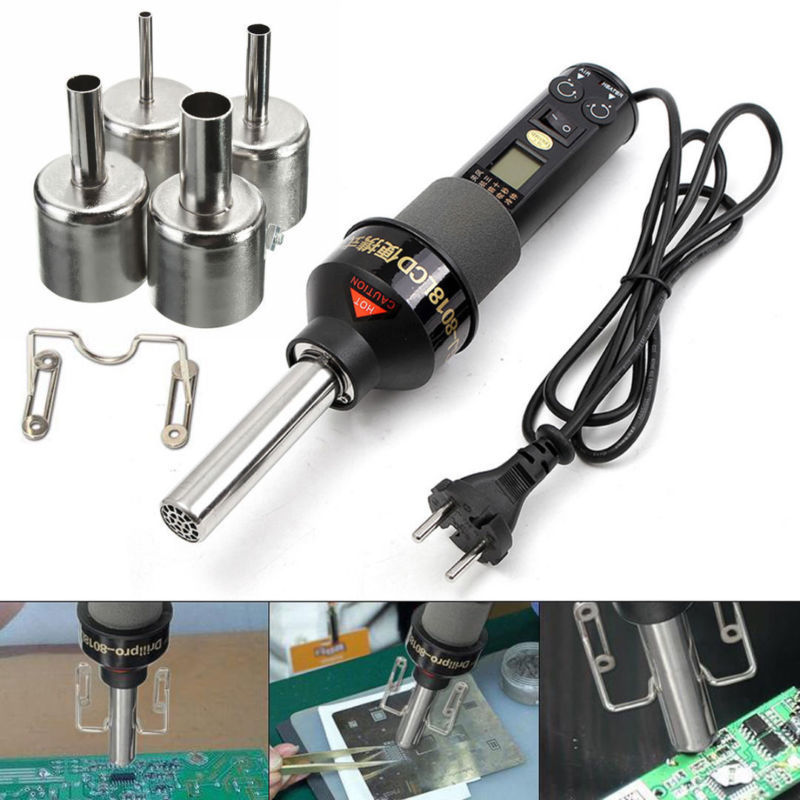
Removing with an iron is problematic for more than a few pads, but applying low temperature solder will help. It's best to use a hot air tool. I saw some cheap ones on eBay (~$30). I use an Aoyue 2702+; around $250.


For power transistors for a couple amps, consider TIP30/31 and TIP120/125. My go to general purpose are 2N3094/3906 and 2N2222/2907.

I'm working on a discrete clock using transistors instead of logic chips. For cases where I want to minimize power requirements, I'm using BC547 instead of 2N3904. BC547 is a higher beta transistor and you can use a base current of 0.05Ic. For most other transistors, the rule of thumb is to use a beta of 10, but BC547 are spec'ed for a beta of 20. If you use both 2N and BC transistors, note that the pinouts are reversed.

I too like to use the 2N7000. Unfortunately, there are no 10 cent P MOSFETs. I picked up a partial reel of NTA4151P SMT devices that I solder to homemade adapters when I need a P device.
upload_2019-2-4_8-55-57.png

You'll be making the transition to surface mount sooner than you expect. All of the nicer stuff (like complementary pairs SMBT3946 - a 2N3904 and 2N3906 in the same package) is only available in SMT.
 

Thread Starter

Shishka

Joined Feb 4, 2019
7
Thank you all for your suggestions!
I went out to buy BS170 (they didn't have BS250, I'll need to order it or search somewhere else :(), BC547 and BC558 for the BJT pairs, I was starting to work on a clock as well by chance, so they were perfect!

I'm not completely new, I've been playing around in the analog world for quite a bit, but never took the time to build something bigger (that works!). I wanted to switch to the digital world which I enjoy a lot more, and wanted to start from the ground up! SMD is surely going to be the next step once I get more familiar with this stuff and have some ideas for projects ;)
 

dl324

Joined Mar 30, 2015
18,333
I was starting to work on a clock as well by chance, so they were perfect!
I just happened to pick up an ammo pack of BC547 from someone selling surplus. Otherwise, I'd use transistors more common to my area (2N).

I saw a piece of art that was a discrete digital clock that inspired me to do my own. Since then, I've seen a couple other designs. One used a custom PCB, but I liked the look of air wiring. The first example I saw attempted to make an abstract piece of art, so you can't see any logic blocks. I'm choosing to make mine more instructional and will organize the components by function. Instead of using 7 segment displays, I'm going to use 5x7 LED matrices for hours and minutes.

The design that gave partial schematics used ripple clocking. I decided to use a synchronous design using S#R# flip flops. I've designed the hours, minutes, and seconds counters and am prototyping hours now. I tried using diode logic for the AND and OR gates, but loading was significant and I'm converting the logic to NAND and NOR with diode logic on the inputs and a transistor on the output so logic levels are restored.

The one with functionality hidden took the creator 3 years and hundreds of hours of labor. I don't plan to take that long, but I'm not in a hurry. I have a number of concurrent projects and I rotate between them so it doesn't start feeling like work.

I doubt that I'll ever publish my schematics, but am willing to share ideas with you if you decide to pursue that project.
 

Thread Starter

Shishka

Joined Feb 4, 2019
7
I wanted to start simple and not limit myself with the use of ICs, I'm mostly going to use 4000 series I think! Thanks anyways, I'll post something if I need some help!
 

Hymie

Joined Mar 30, 2018
1,347
There are many ebay sellers selling transistor kits like this with an assortment of PNP and NPN transistors that work out at not much more than one penny a piece, and are supplied in a compartmented plastic box.

Back in the day, I can recall paying 10 pence for a single BC107.

They make an idea source of low power transistors for projects – I’ve added to the box a print out of the pertinent parameters of each transistor type (voltage rating, gain, pin out etc).

https://www.ebay.co.uk/itm/600pcs-1...hrfyevtOmyez6pIKQDNxX1uWOlWLNmEr1Op6lch34MPlT
 

dl324

Joined Mar 30, 2015
18,333
I wanted to start simple and not limit myself with the use of ICs, I'm mostly going to use 4000 series I think!
A clock would be much easier to design with IC's. Using discrete DTL you have to pay attention to fan-in/out. It's similar to designing microprocessors. You simulate them and back annotate device size changes to meet timing. Except, I'm not going to simulate the circuit. I'm doing it the old fashioned way of building prototypes.
 
Top