Facebook
 Google
 GitHub
 Linkedin

Your second trace, of the guitar signal without the amplifier, shows a signal of approximately 50-70 mV peak value; I wouldn't consider that "extremely" low, so I think you can dispose of your concerns about op amp noise; the MCP6002 should work quite well.This is something from the site written by the author: "The signal coming from the guitar, however, is very low in amplitude and oscillates around 0 V, meaning it contains some negative voltages that the Arduino cannot read.". The input signal is coming from an electric guitar and I don't know if the signal coming from the guitar is considered as extremely low.
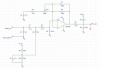
I'm baffled by that result; the amplifier circuit, just as you've shown it, should work and should give you a gain adjustable from about 1.2 to 22. I can't see anything wrong with the amplifier design. Perhaps someone else could comment.Sir, I've already tested the amplifier circuit on Simulink and it wont send any signal to the arduino. Whenever I strum a string, there are no changes in amplitudes, just a straight line. I've run a simulator and here is the image. It's on a 5s period.
I find it odd that the waveform only goes positive relative to ground; I would expect it to go both negative and positive, and I can't understand why it doesn't.I've tested the guitar without the amplifier circuit on simulink and as you can see, whenever I strum a string, there's changes in amplitude.
I'm not familiar with Simulink, so I can't suggest might be wrong with your simulation. I assume something isn't right, since the results you are getting don't seem to make sense.