Strange Neon. Stays on after being unplugged. Why?

Reloadron

Joined Jan 15, 2015
7,908
If I could find a NE2 lamp I would shove it in the oven and see how hot I need to get it before the gas would glow. Maybe my choice of words is not correct but Google is not helping. :(

Yes, enough RF will excite a neon lamp but it takes quite a bit, I think (operative word think) you can detect leakage in a microwave oven door using a neon lamp taped to a wooden stick. Years ago a few hams I knew would tape neon lamps to the ends of diapole antennas for some neat effects.

With all of the junk I am surrounded by I can't find a neon lamp. I have this desire to short the leads and pop it into the oven. :) I figure that is the most plausible explanation so it has my vote.

Ron
 

Thread Starter

Tonyr1084

Joined Sep 24, 2015
9,744
ISSUE SOLVED! It's heat. Night before last I let the vaporizer run all night and the better part of the day. Come nightfall, last night, the unit was room temperature and not producing steam. When I unplugged the unit the night light (neon bulb) extinguished within three seconds. I refilled the unit and ran it all night. This morning it was still steaming. When I unplugged the unit the neon stayed glowing for 87 seconds before I determined I could no longer determine a light source.

Seems pretty self evident now - it was glowing because of being warm.

Thanks all for helping solve this mystery.

Y'all have a good day.
 

MisterBill2

Joined Jan 23, 2018
28,032
ISSUE SOLVED! It's heat. Night before last I let the vaporizer run all night and the better part of the day. Come nightfall, last night, the unit was room temperature and not producing steam. When I unplugged the unit the night light (neon bulb) extinguished within three seconds. I refilled the unit and ran it all night. This morning it was still steaming. When I unplugged the unit the neon stayed glowing for 87 seconds before I determined I could no longer determine a light source.

Seems pretty self evident now - it was glowing because of being warm.

Thanks all for helping solve this mystery.

Y'all have a good day.
It can be nice to have a "warm glow" sometimes.
 

nsaspook

Joined Aug 27, 2009
16,439
ISSUE SOLVED! It's heat. Night before last I let the vaporizer run all night and the better part of the day. Come nightfall, last night, the unit was room temperature and not producing steam. When I unplugged the unit the night light (neon bulb) extinguished within three seconds. I refilled the unit and ran it all night. This morning it was still steaming. When I unplugged the unit the neon stayed glowing for 87 seconds before I determined I could no longer determine a light source.

Seems pretty self evident now - it was glowing because of being warm.

Thanks all for helping solve this mystery.

Y'all have a good day.
I've never seen a NE2 type bulb glow just from the effects of 100C temperature.
http://w5jgv.com/downloads/General Electric Glow Lamp Manual 2nd Edition.pdf
 

Thread Starter

Tonyr1084

Joined Sep 24, 2015
9,744
@nsaspook - I don't know what sort of neon it is. Honestly, it seemed to be a little smaller than the typical NE2 I've seen. Just don't know WHAT sort of neon it is. Only that it IS neon.

Again, thanks all. But I prefer my "warm glow" to come from the fireplace. Most days we're not allowed unless a wood burning fireplace or other wood burning stove is the only source of heat. Air quality issues in Salt Lake City US. Typical winter inversion layer traps pollutants down near the ground.
 

nsaspook

Joined Aug 27, 2009
16,439
It is probably a lot warmer than that inside the bulb.
The problem I see with only heat is the physics of glow discharge. Conduction in a gas requires charge carriers (electrons or ions). For neon gas thermally to get the first ionization energy at 21.6 eV requires a Boltzmann temperature that's very high.
 
Last edited:

MisterBill2

Joined Jan 23, 2018
28,032
The glow threshold of a neon lamp is also related to the light input to the device. We had some very old neaon night lights of the clear plastic plug style. They would not glow in total darkness, but with a light on they would indeed glow. And in bright sunlight they glowed even brighter. Which the physics of that makes sense, although it was funny and a bit puzzling to others. And it is possible that somehow the water and those electrodes became a battery or possibly a large capacitor, although with AC power that does not make much sense at all.
 

Thread Starter

Tonyr1084

Joined Sep 24, 2015
9,744
it is possible that somehow the water and those electrodes became a battery or possibly a large capacitor
To dispel that I pulled the head unit out of the water and the neon continued to glow.

Let's be clear about this, I'm not talking about a high light level of output after being disconnected. It was dim for sure. It was only that I noticed it that made me wonder and eventually to ask on this forum.

Nope. No capacitance involved. The electrodes were completely out of water. And the electrodes are (what appears to me to be) similar metals or carbon or whatever. Geez! If this keeps up I'm going to have to disassemble it just to take some pictures. I don't WANT to; but if I must - - - .
 

Reloadron

Joined Jan 15, 2015
7,908
I wouldn't worry about pictures. It's just interesting. I know that neon is effected by ambient light as to ionization threshold and that a neon lamp is not all neon. I just don't quite understand how the neon can become excited from just what amounts to mild heat but I guess it matters not. Still no clue where any of my neon lamps are. :)

Ron
 

Danko

Joined Nov 22, 2017
2,222
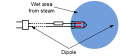
It is dipole.
While wet area becomes dry, lamp is dimmed.
Only what is electromagnetic waves source...
HV power line?
Mains?
Radio station?
Military relay station?
Etc...
1575758422304.png
EDIT:
KSL Newsradio is a pair of radio stations located in Salt Lake City, Utah..........The AM station broadcasts with 50,000 watts
non-directional, day and night
 
Last edited:

Thread Starter

Tonyr1084

Joined Sep 24, 2015
9,744
@Danko Not sure if you're asking a question. This is 110 VAC from a regular plug outlet in the bedroom. My home is at an elevation of 4550 feet above sea level. At that altitude water boils at 203.797˚F.

-C • A + 212
Where C (constant) = 0.001802198
Where A = Altitude
Where 212 is the boiling point of water in Fahrenheit at sea level
-0.0018022 x 4550 + 212 = 203.8˚

I may have said earlier the boiling point was between 208 and 209. That was an error.

So since there is steam coming out of the head unit and the neon lamp is half an inch away from the hot vapors, there's that much temperature nearby. Given the lamp is burning, it too is producing some residual heat. I don't have any idea how much; in part because I don't know what the bulb is other than it's "neon".

Given that when the unit was dry and cold, upon unplugging the unit the neon completely extinguished within 3 seconds. Whereas when there is water and steam present, upon unplugging the unit the lamp has a residual glow for 87 seconds (as measured) till I can no longer detect light with my eye.
 

Ylli

Joined Nov 13, 2015
1,092
Any chance the electrodes within the bulb are getting hot enough to glow? If you run the unit without water for a number of hours, do you or do you not see any 'afterglow'?
 

MisterBill2

Joined Jan 23, 2018
28,032
Any chance the electrodes within the bulb are getting hot enough to glow? If you run the unit without water for a number of hours, do you or do you not see any 'afterglow'?
Because this kind of device heats the water by passing a current through it, when there is no water there is not much heat.
 

Ylli

Joined Nov 13, 2015
1,092
Because this kind of device heats the water by passing a current through it, when there is no water there is not much heat.
Not any external heat, but the neon does draw *some* current and there is a voltage across it. If it is a cheap bulb, the internal electrodes could be small enough that they get hot just from the bulb internal power dissipation.
 

MisterBill2

Joined Jan 23, 2018
28,032
Not any external heat, but the neon does draw *some* current and there is a voltage across it. If it is a cheap bulb, the internal electrodes could be small enough that they get hot just from the bulb internal power dissipation.
Exactly what I meant! The inside of the neon bulb gets hot and the hot surroundings reduce the heat loss and the result is an afterglow, for a short while.
 

AlbertHall

Joined Jun 4, 2014
12,640
The current through the neon is less than 1mA and the voltage is something like 70V so 70mW in the bulb. That's not going to make it very hot.
 

MisterBill2

Joined Jan 23, 2018
28,032
The current through the neon is less than 1mA and the voltage is something like 70V so 70mW in the bulb. That's not going to make it very hot.
It is a constant energy input and if the heat loss is low enough the temperature rise will be higher. In all cases the temperature will rise until the heat loss equals the heat energy input.
 

Danko

Joined Nov 22, 2017
2,222
In this case the electrodes are carbon and you can't "anodize" carbon.
Oh, I see... In our region for such domestic devices aluminium or stainless steel
electrodes are used only.
And iron electrodes are used for industrial, high power devices.
My device, made 60 years ago, has stainless steel electrodes,
so after cleaning from deposit (one teaspoon of sodium bicarbonate for 1 liter of water
and boiling for 5 min), electrodes are shine, just as new.
Seems pretty self evident now - it was glowing because of being warm.
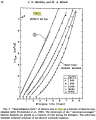
In diagram below we can see dependence afterglow time on temperature and
current (electron density).
Afterglow time was measured with help of mass-spectrometer
and very sensitive photomultiplier tube.
For eye sensitivity afterglow lasts tens microsecond only.
It is why neon lamps are used in stroboscopes for very fast processes monitoring.
1575883449505.png
Nevertheless, on the subject of the power cord acting like a capacitor - I tried shorting the leads using a nail and that did not cause the bulb to extinguish.
So:
1. NAIL experiment excludes power cord and electrodes capacitance as afterglow source.
2. Diagram above show very short afterglow time in wide range of temperatures and currents.
3. Seems only ambient EM waves can be source of energy for afterglow.
4. If air contains radon, then ionization of neon may allow to glow with low intensity EM waves from mains.
 
Last edited:
Top