Start/stop motor control with two limit switches

Thread Starter

matdiss

Joined Jun 7, 2017
4
Hi

I'm new to the forum and only have a very basic understanding of electronics (sorry!). I've been searching and this thread seems to be addressing the problem I have but I need some help!

I am building a clock and want to control the winding action with a motor. When the weight gets to the bottom it will hit a switch causing the motor to start winding. When the weight gets to the top, it will hit another switch and the motor will stop winding.

I'm sure this is very simple to build, but its beyond my knowledge unfortunately - is anyone able to help with an easy to understand circuit for this?

Thanks in advance for your help.

Mat.

Moderator: Post moved to new thread from this thread.
The original Thread Starter owns the thread. You now have your own thread. Hijacking someone else's thread is discouraged.
 

MaxHeadRoom

Joined Jul 18, 2013
30,557
You just need a N.O. (normally open) limit switch and a N.C. limit switch, all in series with a small relay, one N.O. contact on the relay is wired across (in parallel) with the bottom N.O. switch.
When the weight operates the bottom limit the relay closes and the contact on the relay keeps the relay energised until the top N.C. limit is made which then opens the circuit and drops the relay out.
A separate N.O. contact on the relay wired in series with the motor turns the motor on/off.
Max.
 
Last edited:

Reloadron

Joined Jan 15, 2015
7,852
I have a question. Limit switches, be they activated with a roller, plunger or lever all require some degree of force. while I doubt it matters when lifting the weight will it effect the weight as the weight, under its own weight is on the bottom?

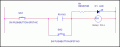
Here is a very basic cartoon of what Max was getting at. I call it a basic latching circuit. Another set of relay contacts would drive your winding motor, not shown. Resistor R1 and the LED D1 are not required or needed.

Latching Relay Ckt.gif

Ron
 

MaxHeadRoom

Joined Jul 18, 2013
30,557
Also pretty much the same as shown in the Telemecanique thread the post was moved from in Fig 2 P.7
M= Relay
G = Motor
Stop = Up L.S.
Start = Down L.S.
Ignore O/L.
Max.
 

Thread Starter

matdiss

Joined Jun 7, 2017
4
Brilliant - thanks Max and Ron, really helpful.

@Ron - one question, what's the relay coil you shown in your circuit?

Thanks Mat.
 

Reloadron

Joined Jan 15, 2015
7,852
Brilliant - thanks Max and Ron, really helpful.

@Ron - one question, what's the relay coil you shown in your circuit?

Thanks Mat.
In the common latching circuit I used the motor would be powered (switched) using a relay. The relay is what "latches" the motor on when the weight reaches a low closing a N/O (Normally Open) Limit switch. In my simple drawing S1 is a N/C Normally Closed limit (top) and S2 is a N/O limit switch. Circuits like this are called a "latching" circuit or a latching motor circuit. If you explain what motor you plan to use and the motor's data we can maybe do an actual drawing of what we might suggest.

As drawn the weight drops to a low point closing the normally open relay contacts when the relay closes (latches) since SW1 is normally closed. Another set of relay contacts, not shown, start the motor and the weight gets moved up. Since the relay is latched through its own contacts it continues to power the motor. When the weight reaches the top it activates SW1 making it open. When the normally closes S1 opens the power to the latched relay drops out and the relay opens till the next time and the process repeats.

Make Sense?

Ron
 

MaxHeadRoom

Joined Jul 18, 2013
30,557
You do not mention the voltages you are dealing with, but normally you should be able to use the same source for both relay and motor.
Did you find the Telemecanique circuit I referenced?
I suggest you draw out the circuit yourself, not only for future reference but if you post it here we can check it.
Typically small relays such as Omron MY style are used.
Max.
 

Thread Starter

matdiss

Joined Jun 7, 2017
4
Thanks for all your help here - I'll go away and do some further investigation and come back with more info - not sure when as I need to find the spare time!! Thanks again for the moment.
 

Thread Starter

matdiss

Joined Jun 7, 2017
4
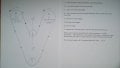
I thought I'd post a diagram of what I'm trying to achieve, regarding the voltages, I will be driving a 9v DC motor and using a 9v battery to power the circuit. Any recommendations on type of relay to use would be very helpful.
 

Attachments

MaxHeadRoom

Joined Jul 18, 2013
30,557
As #12 indicated, you need to find the slowest rate of rotation you need that will be satisfactory and choose a motor with gear reduction that will suffice for the job.
This will enable the smallest motor to be employed in order to give you longest battery life.
There are many sites for 9vdc relays Jameco and Digikey also.
For the method I describe in #2 you would need a DPDT or DPST relay.
Max.
 

shteii01

Joined Feb 19, 2010
4,644
We have NO limit switch on the bottom. We have NC limit switch on the top.

When weight is between switches, the NO is the break in the circuit, the motor is off.

When weight is on the bottom and closes the NO, the circuit is complete, the motor is on. As soon as the weight is off the NO, the circuit is broken again and the motor is off. So we need to have some kind of delay to keep the motor running while NO switch is not engaged, but the weight is at the bottom.
 

MaxHeadRoom

Joined Jul 18, 2013
30,557
If it were me I would prefer to use a defined limit rather than the extra cost of a timer?
Although the mechanism seems like it may be quite a defined operation time, a delay sort of introduces a variable IMO.
Max.
 

Bernard

Joined Aug 7, 2008
5,784
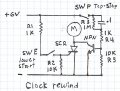
To avoid the drain of a relay, might try an SCR as motor driver. Both switches are NO. As weight falls
SW E closes, triggering the SCR. Motor ( top connected to +6V ) turns to lift weight until top SW F closes
putting a + pulse on base of NPN transistor momentarily shorting SCR which is then reset- or we hope.
From All Electronics, CAT # DCM- 365, US $8.95, 80 RPM @ 6V DC, 110 mA , 12 RPM @ 1.5 V. I have one.
CAT # DCM-470 US $5.75 ( on sale ) 6V DC, 150 mA @ about 30 RPM. I wrote the review.Clock rewind 00000.jpg
4 alk. AAs will last much longer then std. 9V. Knowing weight of weight might be helpful in picking motor.
 
Last edited:

Reloadron

Joined Jan 15, 2015
7,852
Some of what you are asking will depend on the motor current draw? Using discreet components an H-Bridge and a few limit switches but again, depends on motor current draw.

Ron
 
Top