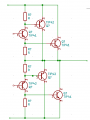
Broskie (TubeCad) has a design for an output stage that is both Darlington and Sziklai at once. I'm damned if I can find it, but it looked like this. Is it common emitter or common collector?
AN-948 The amplifier has a high pass filter. The filter adjusts along with the input of the amplifier.
So it does use negative feedback so the higher audio range is not cut off when input is turned up.
The schematic page 2 is better viewed to match the layout by rotating page counter clockwise.
Printing page 3 of the pdf with laser let on glossy photo paper allows iron on transfer to pcb.
AN-948 The amplifier has a high pass filter. The filter adjusts along with the input of the amplifier.
So it does use negative feedback so the higher audio range is not cut off when input is turned up.
There is no highpass filter. R1, R2 and C1 are a lowpass filter that cuts frequencies and noise that are far above audio frequencies.
Of course the amplifier has negative feedback so that the gain is constant and distortion is very low at all audio frequencies.
Changing a volume control will not affect the frequency response.
There is no need to be condescending it is not as obvious for the level of the thread the TS asked nicely.
Yes It has a low pass filter. It has negative feedback. It also explains more. The application note explains
in more detail there is enough to build it and I am pointing to that part of the explanation which leads also to circuit board layout. The copper pours on the pcb are related and the design has merit. It reads:
The class A driver transistor, Q4, operates at a bias current determined by resistors R8, R9, nominally 5mA. Q4 is driven by a PNP differential input pair, Q1, Q2. The bias current in the input stage is set to 2mA by resistor R3. Negative feedback from the output of the amplifier is fed to the base of Q2 by resistor R6. Components R7, C2 set the closed loop gain of the amplifier (R6 /R7) and provide low frequency gain boosting.
The additional components R15, C7 connected between the output node and ground suppress the high frequency response of the output stage, allowing the h.f. performance of the amplifier to be determined by the input circuit. Components R1, R2, C1 at the input of the amplifier define the input impedance (47Kohm) and suppress noise. The amplifier input stage requires additional power supply ripple suppression which is provided by components R4, C3.
Additional circuit components have been added to ensure high frequency stability of the complete amplifier. Placement of the components and component values will depend to some extent on the printed circuit board layout. The following rules should be followed when designing the printed circuit board:
(a) A 'common ground' principle should be C5 Q5 R8 R9 C4 R5 R3 R12 C3 R15 C2 C6 Q6 D1 R10 R11 Q3 R13 C7 R6 R14 Q4 R4 Q3 Q2 R7 R2 C1 R1 Figure 2. Amplifier Printed Circuit Board Layout adopted, i.e., power supply decoupling capacitors, load and input stage biasing components should all be taken to ground in close proximity, eliminating the effects of common node ground current. Similarly, a "common output node" should be used, the load, feedback resistor and h.f. suppression components being taken from a common point on the pcb.
(b) The length of connecting lead to the gate terminals of HEXFET Power MOSFETs Q5, Q6 should be an absolute minimum to avoid oscillation of the power output stage. A series gate resistor, R10, may be used to suppress oscillation, but too high a resistor value will limit the slew rate. Oscillation of the amplifier caused by capacitive coupling to the base of the driver transistor, Q4, is suppressed by the addition of a series resistor, R14.
(c) Phase shift in the amplifier when driving a reactive load can lead to high frequency instability. With a capacitive load, the addition of a small, air-cored choke (3µH with an 8 ohm, 2µF load) will restore stability. The final value of the choke is defined by experiment.
The point I was making is that if you take AN948 and add a current mirror instead of R5, and a constant current source instead of R3/R4/C3 you have Eliot's circuit.
The Hexfets have a negative temperature coefficient of Vgs_th, so they need the Vbe multiplier (Q3/R11/R12/R13) to keep the bias stable. The lateral MOSFETs have a positive temperature coefficient of Vgs_th, so that the bias will reduce as they get warmer, as the bias voltage is fixed by a resistor.
Hi guys, I ve been checking my MOSFETs just now. I measured DRAIN to SOURCE and all of them start filling up to about 2000 and then DMM shows an open circuit. But one of the PMOS didnt show an open circuit but the rating has stopped just below 2000. Does that mean its faulty? Everything else i measured on it seems fine.
The gate of a Mosfet has an extremely high resistance to the source. It also has a fairly high capacitance that "stores" a previous voltage causing the Mosfet to be turned on and conducting between its drain and source.
Therefore if you measure the resistance between drain and source to see if the Mosfet is shorted then you must connect the gate to the source to turn off the Mosfet.
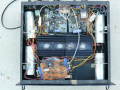
Against the rear of the amp on the right is my "star" ground point. This is my version of a Leach Amp". The transformer is 4x35VAC@3A each. Somewhere there is a small power transformer hiding. 4x9600uF @ 100V for main filter caps.
The small PCB in the mid rear is optoFETS in series with the inputs. There is a speaker relay and a power relay.
The front PCB is lagarithmic turn-on and quick turn off. Transformer is torroidal under it
On intial turn-on, the optos are off and the speakers are off. A flameproof resistor (~50 ohms) is in series with the line voltage. Each cap is crudely monitored for 2/3 50VDC. When they all reach that level,peakers are enabled and a cap slowly starts charging and that voltage is applied as a current to the OPTO's. In about 10s, these see full voltage and are current regulated thus slowly turning on the amp.
I reversed the NPN and PNP transistors and just the current limiting resistor in the protection circuit died.
The amps can be removed using an extension and worked on outside the case.
Drivers exist for LED's for clipping and high temperature. No circuits behind them.
The power on protect circuit needs a little work. There is no DC protection, but there is a fuse in each power supply leg. That will pop the turn-on resistor. To make the protection circuit more complete, it needs to fully open the power after some time limit if the capacitors never make it to 2/3 50V or drop below 2/3 50V.
The gate of a Mosfet has an extremely high resistance to the source. It also has a fairly high capacitance that "stores" a previous voltage causing the Mosfet to be turned on and conducting between its drain and source.
Therefore if you measure the resistance between drain and source to see if the Mosfet is shorted then you must connect the gate to the source to turn off the Mosfet.
If you are measuring it in circuit, it should have 47 ohms (R34) across gate and source, so it should not be "floating".
From your description it appears as though the gate is open circuit. Is something not connected?
I've been doing some work testing the components and they all seem to be working correctly. The problem remains the same. When I connect the power supply to the amplifier and plug it into the outlet, no input signal fed into the amplifier, the loudspeaker goes crazy. It starts producing loud noise and moving aggressivly up and down. I always turn off the power quickly sience I dont want to ruin the speakers. Obviously I measured some voltage on the output for which I dont know its source. I would really appreciate if someone had any advice on the topic sience I have no idea what could be causing this?
My only idea is that maybe there is some current running through ground wiring. The choke I'm using is not air cored as it should be with these kind of circuits, but i figured that would afect the overall performance as much or? And i should also mention that there is no delay between the turning on of power supply and the amplifier.

 Facebook
 Google
 GitHub
 Linkedin