Squarewave vs. squarewave on digital and analog 'scopes

Thread Starter

13hm13

Joined Jun 1, 2023
75
As I have queried from the TS, the issue is why the Siglent, with its default probe and common (alligator) ground clip, produce the characteristic spike while the Tek 465 does not.
As noted prev., I have been able to reduce or increase the spike based on ; (a) direct BNC input from DDS ; (b) touching the cable or moving it around .
Yes, the spring ground contact can improve fidelity, as shown here:
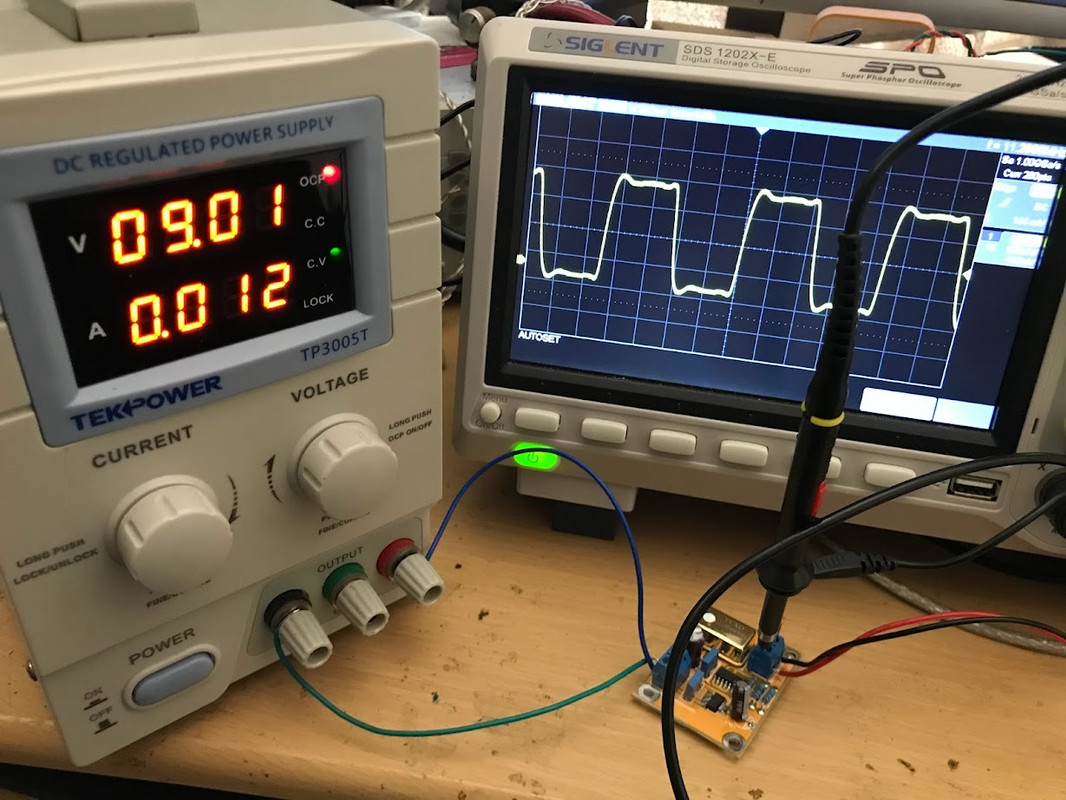

But, in real-word circuits, such "ideal" conditions do not exist.

Maybe at this particular (low-cost) range of DSO's -- any brand -- these type of metrics are not reliable; they are "artifacty" because of price/performance trade-offs.
Nevertheless, since the spike is significantly large in the Siglent (compared to the Tek 465), the mystery remains.
 

WBahn

Joined Mar 31, 2012
32,935
You admit that your set up is sufficiently flaky that making any number of changes, including just touching a cable or moving it around, significantly impacts the waveform. Yet you won't entertain the notion that the reason that you see more high frequency artifacts using a 200 MHz scope compared to a 100 MHz scope might be because a 200 MHz scope is possibly be capturing more high-frequency content in the signal than the 100 MHz scope is. Instead, because the waveform captured by the 100 MHz scope looks cleaner because it doesn't have as many high-frequency artifacts, you conclude that the problem is with the 200 MHz scope.
 

Thread Starter

13hm13

Joined Jun 1, 2023
75
You admit that your set up is sufficiently flaky [...]Yet you won't entertain the notion that the reason that you see more [...] you conclude that the problem is with the [...].
Who are "you"? Doctor Who? Isn't this supposed to be Star Trek?
 

Ya’akov

Joined Jan 27, 2019
10,259
As I have queried from the TS, the issue is why the Siglent, with its default probe and common (alligator) ground clip, produce the characteristic spike while the Tek 465 does not.
As noted prev., I have been able to reduce or increase the spike based on ; (a) direct BNC input from DDS ; (b) touching the cable or moving it around .
Yes, the spring ground contact can improve fidelity, as shown here:


But, in real-word circuits, such "ideal" conditions do not exist.

Maybe at this particular (low-cost) range of DSO's -- any brand -- these type of metrics are not reliable; they are "artifacty" because of price/performance trade-offs.
Nevertheless, since the spike is significantly large in the Siglent (compared to the Tek 465), the mystery remains.
You‘ve got it wrong. The Siglent is showing something much closer to real signal conditions, it is more accurate. All of the effects of parasitics exist. The Siglent is doing the opposite of production unique artifacts, it is better a staying out of the way and not being part of the signal path from the output’s point of view.

While the older scope’s output might be comforting, it is misleading since it can’t show you the reality of a badly matched signal or poor termination. You need to follow best practices to measure things properly. Every source you will find will tell you the same thing—improper probing will result in a distorted waveform.

There is no mystery here. You have an impedance mismatch which will always cause over- and/or undershoot, and ringing. This is the physics of the situation. I am frankly surprised you are so obdurate considering all the information is in front of you. Please do some reading from scope manufacturer’s application notes on probing.
 

Ya’akov

Joined Jan 27, 2019
10,259
Who are "you"? Doctor Who? Isn't this supposed to be Star Trek?
No. It’s supposed to be AAC. It’s dangerous to invent worlds and then judge the people around you from your terrible analogies. For my part I am done trying to “help” you, you are clearly interested in something other than the facts. It seems that you want confirmation of your own underbaked conclusions.

Seriously, you are much too abrasive and unreachable to enjoy interacting with. So, no ill will, no ill wishes, but farewell.
 
Top