Source Transformations

Thread Starter

Hitman6267

Joined Apr 6, 2010
82
SourceTransformation01.jpg

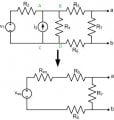
Problem1: The figure illustrates a source transformation. Given that R2 = 20 Ω , R4 = 11 Ω , and R5 = R6 = R7 = 20 Ω , what is the value of Req in Ω?

Answer: 7.1 ohm

Problem 2: The figure illustrates a source transformation. Given that R2 = 20 Ω , R4 = 20 Ω , R5 = R6 = R7 = 20 Ω, v1 = 8.2 V, and i3 = 0.26 A, what is the value of veq in V?

Answer: 6.7V

I've already solved these exercises a long time ago and am trying to understand the method of resolution.


Problem 1: After we transform the current source + R4 into a voltage source and R4. Where are we allowed to put R4 ? And why does it become in parallel with R2

Problem 2: After we transform the current source + R4 into a voltage source and R4. We just replace the current source by a voltage source right ? (not changing its place)

Also could any one tell me when we can sum two independent current sources into one equivalent one and when we can sum two independent voltage sources. I alway have trouble with these and some time I sum sources that shouldn't be summed.
 

The Electrician

Joined Oct 9, 2007
2,986
View attachment 19251

Problem1: The figure illustrates a source transformation. Given that R2 = 20 Ω , R4 = 11 Ω , and R5 = R6 = R7 = 20 Ω , what is the value of Req in Ω?

Answer: 7.1 ohm

Problem 2: The figure illustrates a source transformation. Given that R2 = 20 Ω , R4 = 20 Ω , R5 = R6 = R7 = 20 Ω, v1 = 8.2 V, and i3 = 0.26 A, what is the value of veq in V?

Answer: 6.7V

I've already solved these exercises a long time ago and am trying to understand the method of resolution.


Problem 1: After we transform the current source + R4 into a voltage source and R4. Where are we allowed to put R4 ? And why does it become in parallel with R2
You're doing things in the wrong order. First transform the voltage source into a current source in parallel with R2. The you can simply add the two current sources you will have at that point into a single current source (whose value is V1/R2+I3) in parallel with the parallel equivalent of R2 and R4 (Req).


Problem 2: After we transform the current source + R4 into a voltage source and R4. We just replace the current source by a voltage source right ? (not changing its place)
Continuing with the end result from the previous question, in the usual manner just transform the current source you ended up with into a voltage source in series with a resistance, Req.


Also could any one tell me when we can sum two independent current sources into one equivalent one and when we can sum two independent voltage sources. I alway have trouble with these and some time I sum sources that shouldn't be summed.

You can sum current sources when they are in parallel, and you can sum voltage sources when they are in series.

So, when you have one of each, as in this problem, you start out by determining whether they are in parallel or in series. If they're in parallel, convert the voltage source to a current source first. If they're in series, convert the current source into a voltage source first. Then combine them. And, if called for by the problem, you can always make a last conversion to the required type.
 
Top