Sometimes you feel like a (wire) nut...

Thread Starter

ErnieM

Joined Apr 24, 2011
8,415
I'm in the process of rewiring/rebuilding a beautiful antique torchiere lamp for a friend. I have quite a few wires to connect inside the cluster body and will be using wire nuts to connect the new #18 gauge together, but I am a deer in the headlights when selecting the proper nut sizes.

What would one properly choose to connect 2, 4, or up to 6 wires together?

Thanks for your attention.
 

LowQCab

Joined Nov 6, 2012
5,101
It depends on the Wire-Gauge and the number of Wires to be connected together.
"Yellow" Wire-Nuts are the largest size that You are likely to need.
.
.
.
 

Ya’akov

Joined Jan 27, 2019
10,226
I stopped using wire-nuts for most things. WAGO Lever-nuts (not the push-wire type) are what I use now.
https://www.wago.com/us/discover-wire-and-splicing-connectors/221
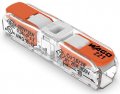
I concur. The Wago Lever-Nuts are very good. The newer, inline version of the 221 is well suited to this application. They definitely cost more but unless the difference in cost is prohibitive, the advantages of reliability, each of testing, and simple application far outweigh that premium.

1704890824262.jpeg

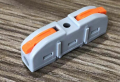
If cost is a barrier, my second choice would be the Chinese version of the Wago idea. While I do prefer the Wagos for a variety of reasons, every test I have seen with the Chinese “copies*” has shown them to be at least as safe as the Wagos concerning over-current, and both handle far more current than their ratings in any case.

1704890925067.png

*The Chinese companies that at first were cloning the Wagos began genuinely innovating around the idea and offer versions that are very useful (e.g. L and N in on one side, and 3 LN pairs out on the other) and not offered by Wago.
 

atferrari

Joined Jan 6, 2004
5,001
I concur. The Wago Lever-Nuts are very good. The newer, inline version of the 221 is well suited to this application. They definitely cost more but unless the difference in cost is prohibitive, the advantages of reliability, each of testing, and simple application far outweigh that premium.


If cost is a barrier, my second choice would be the Chinese version of the Wago idea. While I do prefer the Wagos for a variety of reasons, every test I have seen with the Chinese “copies*” has shown them to be at least as safe as the Wagos concerning over-current, and both handle far more current than their ratings in any case.


*The Chinese companies that at first were cloning the Wagos began genuinely innovating around the idea and offer versions that are very useful (e.g. L and N in on one side, and 3 LN pairs out on the other) and not offered by Wago.
And what if they suffer a pull of a certain intensity?
 

WBahn

Joined Mar 31, 2012
32,702

You should NEVER depend on an electrical connection (solder, crimp, etc..) for mechanical strength to support the weight of the device.
In general, I agree. But I also believe in never say never, so I make a habit of caveating it with something like, "Never do (xxx) unless there's a DAMN good reason, and while damn good reasons DO exist, convenience is NOT one of them. Also, if you choose to do it, the onus is on you to do the work to make damn sure that what you do will actually work and work correctly."

So, in this case, if you are going to rely on an electrical connection for mechanical support, you have to do the proper analysis and design of everything involved to ensure that it will both support the mechanical load while maintaining it's electrical integrity over the entire range of usage over its entire life. If your need to do it justifies the work involved to verify it, then go for it. But, if you ponder the work involved to properly verify it, you will almost always find that it is more trouble than it is worth and look for a more traditional way of providing the mechanical support.
 

nsaspook

Joined Aug 27, 2009
16,249
In general, I agree. But I also believe in never say never, so I make a habit of caveating it with something like, "Never do (xxx) unless there's a DAMN good reason, and while damn good reasons DO exist, convenience is NOT one of them. Also, if you choose to do it, the onus is on you to do the work to make damn sure that what you do will actually work and work correctly."

So, in this case, if you are going to rely on an electrical connection for mechanical support, you have to do the proper analysis and design of everything involved to ensure that it will both support the mechanical load while maintaining it's electrical integrity over the entire range of usage over its entire life. If your need to do it justifies the work involved to verify it, then go for it. But, if you ponder the work involved to properly verify it, you will almost always find that it is more trouble than it is worth and look for a more traditional way of providing the mechanical support.
Ok, but that's a given that there are exceptions but I learned the hard way about weasel words to never. You will get burned by some smart, lazy SOB using wire nuts and electric tape as a overhead light support during a fire and safety inspection.

You design mechanical supports first that can be used as an electrical connection too in some applications but IMO never the other way around because the electrical connection is much more likely to fail first leading to a safety issues for fire or electrical shock.. When I say never at work (or to my kids) that means you better have a damn good reason for violating that rule.

I've been on the explaining side of serious NEVER a few times and it was taken as a valid exception (like a RED/BLACK security violation to the skipper to pass still secret mission information to the crew from a unclassified radio intercept source from the then USSR about our mission and why we were in general quarters, at max speed heading south while manning guns tracking unknown aircraft) but usually with a stern statement of, don't make this a habit.
https://en.wikipedia.org/wiki/Red/black_concept
 
Last edited:

Ya’akov

Joined Jan 27, 2019
10,226
Hmm…

I can’t imagine being comfortable with using a connector to support anything but trivial weight except:

  1. A locking connector, where the lock is an explicit latching mechanism (not just a compliant shell)

  2. The connector comes from a reliable manufacturer with a stake in repeatable specifications

  3. The connector is tested to support the load empirically, including both static and dynamic tests
    where the load is dropped from the maximum possible height while connected.

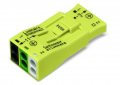
In fact, I have use the Wago Luminaire connectors to support pendant lights that weigh about a half kilo each. They worked well, and passed my tests. In my case I put passed the input side of the connector through a rectangular opening that was not quite the size of the square section (so it rested on the taper). I originally planned to use silicone on the top to fix it in place but the insertion force is pretty high and it wouldn’t hold more than a couple of cycles to I switched to construction adhesive which seems to be just fine. (Just not as maintenance friendly)

1708434353282.png
 

MisterBill2

Joined Jan 23, 2018
27,159
It has been several hours since I most recently used wire nuts to join wires in a junction box. Usually correctly installed wire nuts work very well for the life of the installation. But to know the joint is going to perform as needed the nut must be the correct size , which can be determined by use of the size table published by at least one manufacturer (IDEAL)
My sizing guide is that the diameter of the twisted group of wires should not be more than 3/4 of the diameter of the spring wire cone inside the wire nut plastic housing. Then, for twisting the nut on, the torque should have a definite increase after about two turns, or sometimes 3 turns, and the required torque should increase a bit after that. And it is wise to check that all of the wires in a group are secured by checking that none of them pull out easily after the connection is made.
 
Top