Something went boom, trying to figure out why.

Thread Starter

jjmalove

Joined Jul 6, 2016
51
Just plugged some of my project together and turned it on and had an immediate pop followed by smoke, great.

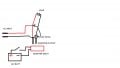
Here is the setup. I have a load that I want to either power with a 110V AC extension cord, or a 12VDC to 110V AC inverter. The way I have it wired is at the bottom. There is some more stuff to the circuit, but I think the problem here has to do with the AC Input and the Inverter Output being tied together? So this was the configuration, with the battery no connected to the system and thus the inverter not powered on. When I plugged the AC Input in there was a pop and some smoke. Have a made a mistake tying those together? If not I can elaborate on the rest of the circuit and see if the mistake is elsewhere.

Thanks!workstuff.jpg
 

drc_567

Joined Dec 29, 2008
1,156
Is the inverter output wiring polarized? Is there a 'hot' wire and a neutral wire? The wall outlet will have this configuration. Maybe take a closer look at the wires for each power source.
 

MrSoftware

Joined Oct 29, 2013
2,273
I'm not an expert here and I'm sure someone with more knowledge in this area will chime in, but I think that in the least your inverter and the AC source would need to be synchronized to be connected in this way. Otherwise you could have piles of current flowing back and forth if the AC waves are out of phase.

Unless your goal is load sharing, I would imagine you would want a switch of some sort separating the two, allowing you to run off of one or the other but not both simultaneously. I think your AC source and inverter would still need to be synchronized though, for a smooth switch-over.
 

#12

Joined Nov 30, 2010
18,224
You connected the wall outlet directly to the output of the inverter. Obviously, the inverter was not designed to have its output plugged into a wall socket. It was designed to replace the wall outlet and be powered by a battery.
 

Thread Starter

jjmalove

Joined Jul 6, 2016
51
Thanks for the responses all.

First answer, yes the inverter output is polarized. I'm confident I got hot and neutral correctly wired and not mixed up.

Second, the intent would never be to power the load with both AC Wall output and Inverter output at the same time. The intent is the flexibility of two ways to power the load. However, currently the input to the load simply has both outputs connected to it.

Third, so my suspicion is correct. I need to have the load setup so that it either is electrically connected only to the AC Wall Output, or electrically connected to the Inverter output, but never both at the same time. That way the Inverter Output and AC Wall Output never tie together and backfeed AC into the Inverter Output. The most obvious answer to me would be to have a switch with three positions? Top is AC Wall Output, middle is neither, bottom is Inverter Output? Anything I'm missing with that solution?
 

wayneh

Joined Sep 9, 2010
18,087
I need to have the load setup so that it either is electrically connected only to the AC Wall Output, or electrically connected to the Inverter output, but never both at the same time.
Correct. There is such a thing as "grid-tie" inverter that can synchronize its sine wave with the one coming from the grid. But most inverters will not be in synch and you have learned the result the hard way. At least you are unharmed and wiser for it.

A 3-position switch should work. There is a type that is "break before make", meaning that you could have just 2 positions. But it seems more prudent to include an off position.
 

Thread Starter

jjmalove

Joined Jul 6, 2016
51
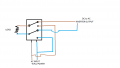
Like this Bob? I'm using 110V AC and don't think anymore than 3 Amps or so. Any other things I need to be aware of? In a typical scenario the device would never be powered by the inverter and then switched to the AC Power while it is live, or vice versa. In the event that did happen I'm thinking it would still be ok? Also when the relay switches position is there any risk of backfeeding in that split second? Something in particular I should look for in a relay? Here is the one I am planning to use: http://www.digikey.com/product-search/en?keywords=k10p-11at5-120
workstuff2.png
 

ian field

Joined Oct 27, 2012
6,536
Just plugged some of my project together and turned it on and had an immediate pop followed by smoke, great.

Here is the setup. I have a load that I want to either power with a 110V AC extension cord, or a 12VDC to 110V AC inverter. The way I have it wired is at the bottom. There is some more stuff to the circuit, but I think the problem here has to do with the AC Input and the Inverter Output being tied together? So this was the configuration, with the battery no connected to the system and thus the inverter not powered on. When I plugged the AC Input in there was a pop and some smoke. Have a made a mistake tying those together? If not I can elaborate on the rest of the circuit and see if the mistake is elsewhere.

Thanks!View attachment 116130
You need a DPDT relay that takes the load off the mains and puts it on the inverter when the mains drops out.

AFAIK: Most relays are break before make - but its probably worth checking the datasheet before connecting up.................
 

djsfantasi

Joined Apr 11, 2010
9,237
In addition to ian's comments, your load must be able to survive a brief interruption of power. Using a relay will have a small, but finite, period during which it will NOT have power. Your load's function must be able to survive this period without power. LEDs won't blink. A microprocessor might complain.
 

#12

Joined Nov 30, 2010
18,224
your load must be able to survive a brief interruption of power.
The specs on that relay show 10 ms break, 13 ms make. Each of those is less than 1 cycle of a 60 Hz wave.
It's a glitch, but not a big one. Watching the results will find whether it's going to be a problem.
 

ian field

Joined Oct 27, 2012
6,536
In addition to ian's comments, your load must be able to survive a brief interruption of power. Using a relay will have a small, but finite, period during which it will NOT have power. Your load's function must be able to survive this period without power. LEDs won't blink. A microprocessor might complain.
Anything with a mains transformer can spike if the current is interrupted at a random point on the sinewave.

An MOV directly across the primary is probably the easiest solution.

For some strange reason, I'm reminded of the Philips G11 chassis CTV - a "stock fault" was horizontal transistor failure at switch off. The repaired set would continue working for as long as you care to leave it running - switch it off, and next time you switch it on the H transistor is S/C.

There was a mains in series choke - not that many turns of fairly fat wire; so not a huge inductance. The fault was the 47R "Q-spoiler" resistor in parallel with the choke going O/C. Current interruption at switch off produced enough of a spike to kill the H-transistor.

When I was a kid; I discovered that some things blow if you keep flicking the switch, but things that blow with normal use switching on and off probably have an underlying fault.
 
Top