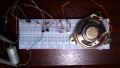
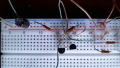
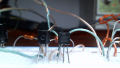
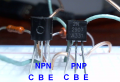
Don't see how.Сircuit below oscillates in reality,
See pictures:Don't see how.
The simulated transistors both have reverse polarity voltage applied to them.
Post your real circuit schematic.


That's a common misconception.here is a simple astable multivibrator that definitely works in real life but fails in LTSpice

For wide range of possible R1 value changes, without latching,Don't see how.
The simulated transistors both have reverse polarity voltage applied to them.
Post your real circuit schematic.

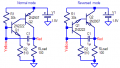
See:on board you have emitter of PNP transistor connected to +

Reverse mode is with the base and emitter interchanged.Therefore Q1 and Q2 used in reverse mode (β=2-3).
"Reverse-active (or inverse-active or inverted)Reverse mode is with the base and emitter interchanged.
Every transistor is reversed (collector and emitter interchanged).You had the NPN and PNP reversed.

LTspice does model BJT reverse mode operation.Seems reversed mode not detailed in LTspice BJT models...
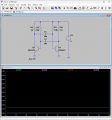
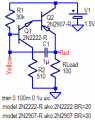
Some basic understanding in electronics would help.Сircuit below oscillates in reality, but not oscillates in LTspice simulation.
How to simulate such kind of circuits in LTspice?
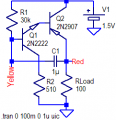
View attachment 311056
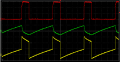
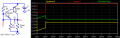
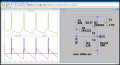
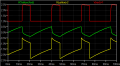
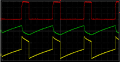
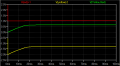
Oscillogram of real circuit:
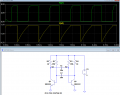
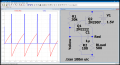
LTspice simulation:
What is the final SCH and values?Reverse β is set: BR=20 for Q1 and Q2.
Result: good coincidence.
the original schematic with adjusted Beta-reverse-factorWhat is the final SCH and values?
What is the final SCH and values?
So, values of parts and circuit itself can not be changed, by definition.Nobody answer my question - how to simulate this particular circuit?