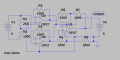
I designed and simualted an instrumentation amp circuit...but not getting the correct voltage difference between two points, the gain is set 1 (opamp has no negative voltage on its -ve supply):
A few things to note about op-amps and instrumentation amplifiers.
The OP27 has a minimum supply voltage of ±4V - that's 8V between Vcc and Vee, and a maximum supply voltage of ±22V.
Below ±4V it is likely to work a bit but not very well, above ±22V it will fail, and you will need to buy another one.
The common mode input range is from 2V above the negative supply to 2V below the positive supply. If inputs are within 2V of either supply it's not going to work.
The outputs will only get to ±12V on a ±15V supply, so they won't get within 3V of either supply.
The OP27 was really designed for audio - so generally amplifying signals to about 1V rms and running off ±15V supplies. If you are amplifying DC voltages, you still need the low offset, but features like rail-to-rail inputs and/or outputs will be more useful than the low noise.
When designing an instrumentation amplifier for DC voltages, pay particular attention to the voltages you expect at the outputs of the first two op-amps. It is easy to calculate values for the overall gain but not realise that you are expecting an impossible voltage from the output of the first stage.
It is working now i increased the power supply rails, increased the size of resistor for a bigger voltage drop....and now opamp produces fairly accurate results

 Facebook
 Google
 GitHub
 Linkedin