Solve a circuit using node voltage method

Status
Not open for further replies.

WBahn

Joined Mar 31, 2012
32,854
Remember how I have repeatedly tried to get you to check both your results and the sim results to see if they are consistent with the original problem?

So let's do that for the sim results.

What is the control current 'i' in the original circuit? It's the current flowing right to left in the 3 Ω resistor? Right?

So what is it?

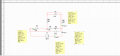
The voltage on the right of the resistor (Probe 1) is 0V. The voltage on the left of the resistor (ground) is 0 V.

So what is the current flowing through the resistor? ZERO!!!!

That means that the voltage across the depended source must be 0 V.

Is it?

Probe 4 = -155 V
Proble 3 = 2 V

So the voltage across the dependent source is 157 V.

Do you see the big red warning flag going up that something is wrong with your simulation??????

This would require that the current in the 3 Ω resistor is -17.44 A, which would require that the voltage at Probe 1 be -52.3 V, but your simulation says that it is 0 V.

Perhaps you might want to take a closer look at your simulation circuit compared to the problem circuit.

Here's a hint (again):

In the original circuit, the current that is controlling the dependent source is the current going THROUGH the 3 Ω resistor, right?

In your Multisim simulation, is the current that is controlling the dependent source going THROUGH the 3 Ω resistor?
 

MrAl

Joined Jun 17, 2014
13,707
Hi,

Yes there appears to be something wrong with that simulation.

What is that "9 ohm" where the ohm symbol is used, is that how they indicate the multiplication factor for the dependent source?

Do you have that dependent source connected properly?
 

Thread Starter

João Sampaio

Joined Jan 30, 2018
13
Hi,

Yes there appears to be something wrong with that simulation.

What is that "9 ohm" where the ohm symbol is used, is that how they indicate the multiplication factor for the dependent source?

Do you have that dependent source connected properly?
Yes, it is how they indicate the multiplication factor.
What i did is correct.
Thank you.
 

Attachments

Thread Starter

João Sampaio

Joined Jan 30, 2018
13
Remember how I have repeatedly tried to get you to check both your results and the sim results to see if they are consistent with the original problem?

So let's do that for the sim results.

What is the control current 'i' in the original circuit? It's the current flowing right to left in the 3 Ω resistor? Right?

So what is it?

The voltage on the right of the resistor (Probe 1) is 0V. The voltage on the left of the resistor (ground) is 0 V.

So what is the current flowing through the resistor? ZERO!!!!

That means that the voltage across the depended source must be 0 V.

Is it?

Probe 4 = -155 V
Proble 3 = 2 V

So the voltage across the dependent source is 157 V.

Do you see the big red warning flag going up that something is wrong with your simulation??????

This would require that the current in the 3 Ω resistor is -17.44 A, which would require that the voltage at Probe 1 be -52.3 V, but your simulation says that it is 0 V.

Perhaps you might want to take a closer look at your simulation circuit compared to the problem circuit.

Here's a hint (again):

In the original circuit, the current that is controlling the dependent source is the current going THROUGH the 3 Ω resistor, right?

In your Multisim simulation, is the current that is controlling the dependent source going THROUGH the 3 Ω resistor?

I was not worried with my simulation, i was worried about what i wrote.
I had the feeling that something was wrong in the simulation, and i saw that u3=0v and i put my reference node in that place to know the voltage in the node 3. But i always tested my circuits like that and i don't know enough about circuits to be sure that a program like multisim isn't correct!
All i wanted was a solving or someone to tell me if i was right or wrong.
 

WBahn

Joined Mar 31, 2012
32,854
Hi,

Yes there appears to be something wrong with that simulation.

What is that "9 ohm" where the ohm symbol is used, is that how they indicate the multiplication factor for the dependent source?
The original problem is sloppy with the units on the dependent source (pretty common). The output of the source if 9 V per 1 A of current in the control node, so the coefficient is 9 V/A which is 9 Ω. That's why a current controlled-voltage source is also known as a transimpedance amplifier (and a voltage-controlled current source is known as a transconductance amplifier).

Do you have that dependent source connected properly?
No. The current controlling the voltage source is NOT the current going through the 3 Ω resistor (in the original simulation set up). He's hooked it up so that it shorts out the 3 Ω resistor, which is why it has 0 V across it and no current through it.
 

MrAl

Joined Jun 17, 2014
13,707
The original problem is sloppy with the units on the dependent source (pretty common). The output of the source if 9 V per 1 A of current in the control node, so the coefficient is 9 V/A which is 9 Ω. That's why a current controlled-voltage source is also known as a transimpedance amplifier (and a voltage-controlled current source is known as a transconductance amplifier).


No. The current controlling the voltage source is NOT the current going through the 3 Ω resistor (in the original simulation set up). He's hooked it up so that it shorts out the 3 Ω resistor, which is why it has 0 V across it and no current through it.
Hi,

Yes i am not familiar with that simulator so the symbols are rather strange to me, but i did pick up on that current controlled source, which was not correctly wired up or something. The results also did not agree with my results after going over them a few times so i knew something was wrong with the simulation.
 

WBahn

Joined Mar 31, 2012
32,854
I was not worried with my simulation, i was worried about what i wrote.
This is a common fallacy -- people accept whatever a computer tells them as being correct. But garbage in, garbage out.

I had the feeling that something was wrong in the simulation, and i saw that u3=0v and i put my reference node in that place to know the voltage in the node 3. But i always tested my circuits like that and i don't know enough about circuits to be sure that a program like multisim isn't correct!
Multisim WAS correct! It gave you correct results for the circuit YOU gave it. The fact that the circuit you gave it didn't match the one you were trying to solve is NOT Multisim's fault.

This is why you need to start learning how to check your own work.

All i wanted was a solving or someone to tell me if i was right or wrong.
Having someone check it for you and tell you if you are right or wrong is not addressing the problem that needs to be addressed -- YOU need to develop those skills. You aren't going to have someone to do that for you on an exam and you usually aren't going to have someone to do that for you out in the real world -- if they could find the answer themselves they wouldn't need to be paying you.

You are already WAY past the point that you should be able to do that; you should have started developing those skills when the entire world consisted of circuits containing a single battery and series/parallel combinations of resistors. So you need to play some catch up.

You should immediately get in the habit of checking EVERY answer you get to verify whether or not it is correct (and I do NOT mean by running to a simulator). IF you will do that, I can almost guarantee you that you will see your grades go up considerably.
 

Thread Starter

João Sampaio

Joined Jan 30, 2018
13
The original problem is sloppy with the units on the dependent source (pretty common). The output of the source if 9 V per 1 A of current in the control node, so the coefficient is 9 V/A which is 9 Ω. That's why a current controlled-voltage source is also known as a transimpedance amplifier (and a voltage-controlled current source is known as a transconductance amplifier).


No. The current controlling the voltage source is NOT the current going through the 3 Ω resistor (in the original simulation set up). He's hooked it up so that it shorts out the 3 Ω resistor, which is why it has 0 V across it and no current through it.
It works both ways. Don't know how, but it does. I tested circuits that i solved in the classes and in none of them it shorted the components.
And when i first tried to mount circuits with dependent sources i found information with both ways. And finally, yesterday i tried like i did today and results were differents to.
But one more time, it wasn't about the simulation.
 

WBahn

Joined Mar 31, 2012
32,854
It works both ways. Don't know how, but it does. I tested circuits that i solved in the classes and in none of them it shorted the components.
And when i first tried to mount circuits with dependent sources i found information with both ways. And finally, yesterday i tried like i did today and results were differents to.
But one more time, it wasn't about the simulation.
If it wasn't about the simulation, then help me understand what you meant when you said, "but the results don't match with the results that i got in multisim so i want to see someone solving the circuit in order to understand what i did wrong."

You got the right answer (namely V3 = -130.5 V). But this didn't match the results you got in Multisum (namely 0 V). You also had an annotation that Multisim showed a current of 17.4 A while your results were 43.5 A (which is the correct answer). But, even though you got the right answers, you wanted someone to help you understand what you did wrong.

What you did wrong was set up the simulation improperly and then fail to ask whether the simulation results made sense. It's ALL about the simulation!
 

Thread Starter

João Sampaio

Joined Jan 30, 2018
13
If it wasn't about the simulation, then help me understand what you meant when you said, "but the results don't match with the results that i got in multisim so i want to see someone solving the circuit in order to understand what i did wrong."

You got the right answer (namely V3 = -130.5 V). But this didn't match the results you got in Multisum (namely 0 V). You also had an annotation that Multisim showed a current of 17.4 A while your results were 43.5 A (which is the correct answer). But, even though you got the right answers, you wanted someone to help you understand what you did wrong.

What you did wrong was set up the simulation improperly and then fail to ask whether the simulation results made sense. It's ALL about the simulation!
i wanted to see a solution in first place. i put here the circuit and asked if someone could solve it.
"Your freedom ends when mine begin."
you didn't want to solve it so you shouldn't have bothered me.
About the other things you said about work and stuff, who do you think you are? It's your opinion and it doesn't mean that i have to considerer it.
I just asked what i asked and thats all.
I'll apreciate this conversation ends.
 
Last edited:
Status
Not open for further replies.
Top