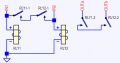
Solution to take two inputs and trigger output when both are active and stay triggered.

Thread Starter

GForce2010

Joined Dec 25, 2010
3
Basically I have a project where I need to short two wires based on a couple on inputs.

Both the inputs are 12v DC.

I need the wires to be shorted only when both the inputs go live, once it's shorter I need it to remain shorted until both inputs drop to 0v.

I've done some research and seen some info suggesting I might be able to do this with a couple of relays but I'm struggle to find any schematics and I also can't workout how they would be wired up myself, assuming this could work.

Can anyone advise if I am on the right track and if so help me out with a basic schematic?

Thanks.
 

Thread Starter

GForce2010

Joined Dec 25, 2010
3
AND gate with an SSR (Solid State Relay)
Please correct me if I'm wrong but that would work in the aspect of needing both inputs to be live to trigger but wouldn't the output switch off as soon as one of the outputs drops to 0 rather than staying triggered until both outputs drop to 0?
 

Ramussons

Joined May 3, 2013
1,567
Please correct me if I'm wrong but that would work in the aspect of needing both inputs to be live to trigger but wouldn't the output switch off as soon as one of the outputs drops to 0 rather than staying triggered until both outputs drop to 0?
You need a S R Flip Flop, the S from a AND gate and the R from a a NOR gate.
 
When the wire goes to zero does it have some impedance (load) or is it floated?

Btw, After connecting the wires (both 12V) you are not able to detect voltage, just current, because both will measure 12V.
 

Thread Starter

GForce2010

Joined Dec 25, 2010
3
Typically after making this post I went back to the circuit simulator and finally managed to get my head round it and came up with a solution using a few small relays.

Thanks.
 

crutschow

Joined Mar 14, 2008
38,321
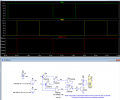
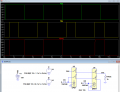
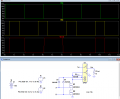
Below is the LTspice sim of a circuit that should do what you want, using two CMOS NOR-gate packages, and only one relay.
Note that the relay is turned on (red trace coil current) to provide the short when the two A and B inputs go high, and is turned off only when both when both go low.

1728603606401.png
 
Last edited:

crutschow

Joined Mar 14, 2008
38,321
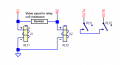
Danko's circuit is elegant and simple, so its operation should be fairly obvious, but below is its LTspice sim for your (and my) amusement:
So both relays close (red trace) when both inputs go high, and don't open until both inputs go low.

1728660527320.png
 
Last edited:

MisterBill2

Joined Jan 23, 2018
27,181
Danko's circuit is elegant and simple, so its operation should be fairly obvious, but below is its LTspice sim for your (and my) amusement:
So both relays close (red trace) when both inputs go high, and don't open until both inputs go low.

View attachment 333513
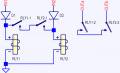
The circuit in post #13 will do it! To connect the controlled will require both A AND B =12 volts. THEN, to stay connected, either A OR B= 12 volts. And the relays only need to be DPST. That is each relay needs to have two sets of normally open contacts.
Now I need to discover a way to simplify the circuit.
It could be done with a single relay that had a lower drop out voltage: Feed both A AND B to the coil thru a diode and a resistor. The resistor will need to drop the voltage enough so that the relay will not operate, but it would stay closed if both A AND B provided enough current to operate the relay. So there is a scheme to do it with only one SPST relay, but it depends on the supply voltage always being 12.0 volts, and the relay having a drop out voltage below six volts and being able to operate at some higher voltage that I have not discovered yet.
 

Tonyr1084

Joined Sep 24, 2015
9,744
Once triggered, how do you propose to DE-Trigger the circuit? Every "ON" must have an equal and opposite "OFF". Otherwise, once ON it's ON for life. Or until the battery runs down.

AH! Batteries. Important question; how are you holding your relays triggered? Battery? If so - depending on the size of the battery your power source will be short lived. If you use a small 12V battery and power two relays for several hours you could be draining your battery to the point where the relays drop out on their own. IF you're using a plug in power source you don't have that issue. But you still have the question of how you shut it down when you want it off. Otherwise two SPDT relays can do the trick - assuming what you're switching (shorting as you spoke) is the same voltage as the control voltage.

Relays have two basic factors: Control coil voltage (AC or DC as well as proper voltage coil) AND the voltage and current that is being switched. If you get a relay with a contact rated for 120VAC @ 10A and try to use it to run a 12VDC 10A system - you'll have smoke. You'll need the RIGHT relay for the job. IF you use a relay at all.

An SPDT relay with a single "Two Input AND Gate" can switch a relay on via a transistor. But again there's that question; how do you shut it off? I'll bang out a diagram of an SPDT relay shortly.
 

Tonyr1084

Joined Sep 24, 2015
9,744
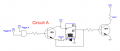
Circuit A uses a feedback from the relay to hold itself on. That feedback is broken by the RESET button.
Screenshot 2024-10-12 at 2.30.48 PM.png
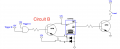
Circuit B uses a Latching Relay. Once energized it holds its set (or reset) even after power has been removed. The reset button is used to RESET the circuit.
Screenshot 2024-10-12 at 2.23.17 PM.png
The diodes are to snub the Back EMF, which otherwise would blow the first transistor out. Second transistor does not need protection from BEMF.

Only when Trigger A & B are simultaneously high (ON) the first transistor will activate the relay. In both diagrams A & B the reset button is used to cancel the output to the second transistor. Sorry, I forgot to label them Q1 & Q2. Q1 is the left transistor in both diagrams.

No values or component numbers were given because I don't know what voltage you're planning on for each part of the circuit. I went with 12V. I assumed DC voltage.
 

MisterBill2

Joined Jan 23, 2018
27,181
The requested operation was to trigger with the AND operation then to hold with the OR operation, and to release with a NAND function. The first double relay circuit did all that.
The circuits with the And gate plus the transistors will require a lot more space and be a lot more complex. Also, they demand a separate reset button.
My single relay concept would be a bit tricky to implement but the theory is sound, while possibly the realization may be a challenge. Packaging in a durable manner is always a requirement.
 

crutschow

Joined Mar 14, 2008
38,321
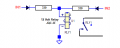
For your amusement, another single relay circuit using two three diodes and two small MOSFETS, that applies nearly full coil voltage, so doesn't depend upon the relay control voltage characteristics:
The cost of the electronics is likely much less than the cost of another relay.

Edit: Forgot to add the transient suppression diode, D6.

1728835358001.png
 
Last edited:

Tonyr1084

Joined Sep 24, 2015
9,744
Basically I have a project where I need to short two wires based on a couple on inputs.
I need the wires to be shorted only when both the inputs go live, once it's shorter I need it to remain shorted until both inputs drop to 0v.
Please correct me if I'm wrong but that would work in the aspect of needing both inputs to be live to trigger but wouldn't the output switch off as soon as one of the outputs drops to 0 rather than staying triggered until both outputs drop to 0?
Bold - mine
Sounds like a concern that when inputs A & B go low (or either one of two go low) the output (the relay that closes a switch) would drop out. I got the gist that the output should remain on even after A & B have gone off.

There is a measure of vaguery here. I'm assuming by "Short" the TS means the closing of a switch. "Outputs" has me confused. It takes an input to get an output. OR vice versa, depending on what you build.
The circuits with the And gate plus the transistors will require a lot more space and be a lot more complex. Also, they demand a separate reset button.
My single relay concept would be a bit tricky to implement but the theory is sound, while possibly the realization may be a challenge. Packaging in a durable manner is always a requirement.
Bold - mine.
Sorry, I didn't see a drawing. Even if you can't draw on the computer, pencil, paper and a cell phone camera will upload a picture so we can see what you're talking about.

Me? In school I hated reading. If the book didn't have pictures I was lost. My disdain for reading is the reason why I haven't gone further in understanding electronics. Pictures work for me.

Bill said: The circuits with the And gate plus the transistors will require a lot more space and be a lot more complex. Did I miss where size was a requirement? What are you seeing that I'm missing?

Also, in the requirements I didn't see any mention of need to have the system shut down at some given point. That's why I added a push button to open (remove) power from the relay, causing it to drop out, opening (un-shorting) or shutting down the load.
 
Last edited:
Top