Solid State Switch with High Off-State Isolation

Thread Starter

PIC-User

Joined Sep 25, 2015
104
Hi all,

I have a project where I need to switch on and off a sinusoidal wave of ~ 4Vpp, 150mA, 13.5MHz. My project works great with relays, but we all know that relays don't last too long. I've been banging my head against the wall trying to find a suitable solid-state switch that works for my project.

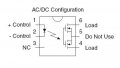
I have tried the LCA110, ASSR-1228, PR22MA11NTZ, and some other chips that use MOSFETs and TRIACs. They just won't work because in the off-state instead of getting 0V at the output port, they all leak from 300mVpp to 800mVpp of the input signal. Obviously, I don't have this problem with a relay, but I can't find a switch or analog multiplexer to make this circuit work?

Does anybody have any ideas of what I might be doing wrong? Any chips that you might recommend? Any ideas or suggestions are highly appreciated.

Thank you,

Robert
 

cmartinez

Joined Jan 17, 2007
8,737
If, as you say, your signal is sinusoidal, and this signal is AC, and you've been trying to control it with a single mosfet, then what's happening is that half the wave of that signal is leaking through the mosfet's intrinsic diode.

You need to use a couple of mosfets connected back to back to get complete isolation and for things to work properly.

a.JPG
 

cmartinez

Joined Jan 17, 2007
8,737
Hi,

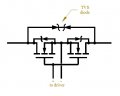
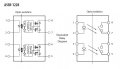
The LCA110 uses two MOSFETs back to back. Please, see the attached picture.
It's datasheet says that it can handle only up to 120 mA, and you say you've been trying to run it at 150 mA. Also, I find its on resistance quite high, at 35 ohms, and its on state leakage current is 1 µA. Its switching speed is also extremely slow, that is 3 ms.
Maybe you should try doing what you want with discrete components instead.
 

Thread Starter

PIC-User

Joined Sep 25, 2015
104
During the On-State the circuit works fine. The problem comes with the Off-State that is not shutting down the output like it is suppose to. A switching speed of 3ms is not really a problem for my application.
 

crutschow

Joined Mar 14, 2008
38,389
To get high isolation at 13.5MHz can be a problem.
One solution may be to use a series-shunt switch arrangement, one in series and one at the output connected to ground.
To stop the signal you turn off the series switch and turn on the shunt switch to ground. The second relay shorts to ground most of the signal leaking through the series switch.

What is the maximum feed-through that you can tolerate across the load?
What is the load impedance?
 

AnalogKid

Joined Aug 1, 2013
12,080
Video crosspoint switches of approx. this bandwidth use L or T pad configurations. Very high off isolation is achieved by turning off a series element and turning on a shunt element. The IC parts probably are not rated for your current level, but the technique should work.

And if the body diode were going into forward conduction, the off state output would be much larger than 800 mV. My guess is that the output voltage is coming from capacitance leakage paths. Can you put 100 kHz through the circuits you have now and see if the leakage is less?

Also, is there any DC level associated with the signal?

ak
 
Last edited:

Thread Starter

PIC-User

Joined Sep 25, 2015
104
No, there is no DC level associated with the signal. It is an antenna signal feeding a few coil antennas one at a time. The coils have an inductance of ~1.8uH. It works great with just relays, but somehow I can't make these MOSFETs work. I suspect it is a simple thing, but I just can't figure it out.

Again, the On-State works fine. It just won't open the circuit in the Off-State

I will follow your advice to use discrete components, but I don't have any discrete MOSFETs handy. I need to order them from Mouser.com. In the meantime I'm stuck with the solid state switches that I have until I get my discrete MOSFETs.

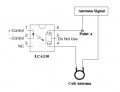
In the attached picture I'm showing you what I'm trying to do with a LCA110. Strangely enough when I put an oscilloscope between point A and ground the switch works fine :confused::confused::confused:. Hmm, this is driving me insane. Any suggestions?????

Robert

LCA110.JPG
 

Lestraveled

Joined May 19, 2014
1,946
Well it appears that you are getting exactly what you should be getting with the LCA110. It is not designed for switching RF. A simple parameter is input to output capacitance. At 13.5 MHz, 3 pF has an Xc of 4K. This alone accounts for a large part of the leakage you are experiencing. I suggest that you look at minicircuits http://www.minicircuits.com/homepage/homepage.html for some good cheap RF switches.
 

Tesla23

Joined May 10, 2009
558
No, there is no DC level associated with the signal. It is an antenna signal feeding a few coil antennas one at a time. The coils have an inductance of ~1.8uH. It works great with just relays, but somehow I can't make these MOSFETs work. I suspect it is a simple thing, but I just can't figure it out.

Again, the On-State works fine. It just won't open the circuit in the Off-State

I will follow your advice to use discrete components, but I don't have any discrete MOSFETs handy. I need to order them from Mouser.com. In the meantime I'm stuck with the solid state switches that I have until I get my discrete MOSFETs.

In the attached picture I'm showing you what I'm trying to do with a LCA110. Strangely enough when I put an oscilloscope between point A and ground the switch works fine :confused::confused::confused:. Hmm, this is driving me insane. Any suggestions?????

Robert

View attachment 92068
One problem is that the output capacitance of the switch (25pF) plus the feedthrough capacitance of 3pF resonates with your 1.8uH antenna at 22MHz which is getting close to your 13.5MHz. Simply modelling the switch in the OFF state as a 3pF series cap and a shunt 25pF cap suggests you will get 244mV at the antenna from 4V source. These capacitances are only estimates and don't include strays. Your oscilloscope probe could be de-tuning the resonance and if that gets you in spec then try adding fixed capacitors. Alternatively you could add a shunt switch that shorts the antenna when the other one is open, or as Lestraveled says, use an RF switch. If these are cheap, use three in a T-configuration, the two series ones open and close as you would expect, and the shunt one is closed when the other two are open.
 

Alec_t

Joined Sep 17, 2013
15,112
If you could tolerate a DC bias current of about half the RMS coil current then s simple diode switch might work, like this :-
RFswitch.PNG
 

Thread Starter

PIC-User

Joined Sep 25, 2015
104
I'll try to switch the signal with a T configuration, 3-MOSFETs, like somebody suggested above. I hope that that works. They have some RF MOSFETs that come with two Gates. Does anybody have any experience with these double gate MOSFETs?

Any other ideas? I looked at the PIN diodes, but they don't have a good off-isolation.
 

Thread Starter

PIC-User

Joined Sep 25, 2015
104
Hi, Lestraveled. Thank you for your input. I checked the minicircuit website, but the chips are expensive (I will need like 16) and they come in a 2x2 mm package with a bunch of pins and connections that makes it almost impossible to work out a prototype out of it. Yes, I know they have evaluation boards but I would need to get like 16 of them :(. Also, I need chips or components that can be easily obtained overseas if I need to assemble a few boards overseas.

Ideally, it would be great to get a 1:8 multiplexing switch. If I can get a chip that comes in different packages with a breadboard friendly package for prototyping would be good. They have some RF MOSFETs in Mouser.com and I think I'm going to give them a try.

Thank you,

Robert
 

Thread Starter

PIC-User

Joined Sep 25, 2015
104
Lestraveled, thank you for your ideas. I have a chip similar to the 74HC4066, the CD4066B and they don't work. I'll check the DG509.

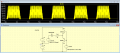
Actually I found a chip that works, the ASSR-1228. :)

ASSR-1228.JPG

The datasheet doesn't say much about the "Turn-Off Circuit" part of the chip. I have to do some research about it. I'll try to find this chip without the optocoupling part. Does anybody have seen this type of circuitry before?
 
Top