Soldering problem - upgrade.... but to what?

dl324

Joined Mar 30, 2015
18,326
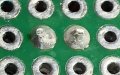
The solder is repelled!
Repelled from what? The iron or what you're trying to solder?

In either case, it may be that the surface needs to be cleaned.

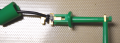
When I try to solder things like this:
upload_2019-4-3_10-29-47.png
I find that a tiny drop of flux spread on the grabber connection makes it significantly easier and faster to form the joint.
 

Ya’akov

Joined Jan 27, 2019
10,234
I don't like lead free solder, and as a rule, I don't use it. But, for the sake of a test, I soldered this LED using some to check the performance of my Kester 951 flux. I used a flux pen to apply it to the board, after I removed as much of the tinning from the protoboard as I could, and retinning those pads.

I used normal leaded technique, with the iron set to 350°C, which is what I use for leaded solder.

This is the result, very ugly to my eye but electrically and mechanically sound and with a nice meniscus as desired. I am sure part of the reason is the iron.

Sorry about the poor quality of the photo, but I think it shows the connection.

fullsizeoutput_ca7.jpeg
 

Thread Starter

d-rainger

Joined Jun 9, 2016
23
The solder is repelled from the tip (which can have some black carbon on it), but not from the job - once the iron has heated it up, the solder goes on good.
We use flux and wire-wool type of cleaning thing on the tip - but not really wet sponge....
I think I just have to do a lot more soldering, every day.... These were new tips though!
 

Ya’akov

Joined Jan 27, 2019
10,234
The solder is repelled from the tip (which can have some black carbon on it), but not from the job - once the iron has heated it up, the solder goes on good.
We use flux and wire-wool type of cleaning thing on the tip - but not really wet sponge....
I think I just have to do a lot more soldering, every day.... These were new tips though!
The quality of the tips can be quite variable. The tip must be tinned with the solder you intend to use. You can also get lead free tip cleaner, which is usually sal ammoniac with particles of solder in it. It will clean a great deal of oxifdation. Wet sponges are not the best idea for irons since they cause thermal shock and reduce the plating life.

A better quality iron and tip really should help a lot. Best to get one that uses integrated heaters. The FX-951 that I use has “sleep” mode where the temperature is set back to reduce tip damage from constant heating, At 350°C set point, it can be left on nearly continuosly without damage.
 

dl324

Joined Mar 30, 2015
18,326
The solder is repelled from the tip (which can have some black carbon on it), but not from the job - once the iron has heated it up, the solder goes on good.
If you can't tin the tip, then it's bad. If a new one does the same thing, it's poor quality.

I use a Weller WTCP that's over 40 years old (with a new heater this year). The tip I'm using is also over 40 years old, but I've heard that the tips being manufactured now aren't as good.
 

MisterBill2

Joined Jan 23, 2018
27,501
Many suppliers of electronic kits deny any warranty service for any item soldered with an iron cleaned with sal ammoniac. So I recommend avoiding it for anything electrical. Removing every trace of a corrosive flux can be quite a production challenge. And the damage done by corrosive flux musty be seen to be believed.
 

Ya’akov

Joined Jan 27, 2019
10,234
Many suppliers of electronic kits deny any warranty service for any item soldered with an iron cleaned with sal ammoniac. So I recommend avoiding it for anything electrical. Removing every trace of a corrosive flux can be quite a production challenge. And the damage done by corrosive flux musty be seen to be believed.
I trust the Hakko tip cleaner to be appropriate. It cleans easily, and it has tinning alloy built-in. I clean and re-tin after that, with the solder I will be using. I don't suggest formulating your own tip cleaner, but buying a commercial one. It is only needed very occasionally.

https://www.amazon.com/gp/product/B0195V52J8/
 

MisterBill2

Joined Jan 23, 2018
27,501
The equipment that my organization produced had to be reliable, so we used regular tin-lead solder. The instruments were for industrial and laboratory use, they were never consumer junk, to be discarded and replaced every few weeks, and most of them are still in service almost 20 years later. Our product was too expensive to just discard, and it was designed to be repairable when things wore out.
Even today, equipment that must have reliable connections is produced with tin-lead solder, but that fact is not made public.
 

MisterBill2

Joined Jan 23, 2018
27,501
I believe the EU has banned leaded solder in most products (RoHS).. I'm former US military... more lead the better... :D
My point exactly! If you ever study the string of wrong information that lead to the ban it becomes clear that all of the decisions were based on the emotions of a fearful collection of uninformed people. And the reduction in the reliability of consumer electronics items that resulted has increased the rate of electronic waster production. So the secondary results are certainly not what the fools actually wanted.
 

be80be

Joined Jul 5, 2008
2,395
This whole thing sounds like the iron is way to hot.
If your tip is burning up the solder and turning black it's way to hot
 

MisterBill2

Joined Jan 23, 2018
27,501
This whole thing sounds like the iron is way to hot.
If your tip is burning up the solder and turning black it's way to hot
Quite possibly the iron is too hot, but the lead-free solder does require a higher temperature to flow. So there is a challenge between warm up time to soldering temp and burning up time.
 

dl324

Joined Mar 30, 2015
18,326
the secondary results are certainly not what the fools actually wanted.
Their hearts were in the right place, but their heads weren't...

Tin whiskers were a known phenomenon well before the EU existed and lead was the solution.

Who knows how much harm they've caused by their shortsightedness?
 

Ya’akov

Joined Jan 27, 2019
10,234
Maybe.... But these irons are not temperature-adjustable. Just plug them in.
The black that forms on the tip is not the solder, it’s burnt flux and bad plating. Better tips have better plating and last far longer even at higher temperatures.

We’re you planning to buy a better iron?
 

MisterBill2

Joined Jan 23, 2018
27,501
To control soldering iron temperature a very simple arrangement can be made using a double-wide electrical junction box, a standard outlet, an inexpensive dimmer, and an electrical cord with a plug on the end. One connection of the dimmer goes to the black wire of the cord, the other connection from the dimmer goes to the line side of the outlet, the one with the shorter slot / brass screw, or other marking. The white wire from the cord goes to the neutral side of the outlet, longer slot or plain screw, the opposite side from the dimmer in any case. Now the dimmer can control the power to the soldering iron plugged into the outlet. Both the dimmer and the outlet must be installed in the outlet box, with the green wire from the cord connected to the ground terminal on the outlet. Do not connect the the line cord to the mains until the dimmer and outlet are installed in the box.
If these instructions are too complicated then please forget them and do not attempt this project.
 

MisterBill2

Joined Jan 23, 2018
27,501
Jeeze I always get nervous instructing people with mains power projects... I won't even touch the relay ones...
Nothing to be nervous about with this project because all of the building is done with the power not only OFF, but not even connected. In addition, once it is completed there is no access to any of the live wires. Besides that, review tat last sentence. It reminds folks that if the project seems to complicated for them, to just forget it.
 

MisterBill2

Joined Jan 23, 2018
27,501
That costs more than my cost to build what I described would cost. AND I find the advertised specifications rather hard to believe. In addition, the travel to a Harbor Freight store "near me" would be quite a trip. My instructions will work for almost any part of the world. You will probably not find a Harbor Freight store in central Thailand, as an example.
 
Top