Solder won't take to PCB pad

Thread Starter

Domarius

Joined Sep 1, 2013
62
A friend's video card (MSi 1080) has has a capacitor just pop off, so I'm attempting to fix it - as I feared, the capacitor next to it popped off as well, after only a slight nudge during examination, I figure it's some kind of manufacturing flaw. Here's a photo I found of the exact PCB with all the heatsinks removed, I can take a photo of mine as it is if it helps:


My main issue is, no matter what I try, I cannot get the solder to adhere to the pad on the PCB. The remaining solder would not melt, and I'm afraid to overheat the PCB. I've already made this mistake on a test board, using the heat gun functionality of my Dremel butane fuled soldering iron, I got a test board specifically so I could make these mistakes, I bubbled the board in one instance, and cooked the components in another case. So for the actual video card, I'm trying not to spend too long on any one area, I don't want to damage it.

Since I couldn't get the existing solder to melt, I gently scraped it off, hoping to bare the original metal pad, though I can see the copper in some spots, so hopefully didn't scrape too far. I did some research and looks like they use special solder paste and cook the board, which would explain the grainy consistency of the existing solder, maybe that's why I couldn't melt it?

Every time I apply a soldering iron to get a bit of solder to adhere to the pad, it just beads. The solder melts and never bonds to the boards, it just forms little beads on the soldering iron tip. I even dared tried using the heat gun functionality for a bit, and the solder beaded again, just sitting on the pad.

I'm using plenty of flux paste to improve the surface area of the heating.

I'm at a loss as to how to get this solder to take, if I could, I could do the technique I saw on YouTube where you put a blob down on one pad, put the component on that blob, melt that foot into place, then solder the other foot down. But I can't get that far.
 
Last edited:

dl324

Joined Mar 30, 2015
18,326
Every time I apply a soldering iron to get a bit of solder to adhere to the pad, it just beads.
Could be a couple of things. You're just melting solder and not heating the pad. Or the pad has some residue on it. You can use liquid flux for the latter.
 

Ya’akov

Joined Jan 27, 2019
10,234
Welcome to AAC.

At a guess, you have a large copper flood in the area you are trying to solder. This would be for a ground plane and/or a way to dissipate heat from some nearby(ish) components such as voltage regulators.

If this is the case the problem is that your soldering iron can't produce enough heat to get the local spot hot enough before the heat is carried off by the flood. You can preheat the board so that the cooling capacity of the flood is eliminated. You need an appropriate hot plate.

The idea is to heat up the board below the point of causing any damage but hot enough that your iron can add enough heat locally to make the solder joint. You can almost certainly find some YouTube videos on the technique.
 

Thread Starter

Domarius

Joined Sep 1, 2013
62
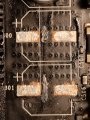
How about a photo of the pad you cannot solder to?
Yes that's a sensible idea, and I just got set up to give you some clear photos.

In the close up you can see the 4 pads which I scraped away the existing solder
IMG_20240822_095758.jpg

The translucent globs in the middle are where I put nail polish to cover up some minor exposure of the copper during my scraping. I noticed the groove running vertically between the opposing pads and figured that might be an air gap between opposing polarity and I didn't want it to arc.

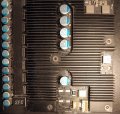
Here's a more zoomed out view for some context.

IMG_20240822_095858.jpg
 
Last edited:

Thread Starter

Domarius

Joined Sep 1, 2013
62
Welcome to AAC.

At a guess, you have a large copper flood in the area you are trying to solder. This would be for a ground plane and/or a way to dissipate heat from some nearby(ish) components such as voltage regulators.

If this is the case the problem is that your soldering iron can't produce enough heat to get the local spot hot enough before the heat is carried off by the flood. You can preheat the board so that the cooling capacity of the flood is eliminated. You need an appropriate hot plate.

The idea is to heat up the board below the point of causing any damage but hot enough that your iron can add enough heat locally to make the solder joint. You can almost certainly find some YouTube videos on the technique.
Thank you - well darn it, if I'd known that I wouldn't have done the scraping, since it may have been possible to heat up the existing solder after all. I will look into this.
 

BobTPH

Joined Jun 5, 2013
11,514
The translucent globs in the middle are where I put nail polish to cover up some minor exposure of the copper during my scraping.
You want the copper exposed! Don’t cover it with nail polish. No wonder your solder does not bond.

To remove old solder from a pad, use copper braid, you place it over the solder and heat it and it wicks off the molten solder. It will leave a thin coating of solder, which actually makes it easire to add new solder.
 

Alec_t

Joined Sep 17, 2013
15,117
There are a lot of vias near those pads, presumbly connecting to a ground plane below. If so, that would suck a lot of heat away from where you are trying to solder.
 

MrChips

Joined Oct 2, 2009
34,807
You are connecting to power and ground planes which are huge heat sinks. You need to heat up the entire board and then use a more powerful soldering iron.
 

Thread Starter

Domarius

Joined Sep 1, 2013
62
You want the copper exposed! Don’t cover it with nail polish. No wonder your solder does not bond.

To remove old solder from a pad, use copper braid, you place it over the solder and heat it and it wicks off the molten solder. It will leave a thin coating of solder, which actually makes it easire to add new solder.
It's ok, I'm referring to the vertical scratches / white glops in the MIDDLE between the pads, not ON the pads.
 

Thread Starter

Domarius

Joined Sep 1, 2013
62
You are connecting to power and ground planes which are huge heat sinks. You need to heat up the entire board and then use a more powerful soldering iron.
Ok then I am plum outta luck then...

But, as a last ditch effort, I bought some conductive adhesive, but I'm not having any luck getting it to dry properly, it just flakes away on my test board, even after leaving it overnight and not touching it till the next day. On a 2nd test I tried heating it and it just melted away, and that was confirmed by the seller, they said not to heat it just let it dry. My current theory is perhaps it just the initial squeeze which is very runny, maybe if I keep squeezing more out of the syringe it will get to some more solid paste... I'm just being frugal with it since there isn't a lot. Does anyone have any experience with conductive adhesive? This is the one I bought:

https://a.aliexpress.com/_mKoCJHI
 
Last edited:

Ya’akov

Joined Jan 27, 2019
10,234
Ok then I am plum outta luck then...

But, as a last ditch effort, I bought some conductive adhesive, but I'm not having any luck getting it to dry properly, it just flakes away on my test board, even after leaving it overnight and not touching it till the next day. On a 2nd test I tried heating it and it just melted away, and that was confirmed by the seller, they said not to heat it just let it dry. My current theory is perhaps it just the initial squeeze which is very runny, maybe if I keep squeezing more out of the syringe it will get to some more solid paste... I'm just being frugal with it since there isn't a lot. Does anyone have any experience with conductive adhesive? This is the one I bought:

https://a.aliexpress.com/_mKoCJHI
NOTE: All links below are to very low cost options that should be “good enough” to do the job. They are very cheap and so will not be the best, and I would expect to be less durable, but should suffice for this repair and be usable for a while.

This is not a solution. It is very unlikely to work at all and certain not to work for very long if ever. Consider why you are fixing it. Presumably even the manufacturers soldering didn’t hold the part on the board, what chance does a dodgy adhesive have?

A hot plate and an iron with high output and good temperature regulation is the way to fix it. You should also get some tacky flux and use eutectic lead solder (63Sn/37Pb).

If a hot plate is impractical because of components on the reverse side of the board then hot air using a temperature controlled hot air tool can be used. The idea is to heat the board below the solder melting point but well above ambient in the area of the rework being done.

This reduces its capacity to dissipate the heat from the iron and allows the local area around where you are soldering to heat enough to form a solder joint. This is why a relatively high output iron is needed.

You will first tin the pads you scraped clean of solder, leaving a small, properly soldered “hump” of solder (projecting maybe .5mm). To do this apply some of the tacky flux to the area. You can be generous since the flux is designed to be board safe and technically you don’t have to clean it off. In practice some isopropyl alcohol will take care of the messy bits.

After successfully tinning the pads, you will apply more flux and place the part on the pads. The flux will keep it positioned but once you heat it, it will be easy to shift so you should carefully hold the part down with a small probe or screwdriver applying the force as close to perpendicular to the PCB as possible. You don’t have to push hard, just enough so that your soldering iron doesn’t move it.

In contravention of the normal rules of applying the solder to the joint you will want to put a small amount of solder on the tip. The solder on the tip will serve to dramatically increase thermal conductivity. The tip/solder should be positioned along one edge of the part’s lead, and the solder should flow off the tip and under the lead joining the bump you created.

The tip should be the biggest one that will fit in the spot so it can have maximal heat transfer. A ”needle” type tip is the worst choice. A “screwdriver” or “chisel” type is the best*. Just keep in mind the goal: transfer the most heat into the joint as quickly as possible.
*the 900M-T-n.nD type is the choice, where n.n is the span in mm, measure your pad

Don’t dwell on the area with the iron for more than a couple of seconds to avoid overheating the part. It shouldn‘t take long if everything is right. Keep the total solder to a minimum, don’t blob it up. Remember: if it isn’t “wetting” the joint (that is, flowing into the existing metal) adding more will not help.

Two more things: find a scrap board and practice! Better to make mistakes where they can‘t hurt. Also, be sure the board is held stable. A silicone mat on a flat, stable surface is a good way for something you can’t easily get into a vice.

Finally, be sure to dissipate any static build up, use an antistatic pad if possible, use a wrist strap that is properly grounded or at least discharge yourself by touching something well grounded before handling the board. It would be a shame to get this done and dis over you’d zapped something on the board and killed it.

Good luck, you can do it—just take your time and be careful.
 
Ya’akov is correct on how to solder that board and I would agree that those caps are on planes that are pulling the heat out of the solder joint so you will need to ensure you supply enough heat to make the join flow. I would bet that the reason they came off in the first place is they were assembled with Lead Free solder and IMHO that and the heat in the area is what caused the issue in the first place, but that's for another day. As he mentioned, using a leaded solder will make that joint 99% better once you get the solder to flow. Practice on a scrap board if you have one that has a large area of copper on it. That will help you see and understand how much heat you may need to get the re-flow. On those types of caps, you will have a smaller area to get the solder on and flow under the part but by pre-tinning the pads, that should go pretty easy once you hit the right temp. Best of luck to you.
 

Thread Starter

Domarius

Joined Sep 1, 2013
62
NOTE: All links below are to very low cost options that should be “good enough” to do the job. They are very cheap and so will not be the best, and I would expect to be less durable, but should suffice for this repair and be usable for a while.

This is not a solution. It is very unlikely to work at all and certain not to work for very long if ever. Consider why you are fixing it. Presumably even the manufacturers soldering didn’t hold the part on the board, what chance does a dodgy adhesive have?

A hot plate and an iron with high output and good temperature regulation is the way to fix it. You should also get some tacky flux and use eutectic lead solder (63Sn/37Pb).

If a hot plate is impractical because of components on the reverse side of the board then hot air using a temperature controlled hot air tool can be used. The idea is to heat the board below the solder melting point but well above ambient in the area of the rework being done.

This reduces its capacity to dissipate the heat from the iron and allows the local area around where you are soldering to heat enough to form a solder joint. This is why a relatively high output iron is needed.

You will first tin the pads you scraped clean of solder, leaving a small, properly soldered “hump” of solder (projecting maybe .5mm). To do this apply some of the tacky flux to the area. You can be generous since the flux is designed to be board safe and technically you don’t have to clean it off. In practice some isopropyl alcohol will take care of the messy bits.

After successfully tinning the pads, you will apply more flux and place the part on the pads. The flux will keep it positioned but once you heat it, it will be easy to shift so you should carefully hold the part down with a small probe or screwdriver applying the force as close to perpendicular to the PCB as possible. You don’t have to push hard, just enough so that your soldering iron doesn’t move it.

In contravention of the normal rules of applying the solder to the joint you will want to put a small amount of solder on the tip. The solder on the tip will serve to dramatically increase thermal conductivity. The tip/solder should be positioned along one edge of the part’s lead, and the solder should flow off the tip and under the lead joining the bump you created.

The tip should be the biggest one that will fit in the spot so it can have maximal heat transfer. A ”needle” type tip is the worst choice. A “screwdriver” or “chisel” type is the best*. Just keep in mind the goal: transfer the most heat into the joint as quickly as possible.
*the 900M-T-n.nD type is the choice, where n.n is the span in mm, measure your pad

Don’t dwell on the area with the iron for more than a couple of seconds to avoid overheating the part. It shouldn‘t take long if everything is right. Keep the total solder to a minimum, don’t blob it up. Remember: if it isn’t “wetting” the joint (that is, flowing into the existing metal) adding more will not help.

Two more things: find a scrap board and practice! Better to make mistakes where they can‘t hurt. Also, be sure the board is held stable. A silicone mat on a flat, stable surface is a good way for something you can’t easily get into a vice.

Finally, be sure to dissipate any static build up, use an antistatic pad if possible, use a wrist strap that is properly grounded or at least discharge yourself by touching something well grounded before handling the board. It would be a shame to get this done and dis over you’d zapped something on the board and killed it.

Good luck, you can do it—just take your time and be careful.
Thank you, that is a tonne of useful advice.

I have considered why I'm fixing it - my friend wants to sell this video card so he can upgrade, and this component popped off with normal handling, not his fault (I popped off the adjacent one in the same way, by accident, it only took a slight nudge), and I can't afford to spend much more time or money on this... he said he wants it to be "sell-able", so he can't pay me more than he already has, and I've already put a lot of time into this and bought some stuff too.

But I got the soldering iron (the one you linked to) on the sale that just happened, and while I don't know what "tacky flux" might be, I hope it's similar to what I already have - flux paste, it's pretty thick, it's completely soild like wax, and has the consistency of ointment, thicker than Vasoline, it reminds me of the old Paw Paw ointment that comes in a red container. And as for heating the board, I was hoping to use my butane powered Dremel (from my earlier post) with the heat gun attachment, it just blows hot air, it has a slider on it for force / heat, but no temperature reading.

Finding a test board which also has a copper flood may be hard - had I known it would be useful I'd have kept the dozens of dead video cards that I've probably come across in my time.

Can I use the solder as kind of an indicator? Try to tin the pad, and if it doesn't melt in 3 seconds, just abort and let the board cool down again?

I was imagining using my Dremel as a heat gun and warming up the board for a few seconds, then applying the solder with the iron for a few more seconds... and experimenting with the timing...
 
Last edited:

Ya’akov

Joined Jan 27, 2019
10,234
Thank you, that is a tonne of useful advice.

I have considered why I'm fixing it - my friend wants to sell this video card so he can upgrade, and this component popped off with normal handling, not his fault (I popped off the adjacent one in the same way, by accident, it only took a slight nudge), and I can't afford to spend much more time or money on this... he said he wants it to be "sell-able", which

But I got the soldering iron (the one you linked to) on the sale that just happened, and as for heating the board, I was hoping to use my butane powered Dremel (above) with the heat gun attachment, it just blows hot air, it has a slider on it for force / heat, but no temperature reading.

Finding a test board which also has a copper flood may be hard - had I known it would be useful I'd have kept the dozens of dead video cards that I've probably come across in my time.

Can I use the solder as kind of an indicator? Try to tin the pad, and if it doesn't melt in 3 seconds, just abort and let the board cool down again?

I was imagining using my Dremel as a heat gun and warming up the board for a few seconds, then applying the solder with the iron for a few more seconds... experiment with the timing...
The problem with using a butane iron’s catalytic converter is the very high temperature. The iron’s output is very concentrated so It will be necessary to keep it quite a distance away and moving constantly. This will make it hard to heat the area properly without overheating.

A hair dryer might even be a better choice. It‘s higher volume will heat more consistently and I think you would have a hard time damaging the board with it. You might have to keep it fairly close to get the area hot enough (if it will achieve that) but I would be inclined to try the blow dryer first.
 

Thread Starter

Domarius

Joined Sep 1, 2013
62
The problem with using a butane iron’s catalytic converter is the very high temperature. The iron’s output is very concentrated so It will be necessary to keep it quite a distance away and moving constantly. This will make it hard to heat the area properly without overheating.

A hair dryer might even be a better choice. It‘s higher volume will heat more consistently and I think you would have a hard time damaging the board with it. You might have to keep it fairly close to get the area hot enough (if it will achieve that) but I would be inclined to try the blow dryer first.
Thank you - I came back and re-read my post, I hadn't edited it properly, here's the changes I just made for what it's worth;
  • he said he wants it to be "sell-able", so he can't pay me more than he already has, and I've already put a lot of time into this and bought some stuff too.
  • I don't know what "tacky flux" might be, I hope it's similar to what I already have - flux paste, it's pretty thick, it's completely solid like wax, and has the consistency of ointment when you scoop it out, thicker than Vasoline, it reminds me of the old Paw Paw ointment that comes in a red container.

I will try the hair dryer, thankyou for the warning about the butane iron!

While I blow on it with the hairdryer, since I'm not using a hot plate with a temperature control, is it worth touching the components and board with my fingers to get a rough idea of how hot it should be? Is getting too hot to touch really bad, or possibly in the right zone? Given the board image I linked to at the start, is there anything I should worry about cooking with the hair dryer? I notice a tiny square component near where I need to solder, which I've been worried about. You can see in the picture I uploaded: C506 and C507.
 

Ya’akov

Joined Jan 27, 2019
10,234
Follow the link in the oregional post for tacky flux or do a web search. It is not what you have.

As far as the checking the temperature, I would try heating for a while (perhaps a minute) then attempting to tin the pad. It should happen readily. If not heating again for a bit, say, 30 seconds and then try again. The key is to get the bulk of the copper planes in the board hot enough to prevent them from moving heat quickly from the point of the soldering.

Those are capacitors. A long as you don’t overheat the board they will be fine.
 

dl324

Joined Mar 30, 2015
18,326
is it worth touching the components and board with my fingers to get a rough idea of how hot it should be? Is getting too hot to touch really bad, or possibly in the right zone?
To melt solder, the temperature is going to be in the 200C range. That's going to be a bit warm to touch comfortably. I use a 700F (371C) tip for most of my soldering (for 63/37 solder that melts at 361F).
 
Last edited:

Thread Starter

Domarius

Joined Sep 1, 2013
62
Follow the link in the oregional post for tacky flux or do a web search. It is not what you have.

As far as the checking the temperature, I would try heating for a while (perhaps a minute) then attempting to tin the pad. It should happen readily. If not heating again for a bit, say, 30 seconds and then try again. The key is to get the bulk of the copper planes in the board hot enough to prevent them from moving heat quickly from the point of the soldering.

Those are capacitors. A long as you don’t overheat the board they will be fine.
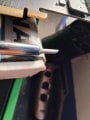
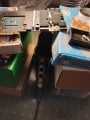
I've been attempting this on and off, and I can't get it to stick.

I had removed the heat sinks on both sides so it's the bare PCB and got the hairdryer propped up underneath it to act like a heating board, and left it running while I worked on it for several minutes.

The board gets quite hot, pretty ouchy to touch, you wouldn't want to leave your finger there, but probably not hot enough to cause injury, at least quickly. No idea what temperature that would be but ChatGPT said the board would normally need to be heated to 100°C to 150°C. Maybe I can't hit that with the hair dryer.

I'm using a large soldering tip using the iron you got me to buy on AliExpress, the tip I'm using is like a thick 5mm cylinder cut off at an angle. I figure this would give the most heat contact. I've set it to the max setting of 500. I'm using a lot of flux to help spread the heat up the solder when I apply it. But the solder just never melts. The only thing that happens is the solder accidentally touches the iron and beads onto itself. It doesn't "tin" the tip like I've usually seen on my other solder iron.

I might have to write this off as a lost cause, just seeing if you have any other advice.
IMG_20240930_132813.jpg

IMG_20240930_132743.jpg
 
Last edited:
Top