Facebook
 Google
 GitHub
 Linkedin

From what I understand, PCB manufacturing has a limitation on the minimum width of the solder resist—it cannot be too thin, typically not less than 5 mil.
In many components, including those with a 0.65 mm pitch, the spacing between pads can become smaller than 5 mil.
This reduction in spacing is due not only to the proximity of the pads but also to the solder mask opening—the larger it is (e.g., a common value is 4 mil), the smaller the remaining solder mask bridge. However, this issue persists even when the solder mask opening is as small as 2 mil.
For example, I am currently working with the NCP730BMT280TBG (LDO) and the PMPB15XP (P-channel MOSFET). Both of these components have tight pad spacing, making it difficult to maintain a sufficient solder mask bridge between them.
Is my understanding correct? If so, how is this issue typically addressed?
What are the recommended design practices for professional manufacturing (without strict compliance to specific standards)? What is commonly accepted in various industries?
What are the typical values for the minimum solder mask sliver/bridge in standard PCB manufacturing (nothing special or high-end)?
Thanks in advanced for any answer,
Eyal
Please see below, NCP730 recommended footprint, and measured in my design: 4.47 mil between pad and thermal pad.
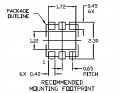
Third image: PMPB15XP recommended footprint


In many components, including those with a 0.65 mm pitch, the spacing between pads can become smaller than 5 mil.
This reduction in spacing is due not only to the proximity of the pads but also to the solder mask opening—the larger it is (e.g., a common value is 4 mil), the smaller the remaining solder mask bridge. However, this issue persists even when the solder mask opening is as small as 2 mil.
For example, I am currently working with the NCP730BMT280TBG (LDO) and the PMPB15XP (P-channel MOSFET). Both of these components have tight pad spacing, making it difficult to maintain a sufficient solder mask bridge between them.
Is my understanding correct? If so, how is this issue typically addressed?
What are the recommended design practices for professional manufacturing (without strict compliance to specific standards)? What is commonly accepted in various industries?
What are the typical values for the minimum solder mask sliver/bridge in standard PCB manufacturing (nothing special or high-end)?
Thanks in advanced for any answer,
Eyal
Please see below, NCP730 recommended footprint, and measured in my design: 4.47 mil between pad and thermal pad.
Third image: PMPB15XP recommended footprint