Facebook
 Google
 GitHub
 Linkedin
MisterBill2
- Joined Jan 23, 2018
- 28,371
Interesting string so far. And a bit of good news that the load is powered by a regulated power supply. That means that any diode voltage drop will be compensated for.
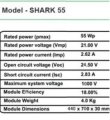
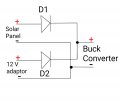
As for the diode ratings, I suggest that the diode working voltage (PRV) be at least twice the maximum voltage output of the solar panel. That should be easy. For the current rating, the maximum current from a 20 watt 12volt solar panel will be less than two amps, What is unknown is the maximum current rating of the DC adapter. So my suggestion there is that the current rating of the diode should be a bit greater than the maximum output current rating of the DC adapter. That number should be on the label. So as a guess, the diodes should be rated for 50 Peak Reverse Volts, and at least 2 amps constant current. The PEAK current rating will be more, that is not important in this application.
As far as the diode polarity, if the diodes have a diode symbol printed on the case, it should point in the direction of the load. (Cathode end toward the load)
Certainly other schemes will work and some of them will provide more power or better efficiency. But the two-diode scheme meets all of the stated requirements and are by far the simplest solution so far.
As for the diode ratings, I suggest that the diode working voltage (PRV) be at least twice the maximum voltage output of the solar panel. That should be easy. For the current rating, the maximum current from a 20 watt 12volt solar panel will be less than two amps, What is unknown is the maximum current rating of the DC adapter. So my suggestion there is that the current rating of the diode should be a bit greater than the maximum output current rating of the DC adapter. That number should be on the label. So as a guess, the diodes should be rated for 50 Peak Reverse Volts, and at least 2 amps constant current. The PEAK current rating will be more, that is not important in this application.
As far as the diode polarity, if the diodes have a diode symbol printed on the case, it should point in the direction of the load. (Cathode end toward the load)
Certainly other schemes will work and some of them will provide more power or better efficiency. But the two-diode scheme meets all of the stated requirements and are by far the simplest solution so far.
Last edited: