Facebook
 Google
 GitHub
 Linkedin

Good day AAC! New member here, with a circuit question that may seem trivial, but that I have had no luck solving so far (and I have tried. A lot.).
Onto the problem: It's quite simple. From a 5v square pulse I require circuit that generates a slow ramp to a maximum value of 2-4v during this pulse, and deramps quickly when the 5v pulse goes back to 0v. To give you an idea of the timescales, the slow ramp is on the order of 100ns to reach its max value, and the deramp is as fast as possible, preferrably less than 5ns to get back to ~0v. The ramp would ideally be linear and stop at some value between 2v and 4v, the deramp can have whichever shape as long as it goes to 0v, or a value below 1v, as long as it is reaches this value quickly and is stable. It's not a one-shot thing, so I can't have the previous pulse affecting the next one, for example by shifting the start level of the ramp. The ramp has to be quite well-defined and not change from pulse to pulse. As long as the start value of the ramp, the ramp shape, and the deramp end value are all constant from pulse to pulse, it doesn't matter much exactly what these values are.
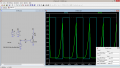
I have 5V and -5V rails to work with. I have already attempted the circuit attached, which resulted in a nice slow inverse exponential ramp due to the capacitor charging through the resistor. However, when the 5V pulse ended, the capacitor did discharge quickly, but not all the way to 0V, merely close (to the schottky diode forward voltage drop) and then very slowly decreased to 0v as the capacitor slowly discharged through the closed schottky diode. I get the same result without the transistor. This won't do, as one of the main requirements is that the voltage stays stable after the deramp.
A bit more info: The 5V square pulse comes from a comparator, so it is limited as a current source. The comparator is an ADCMP551. The ramp is fed to the input stage of another ADCMP551. The input capacitance is negligible, 1pF.
I hope this is all the information required and I look forward to hearing your suggestions.


Onto the problem: It's quite simple. From a 5v square pulse I require circuit that generates a slow ramp to a maximum value of 2-4v during this pulse, and deramps quickly when the 5v pulse goes back to 0v. To give you an idea of the timescales, the slow ramp is on the order of 100ns to reach its max value, and the deramp is as fast as possible, preferrably less than 5ns to get back to ~0v. The ramp would ideally be linear and stop at some value between 2v and 4v, the deramp can have whichever shape as long as it goes to 0v, or a value below 1v, as long as it is reaches this value quickly and is stable. It's not a one-shot thing, so I can't have the previous pulse affecting the next one, for example by shifting the start level of the ramp. The ramp has to be quite well-defined and not change from pulse to pulse. As long as the start value of the ramp, the ramp shape, and the deramp end value are all constant from pulse to pulse, it doesn't matter much exactly what these values are.
I have 5V and -5V rails to work with. I have already attempted the circuit attached, which resulted in a nice slow inverse exponential ramp due to the capacitor charging through the resistor. However, when the 5V pulse ended, the capacitor did discharge quickly, but not all the way to 0V, merely close (to the schottky diode forward voltage drop) and then very slowly decreased to 0v as the capacitor slowly discharged through the closed schottky diode. I get the same result without the transistor. This won't do, as one of the main requirements is that the voltage stays stable after the deramp.
A bit more info: The 5V square pulse comes from a comparator, so it is limited as a current source. The comparator is an ADCMP551. The ramp is fed to the input stage of another ADCMP551. The input capacitance is negligible, 1pF.
I hope this is all the information required and I look forward to hearing your suggestions.




 .
.