Facebook
 Google
 GitHub
 Linkedin
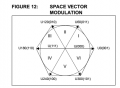
I am trying to control a BLDC motor using space vector modulation using the attached document. I am making a lot of effort to understand the document. I think I came to certain level to understand but struck up to go further. I am not able to understand the space vector modulation. UOUT is the desired resultant vector which we want to represent using two adjacent vectors U0 and U60.
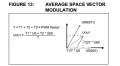
The values for T1 and T2 are taken from a look up table containing 172 fractional sinusoidal values for 0 to 60 electrical degrees. The 172 fractional values are arrived as (1024*60/360) = 172.
I really don't understand the below statement
As a result, for each of the six segments one axis is exactly opposite that segment, and the other two axes symmetrically bound the segment.
The values of the vector components along those two bounding axis are equal to T1 and T2.
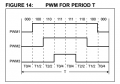
And then the Fig14. Whether this figure is for only UOUT vector. Why T1/2 and T2/2 are equally spaced. I mean to say their timings are same. In case if I take another vector say UOUT1 which is closer to U60 will the timings of T1/2 and T2/2 will be different? The PWM for period will keep varying for each resultant (UOUT vectors)? Thank you in advance.
The values for T1 and T2 are taken from a look up table containing 172 fractional sinusoidal values for 0 to 60 electrical degrees. The 172 fractional values are arrived as (1024*60/360) = 172.
I really don't understand the below statement
As a result, for each of the six segments one axis is exactly opposite that segment, and the other two axes symmetrically bound the segment.
The values of the vector components along those two bounding axis are equal to T1 and T2.
And then the Fig14. Whether this figure is for only UOUT vector. Why T1/2 and T2/2 are equally spaced. I mean to say their timings are same. In case if I take another vector say UOUT1 which is closer to U60 will the timings of T1/2 and T2/2 will be different? The PWM for period will keep varying for each resultant (UOUT vectors)? Thank you in advance.
Attachments
-
313.9 KB Views: 10