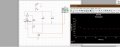
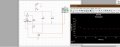
I'm trying to implement the passive extinguishing circuit in Multisim, but I'm having trouble triggering the avalanche!!
Any help would be appreciated.
Thanks.
I'm working on modeling a SPAD (Single Photon Avalanche Diode) detector in Multisim, with passive extinction (series resistor RD).
The goal is to observe a current or voltage pulse characteristic of the avalanche phenomenon, lasting approximately 10 ns, across a load resistor RS = 50 Ω.
Here are my circuit parameters:
VA = 8 V (high bias)
VB = 5 V (low bias)
RL = 55 kΩ
RD = 400 Ω
RS = 50 Ω
CD = 1 pF (diode capacitance)
CP = 1 pF (parasite capacitance)
Triggering is performed with a switch controlled by a rectangular generator.
Problem: Despite the configuration, I can't observe a clear pulse (expected amplitude or shape) on the oscilloscope connected to RS. The current drops too slowly or remains weak.
Hello,
This is the same article I'm reading!! Actually, it's two series of articles from the same authors.
I'm working on modeling a SPAD (Single Photon Avalanche Diode) detector in Multisim, with passive extinction (series resistor RD).
The goal is to observe a current or voltage pulse characteristic of the avalanche phenomenon, lasting approximately 10 ns, across a load resistor RS = 50 Ω.
Here are my circuit parameters:
VA = 8 V (high bias)
VB = 5 V (low bias)
RL = 55 kΩ
RD = 400 Ω
RS = 50 Ω
CD = 1 pF (diode capacitance)
CP = 1 pF (parasite capacitance)
Triggering is performed with a switch controlled by a rectangular generator.
Problem: Despite the configuration, I can't observe a clear pulse (expected amplitude or shape) on the oscilloscope connected to RS. The current drops too slowly or remains weak.
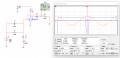
Modeling a spad detector no. simulating a triggering circuit. ok When V1 approaches maximum the threshold triggers a negative pulse. a simple sinewave is used.
The 2N3904 is not the fastest you can play with simulation below. In MS14 example files find RF RCL montecarlo simulation.
starting with a data file from a spad detector. A data file is processed, it replaces sine wave. In practice the blue fast pulse is capable approximating the center
of an optical pulse. Using a 74AC14 Schmitt Trigger Inverter, a delay and edge triggering a faster pulse for an everyday oscilloscope.
Problem: Despite the configuration, I can't observe a clear pulse (expected amplitude or shape) on the oscilloscope connected to RS. The current drops too slowly or remains weak.
The actual non-linear p-n junction, the (photo)diode, is missing. Replacing the diode with the equivalent circuit shown in the paper, made out of some passive R/C components, a switch and a voltage source, doesn't work. Which component do you see experiencing an avalanche breakdown?
I'm inclined to agree that simulating the breakdown of a p-n junction without a p-n junction is a dubious enterprise. I'm not familiar enough with the SPICE models for the bjt and the diode to know if you could establish a set of parameters that would allow you to investigate this.

 Facebook
 Google
 GitHub
 Linkedin