Simulating the frequency response of a Vox wah pedal

Thread Starter

Ross19892018

Joined Dec 26, 2018
32
Hello all,

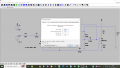
I have recently started to use LTSpice and have decided to draw the circuit of a Vox wah pedal and simulate it's frequency response. Below I have pasted in some pictures of the schematic and how I've set it up in LTSpice. The inductor and surrounding components make up a LC filter which is to be controlled by VR1 i.e the pedal. I couldn't find a pot in the library or a simple way to insert one so I've inserted a couple of resistors and made a potential divider network.
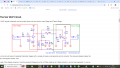
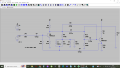
1731785399394.png

1731785329890.png

to simulate, this is how I've set it up the voltage source
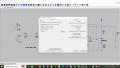
1731785707006.png

Then set the analysis configuration

1731785730405.png

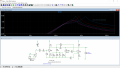
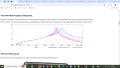
I was expecting to see something along these lines
1731785874189.png

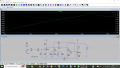
But ended up with this

1731785976703.png

I was hoping when I changed the values of the resistors in the potential divider network i.e VR1 I would get a simulation of the resonant frequency sweeping across the range but I had no change when I did this. The reading I got was at the R12 resistor at 8 ohms I have inserted to simulate a speaker on the output.

If anybody could shed some light on this or give me some tips to fault find the issue I would greatly appreciate it.

Thanks
 

LowQCab

Joined Nov 6, 2012
5,101
This Circuit is not even remotely close to being able to drive an 8-Ohm-Load.
It was designed to drive a very High-Impedance Guitar-Amplifier-Input.

Do You intend to actually construct your own Wha-Wha-Pedal ?
.
.
.
 

Ian0

Joined Aug 7, 2020
13,097
If V2 is a guitar pickup, then it is best simulated by a voltage source in series with 6H and 6kΩ. That will affect the frequency response of the circuit.
 

Thread Starter

Ross19892018

Joined Dec 26, 2018
32
This Circuit is not even remotely close to being able to drive an 8-Ohm-Load.
It was designed to drive a very High-Impedance Guitar-Amplifier-Input.

Do You intend to actually construct your own Wha-Wha-Pedal ?
.
.
.
Yeah I'm going to build it, I just thought I'd try and simulate it first.
 

LowQCab

Joined Nov 6, 2012
5,101
Its a very tedious job to construct a Wha-Wha-Pedal and have it actually
produce the effect that You may be expecting.

Every single Component used in making a Wha-Wha-Pedal will affect the effect that You will get,
even the Guitar-Pickups, and the connecting Cables,
and the Guitar-Amplifier-Input-Characteristics will each have an effect, some can be absolutely profound.
This is because the design of the Circuit is geared towards being the absolute cheapest method possible,
and the exact characteristics of the ancient Components used are very difficult to duplicate.

You could spend years trying to duplicate an exact "Tone" or "Effect" for your Guitar,
using actual Electronic-Hardware,
and still never find the exact "Sound" that You are looking for.

The best way to achieve what You are looking for is to use a used LapTop-Computer
with Guitar-Effects-Software installed on it,
driving a used Stereo-Hi-Fi Receiver and Hi-Fi-Speakers from a Pawn-Shop.

No ridiculously expensive Tube-Amp required.

The effects that can be easily achieved with this type of setup will blow your mind,
and Midi-Control-Foot-Buttons and "Expression-Pedals" can be added later if You want,
and it can easily wind-up being half the cost of just one "designer" Stomp-Box.

It can also provide a Stereo-Feed to the House-Mixer / Front-of-House-PA-System
so You don't have to tote around a heavy Speaker-Cabinet.
.
.
.
 
Last edited:

eetech00

Joined Jun 8, 2013
4,704
Hello all,

I have recently started to use LTSpice and have decided to draw the circuit of a Vox wah pedal and simulate it's frequency response. Below I have pasted in some pictures of the schematic and how I've set it up in LTSpice. The inductor and surrounding components make up a LC filter which is to be controlled by VR1 i.e the pedal. I couldn't find a pot in the library or a simple way to insert one so I've inserted a couple of resistors and made a potential divider network.

View attachment 335977

View attachment 335976

to simulate, this is how I've set it up the voltage source

View attachment 335978

Then set the analysis configuration

View attachment 335979

I was expecting to see something along these lines

View attachment 335980

But ended up with this

View attachment 335981

I was hoping when I changed the values of the resistors in the potential divider network i.e VR1 I would get a simulation of the resonant frequency sweeping across the range but I had no change when I did this. The reading I got was at the R12 resistor at 8 ohms I have inserted to simulate a speaker on the output.

If anybody could shed some light on this or give me some tips to fault find the issue I would greatly appreciate it.

Thanks
Post your .asc file and MPSA18 model file please...
 

eetech00

Joined Jun 8, 2013
4,704
Hello all,

I have recently started to use LTSpice and have decided to draw the circuit of a Vox wah pedal and simulate it's frequency response. Below I have pasted in some pictures of the schematic and how I've set it up in LTSpice. The inductor and surrounding components make up a LC filter which is to be controlled by VR1 i.e the pedal. I couldn't find a pot in the library or a simple way to insert one so I've inserted a couple of resistors and made a potential divider network.

View attachment 335977

View attachment 335976

to simulate, this is how I've set it up the voltage source

View attachment 335978

Then set the analysis configuration

View attachment 335979

I was expecting to see something along these lines

View attachment 335980

But ended up with this

View attachment 335981

I was hoping when I changed the values of the resistors in the potential divider network i.e VR1 I would get a simulation of the resonant frequency sweeping across the range but I had no change when I did this. The reading I got was at the R12 resistor at 8 ohms I have inserted to simulate a speaker on the output.

If anybody could shed some light on this or give me some tips to fault find the issue I would greatly appreciate it.

Thanks
Here is something to get you started.
The output load should be represented by the input impedence of the device connected to the wha-wah output.
The input impedence should be represented by the output impedence of the guitar electronics connected to the wha-wha input.

1731813969697.png
 

Thread Starter

Ross19892018

Joined Dec 26, 2018
32
Post your .asc file and MPSA18 model file please...
Here are the .asc and model I got from ltwiki.org

.model MPSA18 NPN(IS=33.58f ISE=166.7f ISC=0 XTI=3 BF=236 BR=5.774 IKF=0.1172 IKR=0 XTB=1.5 VAF=100 VAR=30 VJE=0.65 VJC=0.65 RE=0.1 RC=1 RB=10 CJE=7.547p CJC=4.948p XCJC=0.75 FC=0.5 NF=1 NR=1 NE=1.579 NC=2 MJE=0.3765 MJC=0.4109 TF=310.1p TR=800.3p ITF=0.6 VTF=6 XTF=35 EG=1.11 VCEO=45 ICRATING=200m MFG=NSC)
 

Attachments

crutschow

Joined Mar 14, 2008
38,322
I just thought as they're in parallel the overall resistance of that network would be 100k if they were both 200k
No.
A pot shows a parallel resistance at its wiper to pot ends of the pot resistance track, thus, for example, if the wiper was at the 50% point, the equivalent wiper resistance would be 1/2 the pot resistance.
Thus the pot wiper equivalent resistance to both ends of the pot is never greater than 1/2 the pot resistance.
 
Last edited:

crutschow

Joined Mar 14, 2008
38,322
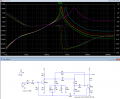
Below is the LTspice sim of your circuit, stepping R11 and R13 to emulate the changing of the pot wiper position while maintaining a constant 100k ohm series resistance (I used some similar transistor models I had):
I removed the 8Ω load as the circuit is not designed to drive a speaker.
The output now closely matches the plot from your reference article.

1731863350758.png
 
Last edited:

Thread Starter

Ross19892018

Joined Dec 26, 2018
32
Here is something to get you started.
The output load should be represented by the input impedence of the device connected to the wha-wah output.
The input impedence should be represented by the output impedence of the guitar electronics connected to the wha-wha input.

View attachment 335997
Hi,

That's some useful information thanks.

Where did you get the pot part? Is that something you've put in or is it in the library?

Thanke
 

Thread Starter

Ross19892018

Joined Dec 26, 2018
32
Below is the LTspice sim of your circuit, stepping R11 and R13 to emulate the changing of the pot wiper position while maintaining a constant 100k ohm series resistance (I used some similar transistor models I had):
I removed the 8Ω load as the circuit is not designed to drive a speaker.
The output now closely matches the plot from your reference article.

View attachment 336025
Yeah that's perfect. I have used the .step function and set up R11 and R13 as you have which has resolved the issue it seems. That response is what I was hoping for. Thanks
 
Top