Simple RC differentiator, hard math

Thread Starter

GarryO'Keeffe

Joined Jan 28, 2015
16
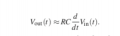
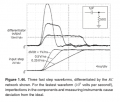
I'm trying to understand the maths behind the simple RC differntiator. I'm reading the sections in Horowidtx and Hill, which sort of make sense. But then the text uses a real world example and give a scope capture of the output. The text then challenges me to prove the results using the formula.
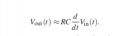
Screen Shot 2024-10-21 at 14.50.42.png

I've tried but I don't really know how to approach this. Can somebody please show me.

Screen Shot 2024-10-21 at 14.50.18.png


Thanks

Garry
 

Attachments

crutschow

Joined Mar 14, 2008
38,316
I'm stuck trying to apply the math.
d/dt Vin(t) is the linear rise time of the input (here in V/ns).
So you multiply the differentiator RC time-constant value times that rise-time value to get the differentiated output voltage during that rise-time.
For example, the 1V/ns rise-time gives an output of 1pF*50Ω*1V/ns = 50mV (as observed).

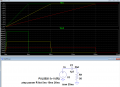
Edit: Added simulation--
Below is an LTspice idealized simulation (no stray impedances):

1729544294293.png
 
Last edited:

MrChips

Joined Oct 2, 2009
34,628
It would be difficult to arrive at a mathematical model of the real signal.
A simple approach would be to model the input signal with a known ramp between a starting and ending voltage.
 

Papabravo

Joined Feb 24, 2006
22,058
I thought the TS was asking for the derivation of the relation between the output voltage and the derivative of the input voltage.
 

MrChips

Joined Oct 2, 2009
34,628
I thought that the TS was asking for a comparison of the mathematical modelling with the results given by the oscilloscope.
 

WBahn

Joined Mar 31, 2012
32,703
I'm trying to understand the maths behind the simple RC differntiator. I'm reading the sections in Horowidtx and Hill, which sort of make sense. But then the text uses a real world example and give a scope capture of the output. The text then challenges me to prove the results using the formula.
View attachment 334090

I've tried but I don't really know how to approach this. Can somebody please show me.


View attachment 334088
Pick one of them. Use the most well-behaved on first, which is the slowest of the three. If the input voltage is ramping at 0.25 V/ns, what is dV(in)/dt?

What do you get if you multiply that by the product of R and C for that circuit?

How does that compare with the magnitude of the corresponding differentiator output signal in that plot?
 

Thread Starter

GarryO'Keeffe

Joined Jan 28, 2015
16
d/dt Vin(t) is the linear rise time of the input (here in V/ns).
So you multiply the differentiator RC time-constant value times that rise-time value to get the differentiated output voltage during that rise-time.
For example, the 1V/ns rise-time gives an output of 1pF*50Ω*1V/ns = 50mV (as observed).

Edit: Added simulation--
Below is an LTspice idealized simulation (no stray impedances):

View attachment 334122
Thanks, I thought this would be more complex!
 
Top