If you want to try out the circuit, here it is with some values (which are not final but to only test the principle of this circuit).
Q2 trigger point is somewhere 7Volts and discharge time of C1 is <1mS. Delay is around 500ms.
Short interrupt in supply will discharge C1 and timing can start again when supply returns. By adjusting R4 and R5 determine when C1 starts discharging, this will be the under voltage limit.
I'm not really sure I understand your need, but you might try something like this.
Start with 2 Schmitt triggers each with a RC delay.
One trigger turns on a MOSFET in series with the power supply and the device and has a cap on the output side.
The other trigger has the output connected to the enable.
The delay on the trigger that is connected to the enable is made longer than the trigger connected to the MOSFET.
This is just a concept you might want to think about.
EDIT:
I just read your range requirement, and I don't know how that applies to the OP stating 12 volt battery. So sorry if this idea will not apply.
I'm not really sure I understand your need, but you might try something like this.
Start with 2 Schmitt triggers each with a RC delay.
One trigger turns on a MOSFET in series with the power supply and the device and has a cap on the output side.
The other trigger has the output connected to the enable.
The delay on the trigger that is connected to the enable is made longer than the trigger connected to the MOSFET.
This is just a concept you might want to think about.
EDIT:
I just read your range requirement, and I don't know how that applies to the OP stating 12 volt battery. So sorry if this idea will not apply.
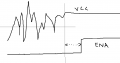
It is quite close to the other suggestions, but the main reason for this system is the fast return to the start point when supply is disconnected, therefore it needs a capacitor discharge circuit that resets the timings.
If you think of heavy duty crocodile clips, or any larger mechanical switching device, the switching bounce can be anywhere from <1ms, to tens of milliseconds, so the reaction time should be fast, parallel resistor would not work fast enough to reset the circuit therefore it needs much stronger discharge mechanism.
It does both. the principle is, that as long as you have these bounces, the main circuit remains OFF. When you have long enough static supply voltage state the main circuit will start operating. It is a protective mechanism for the main circuit to not go into unknown state because of random supply behavior. This relates to POR circuits in microcontroller world; If you have shortage in supply, reset cycle is started. Here the same functionality is implemented to supply line.
Yes, I understand the concept of de-bounce...what I don't understand is the need to reset the timing after every bounce instead of after the entire event.
Yes, I understand the concept of de-bounce...what I don't understand is the need to reset the timing after every bounce instead of after the entire event.
How do you know when the bouncing is over?
This is how POR systems work, this is how the switch bouncing is supressed in softwares. Integrated chips do the same, their inner timer is reset as long as there is unstable input. Constant reset ensures that there has been long enough static state on supply after the contact events are over.

 Facebook
 Google
 GitHub
 Linkedin