Simple mic pre with phantom power - results?

Thread Starter

oneoldude42

Joined Feb 19, 2024
23
Hi all and thank you for all your replies. Below you will find my design for a switched remotely powered WM61A with an on/off LED. It is intended to measure loudspeaker response. I am concerned if this circuit will go across the audio band (20-20k Kz). I am also concerned with the LED circuit. I tested the LED with a 9v battery and the 10k resistor. It does light faintly but good enough to indicate on/off. I am trying to save battery life by limiting LED current. My concern is whether this low LED current will introduce noise to the output even though it is hopefully filtered by the supply filter.

Any thoughts or comments will be greatly appreciated.

Thanks
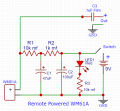
Remote Powered Mic ab.png
 

MisterBill2

Joined Jan 23, 2018
27,571
The circuit in post #21 looks good and it should work for a remotely powered microphone amplifier. Next you can show us the actual amplifier circuit.
 

LadySpark

Joined Feb 7, 2024
194
Hi all and thank you for all your replies. Below you will find my design for a switched remotely powered WM61A with an on/off LED. It is intended to measure loudspeaker response. I am concerned if this circuit will go across the audio band (20-20k Kz). I am also concerned with the LED circuit. I tested the LED with a 9v battery and the 10k resistor. It does light faintly but good enough to indicate on/off. I am trying to save battery life by limiting LED current. My concern is whether this low LED current will introduce noise to the output even though it is hopefully filtered by the supply filter.

Any thoughts or comments will be greatly appreciated.

Thanks

View attachment 316316
I would remove C1 and R1 and increase R2 to 2K Noise is usually not an issue in a paralleled battery source, but R3 could be bypassed with a 220 pf cap. With 11K as the B+ feed resistor is not going to power the fet inside the mic very well.
 

MisterBill2

Joined Jan 23, 2018
27,571
ONE possible option to reduce battery drain will be to put the LED IN SERIES with the load, with no extra resister. Then it will also indicate that the amplifier is drawing power, and connected. In addition, I agree that R1 is greater than I usually see in a microphone amp. a single 1K resistor should be good, or a 1.2K or even a 2.7K resister, depending on what you have on hand. Metal film IS a good choice for lower noise.
 

Audioguru again

Joined Oct 21, 2019
6,826
The WM61A mic has a flat response from 50Hz to 15kHz.
DO NOT have more than a single path for sounds between the mic and the speaker (a second path as a floor reflection) will cancel some frequencies. When I measured a speaker's frequency response I laid it on its back in a fairly large field pointing straight up to the mic on a tree branch above it.
 

Audioguru again

Joined Oct 21, 2019
6,826
The WM61A datasheet shows a load resistor that is only 2.2k because their power supply is only 2.0V! The JFET draws 0.5mA then the mic barely works with low sensitivity with only 1.1V across it. The 11k load works fine when the battery is 6V to 9V.
 

MisterBill2

Joined Jan 23, 2018
27,571
The WM61A datasheet shows a load resistor that is only 2.2k because their power supply is only 2.0V! The JFET draws 0.5mA then the mic barely works with low sensitivity with only 1.1V across it. The 11k load works fine when the battery is 6V to 9V.
OK, putting the LED in series with the load will probably not work in this instance.
 

LadySpark

Joined Feb 7, 2024
194
The WM61A datasheet shows a load resistor that is only 2.2k because their power supply is only 2.0V! The JFET draws 0.5mA then the mic barely works with low sensitivity with only 1.1V across it. The 11k load works fine when the battery is 6V to 9V.
The voltage applied isn't that critical, but I wonder if they need the 9 volt in the first place. Because if they are using a computer mic input, they already have 5V on the + pin.

If that is the case, they only need a 2K resistor, because the coupling cap would be on the sound card blocking the 5V phantom bias.
 

Audioguru again

Joined Oct 21, 2019
6,826
The voltage applied isn't that critical, but I wonder if they need the 9 volt in the first place. Because if they are using a computer mic input, they already have 5V on the + pin.

If that is the case, they only need a 2K resistor, because the coupling cap would be on the sound card blocking the 5V phantom bias.
The Jfet in an electret mic is a constant current source, not a voltage source. Most datasheets show a current of 0.5mA.
A low value supply voltage (and resulting low load resistance) causes low sensitivity and distorted high output levels.
 

MisterBill2

Joined Jan 23, 2018
27,571
The Jfet in an electret mic is a constant current source, not a voltage source. Most datasheets show a current of 0.5mA.
A low value supply voltage (and resulting low load resistance) causes low sensitivity and distorted high output levels.
A.g. makes the good point, in that the maximum amplitude (the Dynamic Range) is certainly limited by the supply voltage. Actually it is a bit more complex than that, but the supply voltage is a solid limit.
 

Thread Starter

oneoldude42

Joined Feb 19, 2024
23
AG and MB2, thanks for your input. Should I lower R1 to 8K? Any current electret mic capsules that will work well here?
Otherwise, is this good to go?
Thanks ab
 

Audioguru again

Joined Oct 21, 2019
6,826
AG and MB2, thanks for your input. Should I lower R1 to 8K? Any current electret mic capsules that will work well here?
Otherwise, is this good to go?
Thanks ab
Reducing R1 from 10k to 8k will reduce the maximum output level a small amount and will increase the distortion a small amount. You will not notice the difference.
Digikey lists 1313 microphones with detailed datasheets.
 

Ian0

Joined Aug 7, 2020
13,132
Welcome to AAC.

No matter what you use you will have to calibrate it if you want to use it for measurement.

That being the case, unless the frequency response is very odd, it doesn’t really matter. So long as it doesn’t roll off before the lower and upper limits you hope to measure, the calibration will allow you to compensate for whatever the curve looks like.

On the other hand, when you can buy a calibrated microphone for $35.00 that almost certainly exceeds anything you would make with your spare parts, it starts to look like wheel spinning to pursue doing that.
I took one apart once - it's just a standard telephone handset capsule in a fancy case, with a balanced (but not differential) output.
Nowhere does it say it's calibrated.
https://mediadl.musictribe.com/media/sys_master/h47/hde/8849927929886.pdf
If you want anyone to believe your measurements, you need a microphone calibrator
https://uk.rs-online.com/web/p/sound-level-calibrators/4980095?gb=s
The only trouble is that microphone calibrators drift and microphones don't, so you have to send your microphone calibrator away for calibration every year, and when you get it back you find that your microphone sensitivity has remained perfectly stable.
If you only need relative measurements, then it's perfectly fine, and so is an ordinary telephone handset insert.

There seems to be two types of telephone handset insert, those with a full 20Hz-20kHz response and those highpass filtered below 100Hz.
They all suffer from the connection between the JFET gate coming adrift from the capsule, depending on how well they are put together, and MEMS microphones have similar characteristics for noise, distortion and frequency response, but don't fall apart.

By the way, this appears to be the TS's third concurrent thread on the same topic.
 

LadySpark

Joined Feb 7, 2024
194
The Jfet in an electret mic is a constant current source, not a voltage source. Most datasheets show a current of 0.5mA.
A low value supply voltage (and resulting low load resistance) causes low sensitivity and distorted high output levels.
correct, it just needs a voltage to polarize the capsule.and its range is limited to 2-10V because of the fet used.
 

Danko

Joined Nov 22, 2017
2,169
it just needs a voltage to polarize the capsule.and its range is limited to 2-10V because of the fet used.
No. Electrical field source with voltage about 100 V already is mounted inside electret capsule for polarization.
Outer voltage 2-10 V used only for JFET feeding.

https://www.sciencedirect.com/topics/physics-and-astronomy/electrets
"I.A.2 Electret Condenser Microphone
An electret material possesses a permanent electrical dipole moment. When used in a condenser microphone, it provides the polarization voltage between the membrane and backplate in place of the external supply voltage. Electret materials are generally high-resistivity polymers, a prime example being PTFE Teflon. They are fabricated by heating a film of the material almost to its melting point and subjecting it to an intense electric field. The net dipole moment results from either rotation of permanent dipoles in polar materials or from migration of free charge carriers. In either case, when the material is cooled to room temperature the net dipole moment is “frozen-in.”

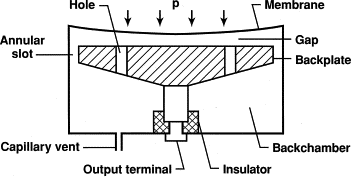
A typical construction is shown in Fig. 3. Here the electret is bonded to the backplate. This has an advantage over arrangements where the electret is bonded to the membrane because electret materials are not very suitable for performing the mechanical function of a membrane. The lower surface makes electrical contact with the backplate and thus is at the same potential as the membrane (a metal). The voltage V0 at the upper surface and across the gap is

FIGURE 3. Typical construction of an air electret microphone. Sometimes the electret is bonded to the membrane.

V0=σt/εε0
where σ is the surface charge density (C/m2), t the foil thickness (m), ɛ the dielectric constant, and ɛ0 the dielectric permittivity of free space (8.85 × 10⁻¹² F/m, or farad per meter). Typical values of σ = 10−4 C/m2, t = 2 × 10⁻⁵ m, and ɛ = 2 lead to a voltage V0 ≈ 100 V, which is comparable to the polarization voltages used in air condenser microphones.
The capacity of an electret material to retain its surface charge is highly temperature dependent. In one test, an electret microphone stored at 50 °C and 95% relative humidity lost sensitivity at a rate of ∼1 dB/year. Under normal ambient conditions an electret microphone can be expected to retain its initial sensitivity for many years.

The acoustic performance of the “backelectret” microphone is not much different from that of the air condenser microphone. The elimination of the external polarization voltage supply, however, has a significant advantage. The generation of a high-dc voltage and the extensive filtering needed to obtain a low noise floor, ripple, and hum require bulky components (except for battery-operated equipment). The absence of this requirement greatly enhances the miniaturization potential of electret-based instrumentation."
 
Last edited:

MisterBill2

Joined Jan 23, 2018
27,571
Producing a temperature-stable electret element is a serious challenge. We used PVDF to be more stable but the elements were not uniformly sensitive. We did produce microphones sensitive from almost DC to over 50 KHz. They were very good but the process to produce them could not make a run of 100 pieces be uniform. So the project was cancelled.
From this it became clear that an MBA should not ever be in charge of engineering. We fed the signals into a FET input opamp.
 
Top