Simple Digital Logic Simulator

Thread Starter

stagekraft

Joined Jan 18, 2022
24
Hey Y'all,

Anyone found a decent "free" digital circuit simulator?

I've been using LTSpice for years for analog stuff, but seems a bit clunky for digital.

Something that I can enter some logic gates, and with the "push of a button" I can see the logic change.

I've looked at a few online things, "free to try", spent the time drawing out my circuit, but when it came time to test...

Now we want money...

And found some others that were just way too cryptic..

You wouldn't think simple digital logic would be that hard to simulate. off, on, off, on....

JohnR
 

WBahn

Joined Mar 31, 2012
32,702
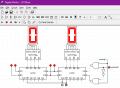
On that seems pretty decent is "Digital" (which I think is a horrible name for a product, given that it makes it hard to find in search results).

I was looking for something that could produce presentation quality graphics of circuits and that I could define my own symbols in, so I haven't used it for actual simulation much. But, it's got some nice features such as fairly easy user interaction with the circuit.

Digital simulation is not as easy as it would appear at first blush. Pure combinational circuits are pretty easy, but as soon as you want to work with sequential circuits, either implicitly or explicitly, you have a host of issues that you have to contend with.
 

Thread Starter

stagekraft

Joined Jan 18, 2022
24
I know it would be a simple matter of bread boarding, but I don't have the parts on hand, and it's cold out in my workshop..:rolleyes:
thought it would be a simple thing to load it in a simulator, but that doesn't seem to be the case...
 

WBahn

Joined Mar 31, 2012
32,702
I gave that one a quick download, looked promising, but I see nothing about passive components, resistors and caps...
Uh... you asked about "simple digital logic simulator" where you can enter some gates. You further implied that you thought this should be simple because everything is either one or off. But now you expect this simple digital logic simulator to be able to interact with analog components. That's a whole other critter.
 

dl324

Joined Mar 30, 2015
18,216
I gave that one a quick download, looked promising, but I see nothing about passive components, resistors and caps...
It's purely a digital simulator. No resistors or caps.

There are some LED/display elements, but they don't load outputs or require current limiting.

The simulator is not without its warts. You can't zoom in/out and selecting and moving incomplete wires is challenging. But it's free, customizable, and will do what you asked for in your original post.
 

Thread Starter

stagekraft

Joined Jan 18, 2022
24
But now you expect this simple digital logic simulator to be able to interact with analog components.
Hmmm, I was never taught that passive components had a digital or analog "gender".
It all depends on how/where they are being used.
In my circuit the cap is being charged to remember a logic state, that's digital in my mind.
Just sayin'...

Now I'll walk away from this thread as I can see all you young-uns are gonna have a heyday with my old school logic.
Just an old grey donkey, thanks for noticing...

Oh BTW..
" There are 10 types of people in the world: those who understand binary, those who don't, and those who can work in any number base. "
that would be 11 types of people....
 

WBahn

Joined Mar 31, 2012
32,702
Hmmm, I was never taught that passive components had a digital or analog "gender".
It all depends on how/where they are being used.
In my circuit the cap is being charged to remember a logic state, that's digital in my mind.
Just sayin'...
Passives like resistors and capacitors are very much analog devices. Your capacitor could any voltage on it, not just "charged" or "uncharged". To charge it, you have to supply current to it and it takes time to move from one charge level to another. The simulator has to determine how much current is going into or out of that capacitor, which changes with time, to determine what the voltage is on it.

How do you expect your simple digital logic simulator capacitor to behave if you connect your capacitor to a voltage divider? Is the capacitor charged or uncharged?

Now I'll walk away from this thread as I can see all you young-uns are gonna have a heyday with my old school logic.
Just an old grey donkey, thanks for noticing...
That's certainly your prerogative.

Oh BTW..
" There are 10 types of people in the world: those who understand binary, those who don't, and those who can work in any number base. "
that would be 11 types of people....
Which puts you in the first group, but not the third.
 

Thread Starter

stagekraft

Joined Jan 18, 2022
24
Which puts you in the first group, but not the third.
And that puts you in the second group if you think "those+those+those=2" (unless you work in base 3)..
Sorry, couldn't resist replying to that..
I was using that silly tag line on a PLC forum 20 years ago, but without "and those who can work in any number base ".
Makes no sense, you may be a Moderator with lots of posts, but your responses are as accurate as an AI bot...

"Passives like resistors and capacitors are very much analog devices. Your capacitor could any voltage on it, not just "charged" or "uncharged". To charge it, you have to supply current to it and it takes time to move from one charge level to another. The simulator has to determine how much current is going into or out of that capacitor, which changes with time, to determine what the voltage is on it."

What, I ask then, is the point of a simulator, if it cannot determine voltage base on fixed passive values (and a time constant)?

And I did not say I was looking for a "Simple Logic Simulator", I said I was looking for a "free" simulator that could handle (what I consider) simple logic, just wanted to re-confirm a circuit I used 40 years ago without physical bread-boarding..

Why is it every time I post a question on this forum, I get a response from "that guy" who want's everyone to believe his words are sacred?
There are those who talk and those who do... keep talking...

Good day to you sir Moderator...
 

WBahn

Joined Mar 31, 2012
32,702
And that puts you in the second group if you think "those+those+those=2" (unless you work in base 3)..
Sorry, couldn't resist replying to that..
I was using that silly tag line on a PLC forum 20 years ago, but without "and those who can work in any number base ".
Makes no sense, you may be a Moderator with lots of posts, but your responses are as accurate as an AI bot...
Well, since I'm in the third group and CAN work in any number base, I can work in base three. YOU chose to insist that '10' could ONLY be interpreted as being a binary number. There is absolutely nothing in my signature that requires or implies it.

"Passives like resistors and capacitors are very much analog devices. Your capacitor could any voltage on it, not just "charged" or "uncharged". To charge it, you have to supply current to it and it takes time to move from one charge level to another. The simulator has to determine how much current is going into or out of that capacitor, which changes with time, to determine what the voltage is on it."

What, I ask then, is the point of a simulator, if it cannot determine voltage base on fixed passive values (and a time constant)?
Since you asked, I will answer, as I'm willing to assume that you asked because you want to actually learn something.

For general-purpose electronic circuits, most simulators fall into one of three categories (there are other, specialize categories as well): Analog, Digital, and Mixed-signal.

Analog simulators work with voltages and currents at each node and device pin. Their degree of fidelity to the actual circuit can range from very crude to exceptionally faithful, depending on the quality of the device models used. They are also extremely slow for large circuits and can take literally days to simulate even a few milliseconds of circuit operation when a circuit has tens of thousands of components, which today would be a fairly small IC. You can certainly simulate a digital logic circuit in an analog simulator by simply using the actual analog circuit that implements each gate, but be prepared to wait a long time to get your results unless the circuit is quite small.

Digital simulators (which you specifically asked for) do not work with voltages or currents at all. They use a behavioral logic model for digital parts, This allows them to be extremely fast, allowing them to simulate logic circuits containing millions of components very quickly, often faster than real time. The simplest simulators use models that only recognize two states, HI and LO, and assume zero propagation delay through gates. These simulators typically cannot handle feedback, and so are used for combinational/registered logic in which there are no feedback paths that don't go through a register. A large fraction of digital designs fall into this category. Other simulators use models that incorporate propagation delays through the gates, which allow them to simulate asynchronous fundamental- or pulsed-mode machines. Either of these might also handle three-state logic and might or might not include indeterminate states or have the ability to detect glitch or race conditions. But because they are purely behavioral, they can't interact with analog circuitry.

Mixed-signal simulators, as the name implies, can do both. This is usually done by building in A/D and D/A interface models that are automatically inserted into the simulation as needed. As with all simulators, the quality of the results depends on the quality of the interface models, which range from very crude to extremely good. No surprising, there is a speed-of-simulation tradeoff involved across that range.


And I did not say I was looking for a "Simple Logic Simulator", I said I was looking for a "free" simulator that could handle (what I consider) simple logic, just wanted to re-confirm a circuit I used 40 years ago without physical bread-boarding..
You might want to read the title you gave the thread, which is "Simple Digital Logic Simulator".

I and others gave you some suggestions for you to consider based on your initial stated requirements. We cannot help that you didn't provide your actual requirements.

Why is it every time I post a question on this forum, I get a response from "that guy" who want's everyone to believe his words are sacred?
There are those who talk and those who do... keep talking...

Good day to you sir Moderator...
If you don't want people to answer your questions, then why ask them? You are completely free to ignore any suggestion or post you want.
 

Thread Starter

stagekraft

Joined Jan 18, 2022
24
Good for you that you can work in ternary, kinda makes sense, but since the computer world doesn't get it, why bother?
my point was your basic tag line has been around probably longer than you, and the fact that you modified it (or somebody did) and then try to make fools of those who take it it's original literal binary sense only proves you are a narcissist ...

Maybe I was presumptuous that there might be a "simple logic simulator" that also accounted for "digitally based" passive components, and I'm willing concede that I must be wrong (hell, I've only been into electronics for 50 years, guess I have not quite figured it out yet)..

I did respond to one person who suggested a piece of software, which I downloaded for a quick try, and as soon as I made the comment that it did not include passives, you jumped straight in with your nasty negativity...

Again, there is always "that guy" who has to prove his "holier than thou" knowledge, and belittle other forum users.

Makes you wonder why sane people even bother posting questions?

Well, the weather is warming up, and perhaps if I dig around in my shop I can find an old 4049 hex inverter to plug into my dusty old bread-board to test my decades old logic, and forego the need for some silly simulator.

Have a nice day Y'all..
 

MrChips

Joined Oct 2, 2009
34,626
But digital is still analog. If you limit the range of values to just two sets, then the simulation problem becomes much easier. Toss in a resistor and you're in a different sandbox.
 

crutschow

Joined Mar 14, 2008
38,314
If you want to do mixed signal simulation then you need something like LTspice, which you already use.
And RCL circuits are analog.
 

Thread Starter

stagekraft

Joined Jan 18, 2022
24
Well, did this morning what I should have done a week ago.
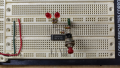
Dug out my old Manual Simulator, and to my surprise, there in the bottom of the box of parts previously used on the the Manual Simulator was a 4049, go figure...
10 minutes later the simple logic circuit was assembled and proved to work (along with my analog LEDs and analog PB switch).

All I wanted to do was check a little alternating logic switch (with debounce) circuit I had remembered using many years back before cutting a pcb...

Just did not seem that should be so difficult to simulate in this modern computerized world..

Regards to all who try to help...
1772126403954.png
 

MrChips

Joined Oct 2, 2009
34,626
Wasn't the circuit itself, just hard to emulate real time push button (it was the debounce part I was checking).
You are asking a lot from a simulator. Switch bounce is a random event. Some switches are more prone to bounce than others. What do you expect a digital logic simulator to output from a switch?
 
Top