Facebook
 Google
 GitHub
 Linkedin

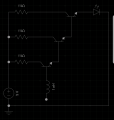
I built a simple amplifier circuit last night, which consisted of 3 BJT NPN transistors, 3 resistors, an LED, and some coils of wire. It's was made to act as a high sensitive touch circuit, this worked well, but then I decided to connect the base of the 1st transistor to a custom air core inductor... then I found that it increased its sensitivity a little, so I made a slightly larger one with few coils and a large cross-sectional area (roughly 2 inches in diameter made with regular 22 gauge insulated wire) this made it act as a close range proximity sensor of some type; when I placed my finger a few mm away the LED illuminated, but when I put my finger through the middle of it... it functioned even better, it worked with metal objects too. I eventually figured out that the larger the cross-sectional area, the more sensitive it was, but too small and you'll have to physically touch it lightly, and too large actually made it stay on without any presence. Was my finger emitting some kind of field that the inductor picked up, or was it some kind of capacitive properties that the coils of wire enhanced, or was the the inductor emmiting some electromagnetic field (although I don't see how it would, because it was an incomplete circuit hanging out like an antenna)? Can anyone explain exactly what this circuit was sensing? The inductor was hooked up just as shown in the schematic, and I was using 2N3904...or 06 (which ever is NPN, I can't remember) transistors. Also, I placed a piece of paper, then glass (actually a mirror) over it to see if it could sense through it, and it performed slightly better even.