Simple 9v circuit

Thread Starter

FendtLad

Joined Sep 18, 2019
22
Hi everyone, I’m looking to make an electrical circuit using a 9v battery to run the small electric motors you find in the tamiya cars on and off all day by itself. I’m hoping to have it run for 20secs then off for maybe the same time. Is there a simple circuit someone can help me with? Thanks
 

jpanhalt

Joined Jan 18, 2008
11,087
A 9 V battery is a very poor choice for power. It typically is rated at 500 mAh. You don't describe your motor. They require a wide range of current at 9 V. A "typical" small RS-540 takes 2 A just to start (unloaded) and a 15 A power supply is recommended (https://www.aliexpress.com/i/4000284392308.html ).

Using just 2 A, you battery will provide power for just 15 min total, probably less as the 500 mA rating is at lower current. At a duty cycle of 50% as you ask, in 30 minutes or less, your battery will be completely dead, not "all day."

1) What motor will you be using?
2) What sort of load it it be under (what is it going to do)?

From that, you can calculate what you need, but for "all day" it will probably be a big battery.
 

Thread Starter

FendtLad

Joined Sep 18, 2019
22
A 9 V battery is a very poor choice for power. It typically is rated at 500 mAh. You don't describe your motor. They require a wide range of current at 9 V. A "typical" small RS-540 takes 2 A just to start (unloaded) and a 15 A power supply is recommended (https://www.aliexpress.com/i/4000284392308.html ).

Using just 2 A, you battery will provide power for just 15 min total, probably less as the 500 mA rating is at lower current. At a duty cycle of 50% as you ask, in 30 minutes or less, your battery will be completely dead, not "all day."

1) What motor will you be using?
2) What sort of load it it be under (what is it going to do)?

From that, you can calculate what you need, but for "all day" it will probably be a big battery.
Thanks for the prompt reply. I don't have a motor yet. If you google "mojo flicker" it is a flicking decoy. That is what I am trying to make. I was hoping the components would be fairly basic but if you have a good way of doing it I'd be happy to hear.
 

jpanhalt

Joined Jan 18, 2008
11,087
Thanks for the prompt reply. I don't have a motor yet. If you google "mojo flicker" it is a flicking decoy. That is what I am trying to make. I was hoping the components would be fairly basic but if you have a good way of doing it I'd be happy to hear.
What are your plans to do it. I don't need a mojo flicker at the moment.
 

DNA Robotics

Joined Jun 13, 2014
670
"Operates up to 30 hours on 3 AA batteries"

I would guess a couple hundred RPMs.
Maybe get a toy car and turn it on it’s side. Attach the wing to the axle.
An Arduino and a MOSFET transistor can turn it on at random times.
A 555 timer and a MOSFET transistor can turn it on and off but it won’t be random.
 

Tonyr1084

Joined Sep 24, 2015
9,744
Once I wanted a computer to remain active - not go to sleep. Back in that time I knew nothing of setting the sleep timer on a computer. So what I did was to take a clock with a second hand sweep and lay it on its back then put an optical mouse over the face of the clock. Every minute the second hand would make the computer think the mouse was being moved, and would keep the computer awake. It was a simple solution to a problem I didn't know the proper way to resolve the issue.

So the obvious question: Why don't you just buy a mojo flicker? Then hack the circuit inside to give you the time period you want. Obviously it's already built with a circuit and a motor. Some engineer has worked out all the details and problems. It must be some sort of time based circuit. Changing a single resistor or capacitor would probably give you the event you want.

mojo flicker
 

Tonyr1084

Joined Sep 24, 2015
9,744
The typical quoted price seems outrageous, Tony.
Didn't realize the TS stated a budget.

OK. What about a window comparator? Set the high limit and the low limit and the charge and discharge rates. I'll be googling that. If I find what I'm talking about I'll get back and post.
 

MisterBill2

Joined Jan 23, 2018
27,504
Thanks for the prompt reply. I don't have a motor yet. If you google "mojo flicker" it is a flicking decoy. That is what I am trying to make. I was hoping the components would be fairly basic but if you have a good way of doing it I'd be happy to hear.
Back in 1956 I did an installation of a 9 volt battery to replace two AA cells in a plastic model dragster car called "The Peeler". It did win races, it was usually good for about 5 races on a 20 foot track before the battery had to be replaced. But at the time battery life did not matter but winning races did matter. That was the compromise. It would still hold today.
 

Thread Starter

FendtLad

Joined Sep 18, 2019
22
Thanks everyone for the replys. I'm open to ideas on batteries and motors. ie if I need a bigger battery thats fine. I'm no electronics guru like most of you guys probably are. even if it runs for 10sec and off for 10 secs thats fine. I was planning to make a few individual ones so they would all be going at different times anyway. Again Thanks everyone for your input.
 

MisterBill2

Joined Jan 23, 2018
27,504
For a time interval generator to create delays and run times you could use a CD4060 IC , which is an oscillator and binary divider. Then you can add an AND gate to use two outputs to enable a run time signal, and an MPSA13 transistor to activate the small motor. The whole package can run on 3 or 4 AA batteries for a few days. And I am guessing that a "Mojo Flicker" is some sort of decoy duck that moves a bit. I am not a duck hunter so I am not familiar with that sort of thing. But consider that there are all kinds of motion toys available and so a search may find another motion device that already produces the required motion and is a lot cheaper.
 

hrs

Joined Jun 13, 2014
530
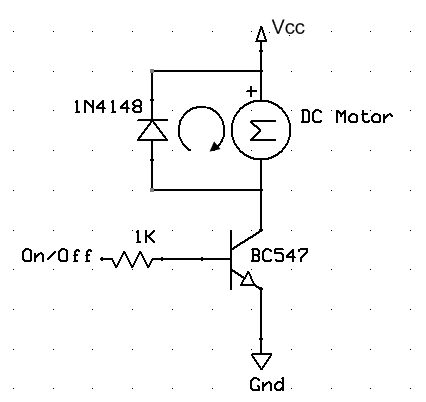
Have a look at this circuit. It operates in astable mode as shown here (note the output). You can calculate component values for approximately 20 seconds on/off. For example R1 = 10k, R2 = 3M, C1 = 10u. And then, instead of the LED, do something like this:


Edit: Also there is the NE555 and the TLC555. For lower power consumption you want the TLC555.
 

Alec_t

Joined Sep 17, 2013
15,117
The video on the Mojo web-site seems to show the 'on' period as only a couple of seconds. If you are going to deploy several of these then an 'off' period of a minute or more would seem ok and help to extend battery life. So a TLC555 driving a small MOSFET would suffice to run a cheapo hobby motor. I think the main challenge will lie in waterproofing everything.
 

MisterBill2

Joined Jan 23, 2018
27,504
That is the motor driver I was describing, except that using an MPSA13, which is a 200mA darlington device allows driving it directly from a CMOS gate, so the total draw from the controls portion would be less than using a 555 timer, and there would be more flexibility.
 

ElectricSpidey

Joined Dec 2, 2017
3,334
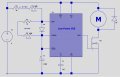
Here is a 555 interval circuit with on time and off time settable with 2 different variable resistors (pots).

A_interval_555.JPG

I didn't draw the VRs because LTSpice sucks at schematics... ;)

The timing values can be adjusted to save power, these are just for reference.
 

Thread Starter

FendtLad

Joined Sep 18, 2019
22
Have a look at this circuit. It operates in astable mode as shown here (note the output). You can calculate component values for approximately 20 seconds on/off. For example R1 = 10k, R2 = 3M, C1 = 10u. And then, instead of the LED, do something like this:


Edit: Also there is the NE555 and the TLC555. For lower power consumption you want the TLC555.
Thanks for the info. I think that would work. I guess all I am after is a slow flashing light circuit but swap the light for a motor.
 

Thread Starter

FendtLad

Joined Sep 18, 2019
22
The video on the Mojo web-site seems to show the 'on' period as only a couple of seconds. If you are going to deploy several of these then an 'off' period of a minute or more would seem ok and help to extend battery life. So a TLC555 driving a small MOSFET would suffice to run a cheapo hobby motor. I think the main challenge will lie in waterproofing everything.
Thanks Alec,
Would it be possible to draw a schematic of how it would work?
 

Alec_t

Joined Sep 17, 2013
15,117
See ElectricSpidey's schematic in post #16.
As an alternative to a 555-based circuit you could use a CD4093B or CD40106B for an oscillator, with a supply voltage in the 4.5V-9V range. Here's an example :-
Flicker.png
R1 sets the interval between pulses and R2 sets the pulse duration. With the component values shown the pulse duration is about 1.5 sec and the pulse interval is about 90 secs.
 
Top