silicon diode construction?

Thread Starter

vead

Joined Nov 24, 2011
629
Hello
If there is no supply across the semiconductor component (diode, Transistors) than electron in component don't move anywhere. And when we apply voltage across the semiconductor component, electron move from one atom to another atom toward negative to positive terminal of battery. Thus current means flow of electron. Holes are the absence of electron. That means we need two material, one create hole and another will create electron. I think that is N type material and P type material. Is that silicon diode make with pure silicon material or we added some impurity. Does silicon diode make with tow different materials P and N type material?
 

dl324

Joined Mar 30, 2015
18,296
Both P and N type wafers are manufactured. N or P type material is made on them by doping with appropriate chemicals.
 

AlbertHall

Joined Jun 4, 2014
12,624
With no applied voltage electrons and 'holes' do still move around but it is a random drift like a drunk on a Saturday night.
Have a look in the bar above: Education/Semiconductors/Diodes and rectifiers.
 

Thread Starter

vead

Joined Nov 24, 2011
629
Both P and N type wafers are manufactured. N or P type material is made on them by doping with appropriate chemicals.
I know the silicon is raw material. Silicon found in nature in compound form. There are many process to make single silicon wafer, cleaning, melting, etching, slicing.. Etc. Do you mean to make silicon diode on silicon wafer we added to some impurity and get two part one is P type and another is N type that is another matter
But I am asking diode like 1N4007. Is it silicon diode. If yes then there should be Junction, P and N type material? May be questions how does analog diode make?
 
Last edited:

dl324

Joined Mar 30, 2015
18,296
May be questions how does analog diode make?
upload_2016-8-29_10-56-26.png

This is for an integrated diode, some steps can be omitted for a discrete diode where you don't require isolation between devices and can use a substrate contact for one of the diode terminals.
 

Thread Starter

vead

Joined Nov 24, 2011
629
View attachment 111186

This is for an integrated diode, some steps can be omitted for a discrete diode where you don't require isolation between devices and can use a substrate contact for one of the diode terminals.
Sorry, it is not that, what I am looking for, please see post 4. I want to know about diode which we connect on breadboard or pcb 1N4007. I have read that diode is made of two types of material N type and P type. When they both combine. A Junction is created which type of material are the P type and N type?
 

dl324

Joined Mar 30, 2015
18,296
Sorry, it is not that,
It is the same principle for integrated and discrete diodes; I explained the difference.

For discrete diodes, they would eliminate the n-well formation and just create an n+ region in the P substrate. The substrate would be the anode and the n+ region would be the cathode. The junction geometry will control diode characteristics.
 

dl324

Joined Mar 30, 2015
18,296
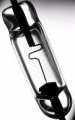
Came across this picture at wikipedia and remembered this thread:
upload_2016-9-4_8-18-16.png
It's a diode of Chinese manufacture from the 70's. One terminal is bonded/epoxied to a metal "slug" on the bottom lead. The other terminal is connected via a wire to the top lead.

I've seen diagrams showing both terminals connected as in the bottom lead, but this should have problems with different coefficients of thermal expansion.

If you look at a 1N914 or 1N4148 type diode under a microscope, you might be able to see something similar.
 
Last edited:

hp1729

Joined Nov 23, 2015
2,304
Hello
If there is no supply across the semiconductor component (diode, Transistors) than electron in component don't move anywhere. And when we apply voltage across the semiconductor component, electron move from one atom to another atom toward negative to positive terminal of battery. Thus current means flow of electron. Holes are the absence of electron. That means we need two material, one create hole and another will create electron. I think that is N type material and P type material. Is that silicon diode make with pure silicon material or we added some impurity. Does silicon diode make with tow different materials P and N type material?
Y would blame Forest Mimms for this misconception people have about the movement of electrons. In his description of electricity he shows electrons sleeping (snoring) before electricity is applied. :)
Otherwise his books are pretty good with only a few such "simplifications".
 

Papabravo

Joined Feb 24, 2006
22,075
Actually, at all temperatures above absolute zero the electrons are in constant motion drifting around and having a gay old time with no care or direction. The application of a bias voltage changes the electrical potential and it suddenly favors motion in a particular direction. It's like when mom and dad come home and the teenagers move to another house.
 

dl324

Joined Mar 30, 2015
18,296
If you look at a 1N914 or 1N4148 type diode under a microscope, you might be able to see something similar.
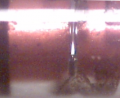
I tried; at 60X you can't see much.
upload_2016-9-4_10-45-47.png

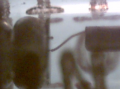
Here's a picture of a 1N270 (germanium diode) at 60X:
upload_2016-9-4_10-43-41.png
The cathode is on the left in both photos.
 
Top