Signal Conditioning Circuit Design

Thread Starter

jsthomps

Joined Mar 30, 2010
31
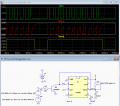
I posted a thread recently asking how I could best detect the AC magnetic field of an open frame relay circa 1960's. I received many great suggestions but what I have settled on is using a hall effect sensor in very close proximity to the relay coil. The problem I pose here is that I need a circuit that can convert this signal:
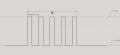
Screenshot 026a.jpg
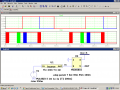
to this signal:
Screenshot 026b.jpg
The relay in question pulses for about 88ms but other relays being monitored may activate for as long as 2000ms. The plan is to send the conditioned pulse to an MC interrupt line so it can take action on the raise and/or fall (relay ON/relay OFF) of the signal. See block diagram below:

Screenshot 027.JPG
Any ideas would be greatly appreciated.
Thanks in advance,
Scott
 

wayneh

Joined Sep 9, 2010
18,104
It looks like all you need is a monostable multivibrator (one-shot), one of the standard 555 timer IC circuits. Once triggered, the output remains fixed for a given time period and subsequent trigger pulses are ignored until that period ends and the timer resets.
 

MaxHeadRoom

Joined Jul 18, 2013
30,654
The 555 already mention often used this way as a watch dog timer .
Or directly intro the MC if it is a Pic a capture/compare mode should do it.
Max.
 

crutschow

Joined Mar 14, 2008
38,503
The relay in question pulses for about 88ms but other relays being monitored may activate for as long as 2000ms. The plan is to send the conditioned pulse to an MC interrupt line so it can take action on the raise and/or fall (relay ON/relay OFF) of the signal.
If you need to know how long the relay is on then you would need a retriggerable one-shot with a >20ms timeout period.

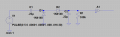
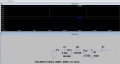
Here's the LTspice simulation of a 555 configured as a retriggerable one-shot, which should do what you want.

upload_2017-7-10_11-39-25.png
 

Attachments

MaxHeadRoom

Joined Jul 18, 2013
30,654
The relay in question pulses for about 88ms but other relays being monitored may activate for as long as 2000ms. The plan is to send the conditioned pulse to an MC interrupt line so it can take action
If inputting to a interupt already I would investigate doing it all in the MC and set up the watch dog in it directly.
Max.
 

crutschow

Joined Mar 14, 2008
38,503
To allow for pulse train timing tolerances, you could measure the period of the first pulse (between the first and second pulse rise) with the MC and then, when there are no more pulses after that period of time, the pulse train has terminated.
So you will know the pulse train has terminated within one pulse period of time.
 

ebeowulf17

Joined Aug 12, 2014
3,307
Based on the description from the MAX6816 datasheet, I don't think this will help with a continuously oscillating signal:

These switch debouncers remove bounce when a switch opens or closes by requiring that sequentially clocked inputs remain in the same state for a number of sampling periods. The output does not change until the input is stable for a duration of 40ms.
If the hall effect sensor output is oscillating in relation to the AC coil frequency, and assuming that AC is derived from the 50-60Hz mains (which is just a guess, but seems likely,) then the signal will NEVER be stable high for 40ms, and therefore the output will never switch high.

I have no prior experience with this chip, so please correct me if I've misinterpreted the datasheet.
 

ebeowulf17

Joined Aug 12, 2014
3,307
I posted a thread recently asking how I could best detect the AC magnetic field of an open frame relay circa 1960's. I received many great suggestions but what I have settled on is using a hall effect sensor in very close proximity to the relay coil. The problem I pose here is that I need a circuit that can convert this signal:
View attachment 130702
to this signal:
View attachment 130703
The relay in question pulses for about 88ms but other relays being monitored may activate for as long as 2000ms. The plan is to send the conditioned pulse to an MC interrupt line so it can take action on the raise and/or fall (relay ON/relay OFF) of the signal. See block diagram below:
View attachment 130704
Any ideas would be greatly appreciated.
Thanks in advance,
Scott
Just curious, what hall effect sensor have you decided to use? Have you tested it yet to see what kind of field strength/output voltage you'll be working with?

As to your main question in this thread, I would probably handle it in code, unless you're severely restricted by your mcu in terms of memory use, code size, etc. Code is free and can be used over and over again for every input. An electronic solution means extra expense and more soldering for each additional input. Don't get me wrong, there are times it's better to have the electronics ease the load on the mcu, but if it's a toss-up, I'd do it in code.
 
Top