Facebook
 Google
 GitHub
 Linkedin

Hi,
My name is Julio and i'm new here. This is my first thread.
So i'm studying electronics engineer and i have a mark about signal amplifier.
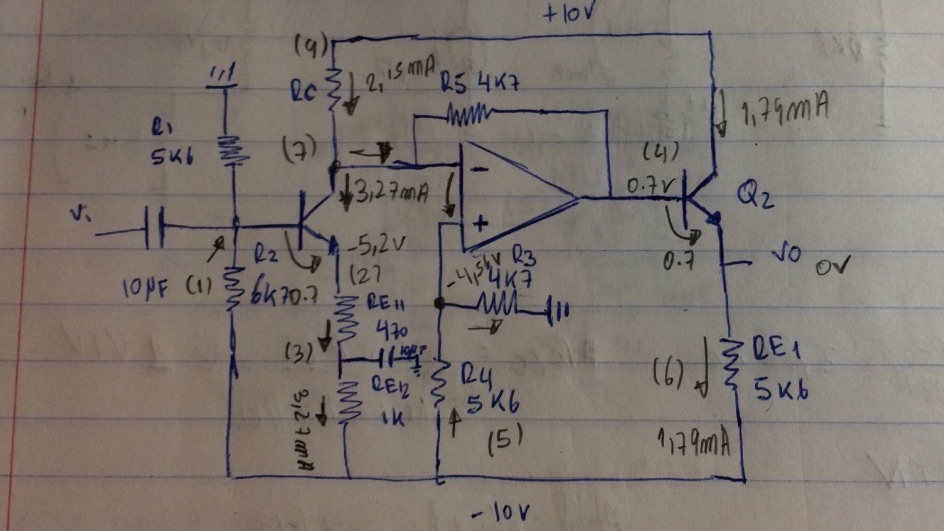
This is the circuit that i already calculate all point voltages and currents. I also calculate resistor RC (6K8). Now assuming that bjt Beta is 400 i need to calculate the gain for signal. So vcc and vss for signal is actually ground's so i have in first floor one EC(whit RE), after a ampop(that i don't now what is the configuration) and for the end, i have a CC(common collector).If there is no erro with my calculations AV1(EC)=-14,24V/V, AV3(CC) usually is 1. Now i'm stucked with the gain of ampop... Anyone can help me? What is the contribution of the ampop in this state?
In the practice the entire gain that i obtain is (Vout/Vin) = 10V/V, i don't now for sure if is 100 percent correct... Hope for answer's. Thanks people.
My name is Julio and i'm new here. This is my first thread.
So i'm studying electronics engineer and i have a mark about signal amplifier.
This is the circuit that i already calculate all point voltages and currents. I also calculate resistor RC (6K8). Now assuming that bjt Beta is 400 i need to calculate the gain for signal. So vcc and vss for signal is actually ground's so i have in first floor one EC(whit RE), after a ampop(that i don't now what is the configuration) and for the end, i have a CC(common collector).If there is no erro with my calculations AV1(EC)=-14,24V/V, AV3(CC) usually is 1. Now i'm stucked with the gain of ampop... Anyone can help me? What is the contribution of the ampop in this state?
In the practice the entire gain that i obtain is (Vout/Vin) = 10V/V, i don't now for sure if is 100 percent correct... Hope for answer's. Thanks people.