Facebook
 Google
 GitHub
 Linkedin
Hi,
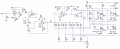
I'm trying to create a Driver circuit for a laser diode stack (see attached diagram)
To adjust the power of the laser stack, on pin 3 of the operational IC3, using a voltage ranging from 0 to 4V, I adjust the maximum current that the driver can supply.
With the R1 trimmer I carry out the calibration.
+ Vo1 and + Vo2 = + 12Vdc
-Vo1 and -Vo2 = -12Vdc
On V + and V- there are 24Vdc
On LD + and LD- the laser diode stack is connected, it can have a maximum absorption of 60 amps for a few milliseconds e.g. 30ms.
If you kindly give me some advice on the value of the SHUNT resistances (R25, R24, R23, R22) to use ...
is 0.1 ohm 10Watt ok?
I'm trying to create a Driver circuit for a laser diode stack (see attached diagram)
To adjust the power of the laser stack, on pin 3 of the operational IC3, using a voltage ranging from 0 to 4V, I adjust the maximum current that the driver can supply.
With the R1 trimmer I carry out the calibration.
+ Vo1 and + Vo2 = + 12Vdc
-Vo1 and -Vo2 = -12Vdc
On V + and V- there are 24Vdc
On LD + and LD- the laser diode stack is connected, it can have a maximum absorption of 60 amps for a few milliseconds e.g. 30ms.
If you kindly give me some advice on the value of the SHUNT resistances (R25, R24, R23, R22) to use ...
is 0.1 ohm 10Watt ok?