Facebook
 Google
 GitHub
 Linkedin
I am trying to repair a Stewart Warner tachometer transmitter from a mid 60s vintage 289 Shelby Cobra. Fortunately, I had the opportunity to reverse engineer a functional tachometer from one of these cars about a year ago.
The head unit is a simple ammeter calibrated in RPM. The transmitter is a one-shot triggered with the high voltage kick from the coil when the points open with each ignition event.
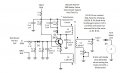
The transmitter is a blocking oscillator one-shot. When the input voltage is high enough, Q1 starts to turn on, causing current to start to flow through winding 1 of the pulse transformer. That current induces current in winding 2 of the transformer which drives the Q1 emitter negative, turning the transistor on harder. The transistor rapidly saturates. As the current stops changing in the transformer, Q1 falls out of saturation and the current starts to fall. That couples back through the transformer rapidly turning Q1 off, engine the one-shot pulse.
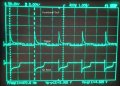
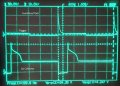
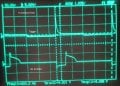
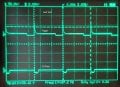
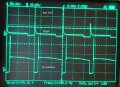
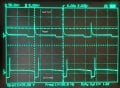
I took screen shots of all 3 of Q1’s terminals in the functional tach I revers engineered so you can see what a good tach does.
I recently received an identical tach that was non-functional. The head unit is functional and matches that of the good tach. I determined that C4 and Q1 in the transmitter were bad, so I replaced them. That brought the tach back to life but, after calibration, it would not go above about 3000 RPM.
It was clear from the scope traces from the bad tach that Q1 is not turning on hard enough. The emitter doesn’t go far enough negative and the pulse width is too narrow. I have a supply of 2N35 transistors. I tested all of them with a curve tracer and tried the three units with the highest gain and got the same results with all three.
I replaced all of the other caps with new ones even though the other old ones tested within spec, just to be safe. No change.
I checked the resistance of all of the resistors out of circuit and they were all within spec except for R4 and R7 which were barely out of spec. R4 measured 5.2 ohms and R7 measured 5.7 ohms. I don’t think they are far enough out of spec to cause the symptoms I am seeing.
I have temporarily added 0.01uF and 0.1uF caps to C3 to see if it could add energy to the pulse, but there was no change to the waveforms.
At this point, I am down to suspecting a problem with the pulse transformer. I have no clue as the failure modes of pulse transformers. The only theory I can come up with is that some of the turns of one winding 1 or 2 are shorted out. However, I measured the inductance of each of the windings of the transformer and they are very close to those of the good tach. Since I felt it was very risky to try unsoldering and resoldering the fine wires of the transformer, I measured the inductances in-circuit. I know, sub-optimal…
Worst case, I can replace the guts of the transmitter with the guts of a TachMatch to make the tach work in the car again. But the owner of this very rare and expensive car has asked me to try to repair it to keep it original.
Any ideas as to how to repair this tach would be greatly appreciated. Also any experiences with pulse transformer failures other than open circuits would also be appreciated.
The head unit is a simple ammeter calibrated in RPM. The transmitter is a one-shot triggered with the high voltage kick from the coil when the points open with each ignition event.
The transmitter is a blocking oscillator one-shot. When the input voltage is high enough, Q1 starts to turn on, causing current to start to flow through winding 1 of the pulse transformer. That current induces current in winding 2 of the transformer which drives the Q1 emitter negative, turning the transistor on harder. The transistor rapidly saturates. As the current stops changing in the transformer, Q1 falls out of saturation and the current starts to fall. That couples back through the transformer rapidly turning Q1 off, engine the one-shot pulse.
I took screen shots of all 3 of Q1’s terminals in the functional tach I revers engineered so you can see what a good tach does.
I recently received an identical tach that was non-functional. The head unit is functional and matches that of the good tach. I determined that C4 and Q1 in the transmitter were bad, so I replaced them. That brought the tach back to life but, after calibration, it would not go above about 3000 RPM.
It was clear from the scope traces from the bad tach that Q1 is not turning on hard enough. The emitter doesn’t go far enough negative and the pulse width is too narrow. I have a supply of 2N35 transistors. I tested all of them with a curve tracer and tried the three units with the highest gain and got the same results with all three.
I replaced all of the other caps with new ones even though the other old ones tested within spec, just to be safe. No change.
I checked the resistance of all of the resistors out of circuit and they were all within spec except for R4 and R7 which were barely out of spec. R4 measured 5.2 ohms and R7 measured 5.7 ohms. I don’t think they are far enough out of spec to cause the symptoms I am seeing.
I have temporarily added 0.01uF and 0.1uF caps to C3 to see if it could add energy to the pulse, but there was no change to the waveforms.
At this point, I am down to suspecting a problem with the pulse transformer. I have no clue as the failure modes of pulse transformers. The only theory I can come up with is that some of the turns of one winding 1 or 2 are shorted out. However, I measured the inductance of each of the windings of the transformer and they are very close to those of the good tach. Since I felt it was very risky to try unsoldering and resoldering the fine wires of the transformer, I measured the inductances in-circuit. I know, sub-optimal…
Worst case, I can replace the guts of the transmitter with the guts of a TachMatch to make the tach work in the car again. But the owner of this very rare and expensive car has asked me to try to repair it to keep it original.
Any ideas as to how to repair this tach would be greatly appreciated. Also any experiences with pulse transformer failures other than open circuits would also be appreciated.
Attachments
-
 457.6 KB Views: 2
 -
 489.2 KB Views: 2
 -
 469.8 KB Views: 6
 -
 176.6 KB Views: 8
 -
 526.9 KB Views: 6
 -
 462.2 KB Views: 3
 -
 551.1 KB Views: 2