Shaded Pole Motor Speed Control

Thread Starter

KAN3KI5

Joined Feb 25, 2018
14
Hi. I've received a task recently as part of a design project. I'm going to be given a 24W 230VAC shaded 2 pole motor in order to be used as a variable speed fan. The fan is supposed to sense temperature and adjust the speed of the motor accordingly. I need to know the best method for achieving this (controlling the speed, not the other part). I have researched and have come up with simply lowering the voltage to the motor but it seems to be destructive to the motor. Any tips?
 

cmartinez

Joined Jan 17, 2007
8,765
I've done some experimenting with shaded pole motors before, and yes, they can be controlled with ordinary triacs configured as dimmers. The thing is that below 50% power they tend to become a little too unstable under load. It should work ok for fan, though.
Keep in mind also that those cheap-o shaded pole motors used in fans normally have low-quality bearings, and they "age" rather quickly and are their most important source of eventual failure.
 

ebp

Joined Feb 8, 2018
2,332
Any motor can pose a turn-off problem for a triac because the inductance causes high δv/δt as the triac turns off, turning it right back on again. A simple RC snubber across the triac usually does the job. Some triacs are specifically designed to handle high δv/δt. Back-to-back SCRs also cope well, but that is usually reserved for much higher power loads because it is usually more expensive and requires two power devices. There are lots of triacs in isolated packages, which can be convenient.

I've certainly noticed some fans can make a pretty obnoxious noise when controlled with a triac.

Most of the "household" fans I have/had can be oiled quite easily, but it typically isn't something that can be done in 5 minutes. I have one box fan that has to have the motor disassembled to lube it. I'm quit willing to do it because I can't find a fan like it anymore.

Are we allowed to talk about this stuff? Moderator?
 

KL7AJ

Joined Nov 4, 2008
2,229
For a 24W shaded-pole motor running a fan?
That's overkill.

Such fan motors are readily controlled by a TRIAC lamp dimmer type circuit, as Max suggested.
The only problem can be a buzz in the motor from the chopped sine-wave.
A shaded pole motor is synchronous. If you simply reduce the duty cycle, you're relying on losses to slow the motor down....very inefficient....and noisy.
 

MaxHeadRoom

Joined Jul 18, 2013
30,663
A shaded pole motor is synchronous. If you simply reduce the duty cycle, you're relying on losses to slow the motor down....very inefficient....and noisy.
A shaded pole motor is very inefficient to start with.
Also a shaded pole/induction motor cannot be synchronous, there has to be a certain amount of slip in order for induction to take place.
Max.
 

Thread Starter

KAN3KI5

Joined Feb 25, 2018
14
This design project is quite out of my way as i only know basic electronics. Currently studying computer engineering, not electronic (Have no idea why this is our task now :confused:). In the big picture of things, this fan is going to be controlled by the room temperature (a thermistor) but, i do not have access to it, that's someone else's thing. What i receive is a voltage from the other guy (0-12V) and I'm supposed to adjust the speed of the motor accordingly. Though the motor will function in states of High, Med, Low speed and off.
If you have/ can recommend material for me to study I'm willing to look over it. So far I've determined that VFD's are quite expensive and to make one myself isn't going to be cheap and is out of the budget. Someone in my class said that i should use a Triac which is how i got the idea, but now everyone has conflicting opinions so not really sure what will work and what won't.
 

Thread Starter

KAN3KI5

Joined Feb 25, 2018
14
Okay. Researched a bit more and have an idea. What if I use an optocoupler with a triac so that when the optocoupler is triggered the triac starts conducting and then runs the motor and when the optocoupler is off, the triac will fall below threshold current and then switch the motor off again. Thinking of feeding a square wave with same frequency as mains to the optocoupler from a timer or something else. Thoughts?
 

Thread Starter

KAN3KI5

Joined Feb 25, 2018
14
Another thing I saw was a vfd that was made with IGBTs as inverters and uses a pwm signal to control it. But this was for a PSC motor, would it work for a shaded pole?
 

MaxHeadRoom

Joined Jul 18, 2013
30,663
Okay. Researched a bit more and have an idea. What if I use an optocoupler with a triac so that when the optocoupler is triggered the triac starts conducting and then runs the motor and when the optocoupler is off, the triac will fall below threshold current and then switch the motor off again.
That is the gist of the AN-3006 app note?
i.e. Phase angle triggering.
Max.
 

Thread Starter

KAN3KI5

Joined Feb 25, 2018
14
Hi
I've gotten the stuff needed from the circuit in the App Note and it seems to be working okay, just a few quick questions. It's currently operating off a 115V supply at 60Hz. Our mains here is 230V at 50Hz. What would I need to change to get that to work? I know the resistor on the left going to the rectifier bridge will need changing, but anything else? And I need to change out the potentiometer at the 555 timer. What we're going to be given is a 0-5V dc voltage for testing and the fan needs to change its speed based on that. Any ideas?
 

cmartinez

Joined Jan 17, 2007
8,765
Hi
I've gotten the stuff needed from the circuit in the App Note and it seems to be working okay, just a few quick questions. It's currently operating off a 115V supply at 60Hz. Our mains here is 230V at 50Hz. What would I need to change to get that to work? I know the resistor on the left going to the rectifier bridge will need changing, but anything else? And I need to change out the potentiometer at the 555 timer. What we're going to be given is a 0-5V dc voltage for testing and the fan needs to change its speed based on that. Any ideas?
The only way I can give you an informed opinion is if you were to post a schematic of what you're using, with part values and all.
 

MaxHeadRoom

Joined Jul 18, 2013
30,663
Hi
I've gotten the stuff needed from the circuit in the App Note and it seems to be working okay, just a few quick questions. It's currently operating off a 115V supply at 60Hz. Our mains here is 230V at 50Hz. What would I need to change to get that to work? I know the resistor on the left going to the rectifier bridge will need changing, but anything else? And I need to change out the potentiometer at the 555 timer. What we're going to be given is a 0-5V dc voltage for testing and the fan needs to change its speed based on that. Any ideas?
Just change the series resistor to double the value.
Why would you need to change the pot value?
Max.
 

Thread Starter

KAN3KI5

Joined Feb 25, 2018
14
The only way I can give you an informed opinion is if you were to post a schematic of what you're using, with part values and all.
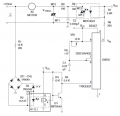
Here's the circuit from the App note:
Capture.PNG

Why would you need to change the pot value?
From what i understand, the value of the pot determines how long the pulse duration from the 555 timer is. Correct? By change the pot, i meant remove it. Basically i want it to function such that if i feed a 0V-5V dc signal into the system (Because that's how the system is getting tested), I want the pulse width to become greater or less depending on the voltage supplied. Basically, if I'm getting 5V DC into the system the fan should be at full speed, at 2.5V the fan should be around 1/2 of it's max speed and so forth.
 

MaxHeadRoom

Joined Jul 18, 2013
30,663
If you need a speed dependent on an external signal then you may need to feed the signal to the discharge in, I have also used a 8 pin picmicro based around the AN958 app notes.
Max.
 

Thread Starter

KAN3KI5

Joined Feb 25, 2018
14
I have also used a 8 pin picmicro based around the AN958 app notes.
Apologies for not mentioning this earlier, i thought i had :(. I cannot use a micro-controller. Life would be so much easier if i could. Which is the main reason why I'm having so much of trouble with this circuit.
 
Top