Facebook
 Google
 GitHub
 Linkedin

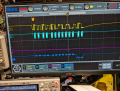
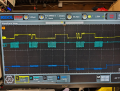
Sure you can send data both ways. I don't use resistors in this example because I set the TRIS mode on the SPI TX port pin for input or output.I've been looking closely at SPI but haven't seen a 2 wire SPI reference anywhere. In my case its only a master and a single slave so the chip select really isn't needed. So i'm left with a clock and a single data line between the master and slave. I know my implementation sends data both ways. What does the SPI protocol look like for sending data both ways on a single data line?
This slave device uses a bi-directional data line for SPI.
https://www.parallax.com/product/lsm9ds1-9-axis-imu-module/
Example code modified for PIC32MK:
C:
/**
* @file LSM9DS1_SPIwrite.c
*
* @author Matthew Matz
*
* @version 0.5
*
* @copyright
* Copyright (C) Parallax, Inc. 2016. All Rights MIT Licensed.
*
* @brief This Propeller C library was created for the Parallax 9-axis IMU Sensor, based
* on the STMicroelectronics LSM9DS1 inertial motion sensor chip.
*/


#include "lsm9ds1.h"
#include "config/pic32mk_mcj_curiosity_pro/peripheral/gpio/plib_gpio.h"
#include "config/pic32mk_mcj_curiosity_pro/peripheral/spi/spi_master/plib_spi2_master.h"

extern int __pinM, __pinSDIO, __pinSCL;

/*
* PIC32: changed to use hardware SPI module and plib_gpio pin functions
*/
void imu_SPIwriteByte(unsigned char csPin, unsigned char subAddress, unsigned char data)
{
    uint8_t tmp = subAddress & 0x3F;

    SPI2CONbits.DISSDO = 0; // half-duplex switching, SPI TX ON, PORT pin mode OFF
    if (csPin == __pinM)
        csPin_m_Clear();
    else
        csPin_ag_Clear();

    SPI2_Write(&tmp, 1);
    SPI2_Write(&data, 1);
    if (csPin == __pinM)
        csPin_m_Set();
    else
        csPin_ag_Set();

}

void imu_SPIreadBytes(unsigned char csPin, unsigned char subAddress, unsigned char *dest, unsigned char count)
{
    int i;

    // To indicate a read, set bit 0 (msb) of first byte to 1
    unsigned char rAddress = 0x80 | (subAddress & 0x3F);

    // Mag SPI port is different. If we're reading multiple bytes,
    // set bit 1 to 1. The remaining six bytes are the address to be read
    if ((csPin == __pinM) && count > 1) rAddress |= 0x40;

    SPI2CONbits.DISSDO = 0; // half-duplex switching, SPI TX ON
    if (csPin == __pinM)
        csPin_m_Clear();
    else
        csPin_ag_Clear();

    SPI2_Write(&rAddress, 1);
    SPI2CONbits.DISSDO = 1;
    for (i = 0; i < count; i++) {
        SPI2_Read(&dest[i], 1); // half-duplex switching, SPI TX OFF, PORT pin mode input
    }
    if (csPin == __pinM)
        csPin_m_Set();
    else
        csPin_ag_Set();

}
/*
* Based on the Arduino Library for the LSM9SD1 by Jim Lindblom of Sparkfun Electronics
*/
C:
#include "definitions.h"                // SYS function prototypes
#include "../../Utility/libsimpletools/simpletools.h"
#include "lsm9ds1.h"
#include "imu.h"
#include "../../eadog.h"

int __pinAG, __pinM, __pinSDIO, __pinSCL;
char __autoCalc = 0;

int imu_init(int pinSCL, int pinSDIO, int pinAG, int pinM)
{
    char buffer[STR_BUF_SIZE];

    __pinAG = pinAG;
    __pinM = pinM;
    __pinSDIO = pinSDIO;
    __pinSCL = pinSCL;

    // Set both the Accel/Gyro and Mag to 3-wire SPI mode
    /*
     * We don't use SPI bit-banging for 3-wire because it's possible to setup a hardware 3-wire mode on the PIC32 module
     * on the pic32mk hardware SPI module jumper mosi to miso for half-duplex 3-wire mode and config for SPI MODE 3
     * set the TRIS mode on the SPI TX port pin for input so we can turn-off the transmitter voltage during SPI receive
     * on the bidirectional SPI line
     *
     * SPIxCON: SPI CONTROL REGISTER
     * bit 12 DISSDO: Disable SDOx pin bit(4)
     * 1 = SDOx pin is not used by the module. Pin is controlled by associated PORT register
     * 0 = SDOx pin is controlled by the module
     */
    TRISCbits.TRISC7 = 1; // SPI2 TX port set to port control as a input so we don't affect received data when in port mode
    imu_SPIwriteByte(__pinAG, CTRL_REG8, 0b00001100);
    imu_SPIwriteByte(__pinM, CTRL_REG3_M, 0b10000100);

    // To verify communication, we can read from the WHO_AM_I register of
    // each device. Store those in a variable so we can return them.
    char xgTest = 0, mTest = 0;
    imu_SPIreadBytes(__pinM, WHO_AM_I_M, (unsigned char *) &mTest, 1); // Read the gyro WHO_AM_I
    imu_SPIreadBytes(__pinAG, WHO_AM_I_XG, (unsigned char *) &xgTest, 1); // Read the accel/mag WHO_AM_I
    int whoAmICombined = (xgTest << 8) | mTest;

    if (whoAmICombined != ((WHO_AM_I_AG_RSP << 8) | WHO_AM_I_M_RSP)) return 0;

    //Init Gyro
    imu_SPIwriteByte(__pinAG, CTRL_REG1_G, 0xC0);
    imu_SPIwriteByte(__pinAG, CTRL_REG2_G, 0x00);
    imu_SPIwriteByte(__pinAG, CTRL_REG3_G, 0x00);
    imu_SPIwriteByte(__pinAG, CTRL_REG4, 0x38);
    imu_SPIwriteByte(__pinAG, ORIENT_CFG_G, 0x00);

    //Init Accel
    imu_SPIwriteByte(__pinAG, CTRL_REG5_XL, 0x38);
    imu_SPIwriteByte(__pinAG, CTRL_REG6_XL, 0xC0);
    imu_SPIwriteByte(__pinAG, CTRL_REG7_XL, 0x00);

    //Init Mag
    imu_SPIwriteByte(__pinM, CTRL_REG2_M, 0x00);
    imu_SPIwriteByte(__pinM, CTRL_REG4_M, 0x0C);
    imu_SPIwriteByte(__pinM, CTRL_REG5_M, 0x00);

    //Set Scales
    imu_setGyroScale(2000); // 2000
    imu_setAccelScale(16);  // 16
    imu_setMagScale(16);   // 16

    //Look for calibrations in NVRAM
    char biasStamp[8] = {0};
    char mBiasStored[8] = {0};
    char aBiasStored[8] = {0};
    char gBiasStored[8] = {0};
    get_nvram_str(0, biasStamp);
    get_nvram_str(7, mBiasStored);
    get_nvram_str(14, aBiasStored);
    get_nvram_str(21, gBiasStored);

    if (strncmp(biasStamp, "LSM9DS1", 7) == 0) {
        sprintf(buffer, "LSM9DS1 cal header found");
        eaDogM_WriteStringAtPos(8, 0, buffer);
        OledUpdate();
        if ((mBiasStored[0] = 'm')) {
            int mxB = (mBiasStored[1] << 8) | mBiasStored[2];
            int myB = (mBiasStored[3] << 8) | mBiasStored[4];
            int mzB = (mBiasStored[5] << 8) | mBiasStored[6];

            imu_setMagCalibration(mxB, myB, mzB);
        }

        if ((aBiasStored[0] = 'a')) {
            int axB = (aBiasStored[1] << 8) | aBiasStored[2];
            int ayB = (aBiasStored[3] << 8) | aBiasStored[4];
            int azB = (aBiasStored[5] << 8) | aBiasStored[6];

            imu_setAccelCalibration(axB, ayB, azB);
        }

        if ((gBiasStored[0] = 'g')) {
            int gxB = (gBiasStored[1] << 8) | gBiasStored[2];
            int gyB = (gBiasStored[3] << 8) | gBiasStored[4];
            int gzB = (gBiasStored[5] << 8) | gBiasStored[6];

            imu_setGyroCalibration(gxB, gyB, gzB);
        }
    } else {
        sprintf(buffer, "No LSM9DS1 cal header found %s", biasStamp);
        eaDogM_WriteStringAtPos(8, 0, buffer);
        OledUpdate();
    }


    // Once everything is initialized, return the WHO_AM_I registers we read:
    return whoAmICombined;
}
Code:
void imu_readAccel(int *ax, int *ay, int *az)
{
  unsigned char temp[6]; // We'll read six bytes from the accelerometer into temp
  short tempX, tempY, tempZ;

  imu_SPIreadBytes(__pinAG, OUT_X_L_XL, temp, 6); // Read 6 bytes, beginning at OUT_X_L_XL
  tempX = (temp[1] << 8) | temp[0]; // Store x-axis values into ax
  tempY = (temp[3] << 8) | temp[2]; // Store y-axis values into ay
  tempZ = (temp[5] << 8) | temp[4]; // Store z-axis values into az

  *ax = (int) tempX;
  *ay = (int) tempY;
  *az = (int) tempZ;

  if (__autoCalc & 0b10)
  {
    *ax -= __aBiasRaw[X_AXIS];
    *ay -= __aBiasRaw[Y_AXIS];
    *az -= __aBiasRaw[Z_AXIS];
  }
}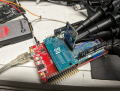
Proto shield board on the PIC32MK DEV board.
Last edited: