Sequential power supply circuit

k1ng 1337

Joined Sep 11, 2020
1,038
k1ng 1337,

Thanks for all the information I was doing an intensive research on whether going about with Arduino or Rasberry Pi. I have finally concluded to go with the Pi Pico and learning micropython to program it. I presume that would be much easier.
I found it to be easy when I began learning and I still find the Pico the easiest to implement for more complex jobs. Debugging is much faster because Python code doesn't need to be compiled and uploaded to the device to run. This saves time and headache because the "back-end" is fully operational. Given the costs of both, I say buy both and see which you like more because they each have their strengths.
 

ElectricSpidey

Joined Dec 2, 2017
3,335
It's not a "bummer" it's a choice.

4049:
2 chips or 1 chip and 1 transistor & resistor/s.

Load driver:
1 chip and 1 resistor network.

And the load driver can do a voltage translation if needed.
But I'm thinking the point is moot if the OP has decided to go the micro route.
 

Irving

Joined Jan 30, 2016
5,134
Debugging is much faster because Python code doesn't need to be compiled and uploaded to the device to run.
Not sure I agree with that... whats stored on the MCU is an encoded version of the source - it still has to be encoded and downloaded.

Anyway its a moot point. The ATtiny code for this takes <5sec to compile & download, so hardly a wait!
 

AnalogKid

Joined Aug 1, 2013
12,143
About these 7 load circuits . . . Is there any reason they have to be hard-wired to GND? IOW, what about connecting the + inputs of the circuits directly to the +12 V supply, and switching the GND connections?

If this is an option, then a discrete (non-uC) circuit looks like this:

CD4060 produces 1-hr timebase
CD4017 counter steps through the 7 circuits
ULN2004 is a 7-circuit switch, rated for 1/2 amp per output

Internally, a ULN2004 section is a darlington transistor, not a saturated switch, so there is approx. 0.8 V across an output when it is "on". If this is a problem, can the power supply be turned up 7%?

ak
 
Last edited:

k1ng 1337

Joined Sep 11, 2020
1,038
Not sure I agree with that... whats stored on the MCU is an encoded version of the source - it still has to be encoded and downloaded.

Anyway its a moot point. The ATtiny code for this takes <5sec to compile & download, so hardly a wait!
Well, then the encoding and downloading occurs almost instantly for most of my programs. It's only when I call certain libraries where it becomes a second or two. I also happen to like how Micro Python and Circuit Python are set up to access the "machine" outside of regular Python. It's a great system IMO.
 

Thread Starter

sab201

Joined Nov 18, 2023
297
AnalogKid,
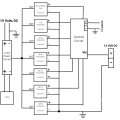
ULN2004 sounds like good you can see the circuit I made here.
sketch-1718084667592.jpg
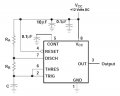
When other pulse generation circuits are OFF, the one that is ON will feed the load circuit. Since OUT signals are all shorted together, there will still be voltage present at the OUT pins of the other Pulse generators. I am not an electronics expert but I assumed that this wouldnt pose any problem to the 555 timer ICs on the pulse generators since power to it will be OFF.

Now when you say that ULN2004 can be used where the ground lines are used to switch the circuits I am not sure what will be the outcome. I have given the circuit may be you can suggest. Thanks.

EDIT: OUT pin of the 555 timer and the grounds of the pulse generator circuits and load power circuit are common. So the pulse output is from OUT to GND.sketch-1718092519260.jpg
 
Last edited:

Thread Starter

sab201

Joined Nov 18, 2023
297
Even though a uC can be used still I need a strategy on the uC output to control and switch the 12 Volt power supplies.
 

Irving

Joined Jan 30, 2016
5,134
Even though a uC can be used still I need a strategy on the uC output to control and switch the 12 Volt power supplies.
If you want to do that pulsing the MCU will do that for you, no 555s needed. But you can't connect 555 outputs together, they are not open collector but a totem pole output. a 12v pulse on the output of a 'switched off' 555 will partially power it on, leading to some weird side-effects.
 

Thread Starter

sab201

Joined Nov 18, 2023
297
If you want to do that pulsing the MCU will do that for you, no 555s needed. But you can't connect 555 outputs together, they are not open collector but a totem pole output. a 12v pulse on the output of a 'switched off' 555 will partially power it on, leading to some weird side-effects.
You are right. But can an MCU generate pulses of more than 5 V peak value? I dont think it can. Yes you are right I had that doubt that these outputs cant be connected together. May be I could use diodes in the circuit that is why I want to discuss it here.
 

ElectricSpidey

Joined Dec 2, 2017
3,335
If I might offer a different solution...

You can use a single 555 and a 4017 to change the frequency, as I have done with many a project.

Then if you need 50/50 you can use a F/F to get that then buffer the output to get the current you need.

Let me know if you are interested.
 

Irving

Joined Jan 30, 2016
5,134
You are right. But can an MCU generate pulses of more than 5 V peak value? I dont think it can. Yes you are right I had that doubt that these outputs cant be connected together. May be I could use diodes in the circuit that is why I want to discuss it here.
No, but that's the job of the external driver, the MCU is in charge of timing. What do the 555s drive?
 

MisterBill2

Joined Jan 23, 2018
27,567
It looked to me like it took until post #20 to realize that the CD4066 is ANALOG switch intended for switching SIGNALS, not power. I was going to suggest looking at the actual DATA sheets by the manufacturers.
But the wiring diagram in post #20 shows that may have been realized.
 

AnalogKid

Joined Aug 1, 2013
12,143
Now that you have shown us what you are doing, there is a much easier way to do it. You can switch the timing capacitors in and out of the astable circuit while the 555 runs continuously.

1 - 555

7 - timing capacitors

1 - ULN2004

1 - 4017 driving the ULN2004

1 - CD4060 timebase

Schematic later.

ak
 

Thread Starter

sab201

Joined Nov 18, 2023
297
No, but that's the job of the external driver, the MCU is in charge of timing. What do the 555s drive?
Right now I am using the output of the 555 timers as input to the wiper pin of the voltage pot of a power supply buck converter (as suggested by Crutschow in another thread). When I do this, I find that it works better at a higher pulsing voltage from the 555 timer.

In another version of the Load Power Circuit I wish to use a MOSFET switching module driven by a pulse generator where the supply from the buck converter is switched ON/OFF through the MOSFET switching module to the Load to send the pulsing power supply. I suppose this is what you are saying about the job of the external driver at the output of the microcontroller. However this is still under testing stage and incase I succeed in this version of Load Power Circuit I suppose the PWM outputs from the microcontroller at 5 Volts DC should be enough to drive the switching MOSFET module to supply pulsing power to the load directly.
 

Thread Starter

sab201

Joined Nov 18, 2023
297
Now that you have shown us what you are doing, there is a much easier way to do it. You can switch the timing capacitors in and out of the astable circuit while the 555 runs continuously.
ak
Thanks AnalogKid... I suppose that the timing is controlled by a combination of both resistors and a capacitor. I am curious to know about this.
 

Irving

Joined Jan 30, 2016
5,134
If all you are doing is powering a single end circuit with different pulse rates, you don't need 7 outputs, just the one output with a variable pulse rate and a driver for whatever voltage you need.... are you varying the voltage or just its on/off rate?

It would be really helpful to explain the end result you desire rather than release parts of the jigsaw - I suspect you are making is much more complicated than necessary by addressing each item in isolation.
 

Thread Starter

sab201

Joined Nov 18, 2023
297
If I might offer a different solution...

Let me know if you are interested.
Thanks ElectricSpidey. I am always open to new ideas and possibilities other than my own you guys have a lot of experience in this field which I do not. AnalogKid seems to have a similar one. Ofcourse all methods have their own advantages and disadvantages and it would be wise to take everything into consideration. I wished to have discrete 555 timer circuits for each frequency with indicating light colors since I considered that the failure of one might not affect the others and the operation of the entire circuit.
 

Thread Starter

sab201

Joined Nov 18, 2023
297
If all you are doing is powering a single end circuit with different pulse rates, you don't need 7 outputs, just the one output with a variable pulse rate and a driver for whatever voltage you need.... are you varying the voltage or just its on/off rate?

It would be really helpful to explain the end result you desire rather than release parts of the jigsaw - I suspect you are making is much more complicated than necessary by addressing each item in isolation.
I am just varying the frequency not the peak value. Like I said above I like to have discrete circuits so that failure of one does not pose significant impact on the entire circuit.

Yes my bad, I should have drawn the circuit and posted it in the beginning of the thread, it took a bit of time and effort to draw it.

Thanks everyone for all your valuable responses.
 

ElectricSpidey

Joined Dec 2, 2017
3,335
Here is an idea.

You could use a 7 input OR gate with a buffered output, connected to the outputs of the 555s.

Then it may be possible to control which 555 is active by using the 4017 connected to the reset pins of the 555s.

Then you could use your original idea using 7 555s for the reasons you mentioned.
 
Top