It might if you use a filter - the white background reflects all colours, if you can figure some way to use blue light - the red pointer will reflect less of it than the white background.
I tried it with very crude setup; blue 5mm LED @ 20 mA, Si detector, 1 mm wide X 7 mm long, white paper, & 1 mm red wire. LED & sensor angled about 30 deg. paper about 1 cm in front. Detected 1 mm wire moving back & forth. Worked about as well with white wire as it did with white LED. OK with real photo reflective sensor, K but spacing is critical, about 5 mm, & not as sensitive to wire movement.
I tried it with very crude setup; blue 5mm LED @ 20 mA, Si detector, 1 mm wide X 7 mm long, white paper, & 1 mm red wire. LED & sensor angled about 30 deg. paper about 1 cm in front. Detected wire moving back & forth. Worked about as well with white wire as it did with white LED. OK with real photo reflective sensor, K but spacing is critical, about 5 mm, & not as sensitive to wire movement.
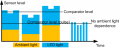
Good job! I like it. Can you feed LED by pulse 1...10 kHz voltage and put signal from sensor through capacitor on input of any high gain amplifier?
EDIT: May be some astable multivibrator with LED in series with collector's resistor.
Max, I agree with you. QRE1113 contains 48% electro-optical efficiency infrared LED, and phototransistor, spectrally matched with LED. At very short distances illumination intensity from LED much more than any possible intensity from ambient light.
I had experience with design of reflective sensor for ceramic products on conveyer inside steel tunnel with infrared emitters, through quartz window on distance 300 mm. I used blue LED, photodiode + blue filter, both with lenses for focusing on product, but only after applying pulse current for LED I got desired stable results.

 Facebook
 Google
 GitHub
 Linkedin