Detect if a sensor is present in a circuit

Thread Starter

m.buckham

Joined Jul 15, 2024
4
Hello,

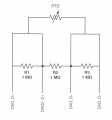
I am testing 4 wire RTDs with a DAQ, and have 3 parallel resistors connected across the 4 wires as shown. This helps with avoiding false negatives in the test (distinguishes if there is an error in the measurement system vs the RTD), because I will get different measurements if the RTD is working (1kohms) vs failed open circuit (3Mohms). Is there a name for this circuit? Is this an example of signal biasing?
1721102880270.png

Thank you,
M
 

KeithWalker

Joined Jul 10, 2017
3,603
You haven't given us enough information to answer your questions. Your bit of a circuit diagram doesn't show how it is powered or how the common return is referenced to the measuring device.
 

Thread Starter

m.buckham

Joined Jul 15, 2024
4
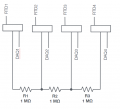
Hi Keith, thank you for the reply. Hopefully this diagram provides a bit more info. The RTD's 4 wires are connected to a DAQ channel, where 2 wires are for driving the device and 2 wires are for sensing/measuring.
1721144979881.png
M
 

KeithWalker

Joined Jul 10, 2017
3,603
I don't think that is what you really mean! DAQ_D+ is connected to DAQ2_S+, shorting out R1. R3 is similarly shorted. What does the DAQ measure? Does it supply power to the circuit?
How about a real diagram showing the whole measurement setup.
 

Thread Starter

m.buckham

Joined Jul 15, 2024
4
Sorry, I just realized DAQ2_S+ is a typo, it's supposed to be DAQ_S+.

I want the DAQ to just the resistance of the RTD, if the RTD is ok. If the RTD is not ok, I want to get a different measurement and not read open circuit. I am able to get readings from the DAQ, but now I'm confused about how it's working. If the RTD failed open circuit, then it would short R1 and R3, and you would just read R2, right? Otherwise the DAQ_S+ and DAQ_S- are measuring the resistance of the RTD and R2, and R2 introduces a small error in the measurement (assuming it's much larger than the RTD resistance)?
 

KeithWalker

Joined Jul 10, 2017
3,603
The usual way a RTD is used is by putting it in series with a resistor, across a voltage source, and measuring the voltage at the junction. Open or shorted RTDs will give obvious extreme values.
I still don't understand how you are proposing to measure yours.
 

KeithWalker

Joined Jul 10, 2017
3,603
I must apologize for misinterpreting your questions. You stated " I am testing 4 wire RTDs with a DAQ, and have 3 parallel resistors connected across the 4 wires as shown". Your diagram shows four RTDs. I assumed from that information you were measuring multiple RTDs in the same package, having four different connections.
Having thought about it for some time, I realized that you probably meant that you are measuring the resistance of the RTDs using four wire measurement. My answers must have seemed a little strange because of the misunderstanding.
In spite of that, my advice is still the same. The connections in your second diagram. R1 and R3 will have no effect on the measurement because they are both shorted out. R2 will affect the accuracy of the measured resistance. By how much will depend on the nominal resistance of the RTD. If the RTD goes open circuit, the measured result will be the value of R2. I don't see how that will be any better than having a complete open circuit. As I stated, odd results from a failed RTD are usually taken care of in the software that is interpreting the results from the A/D.
 

MisterBill2

Joined Jan 23, 2018
27,159
A standard (sort of) method of sensing a sensor failure is called "upscale burnout" or "downscale burnout" sensing. That consists of a much higher value resistor being used to bias the sensing input in the event of the sensor element failing open. The shunt resistor value being chosen to be high enough that it does not cause an excessive error during normal operation.
 

MisterBill2

Joined Jan 23, 2018
27,159
Actually, the circuit in post #3 is complete and those 1 Meg resistors would provide burnout or wire break protection. It would just be a bit unconventional.
 
Top