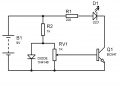
I would like help with this circuit, I would like to calculate the voltage Vc and the total current flowing through the circuit. Consider the diode is Si and replaced by and 0.7 battery and the beta is too big therefore Ib is small.
I would like help with this circuit, I would like to calculate the voltage Vc and the total current flowing through the circuit. Consider the diode is Si and replaced by and 0.7 battery and the beta is too big therefore Ib is small. View attachment 285535
You are told that the diode voltage is 0.7V but you are not told what is the base-emitter voltage of the transistor. Some are 0.6V and others are 0.8V.
You must guess that the too big beta of the transistor and its small Ib makes it turn on well with the 0.7V then you can use Ohm's Law to calculate the collector current.
You also must guess what is the color of the LED light.
Collector voltage with respect to what point in the circuit? I am guessing you are talking about the voltage from the collector to the emitter? Then as a function of what variable? You mention the "current in the circuit", there are four currents in this circuit! I take it as a function of the position of RV1? In a real circuit you cannot assume the 1N4148 forward voltage drop is 0.7V as the datasheet spans 0.62V to 0.72V. Neither can you assume the base emitter drop as the datasheet for that part spans from 580mV to 700mV. As the collector current is a function of the base emitter drop and both the 1N4148 and the transistor are temperature dependent in this circuit as well. Not to mention no part number for the LED is mentioned, and the forward drop of them can be all over the board. No engineer would make a circuit like this as it varies with the parts used and with temperature as well. If this is a test question, it is almost impossible to answer intelligently.
I would like help with this circuit, I would like to calculate the voltage Vc and the total current flowing through the circuit. Consider the diode is Si and replaced by and 0.7 battery and the beta is too big therefore Ib is small. View attachment 285535
What model can you use for the transistor?
I am not so sure you are given enough information to complete this task. When you say Ib is small and Beta is big, that seems to imply that the transistor is in saturation so you have to find the saturation voltage. Alternately you may have to use the formula for transconductance to get the current and then the Vc voltage. There is also the possibility that you have to calculate the range of Vc due to the fact that RV1 is actually a potentiometer.
The best we could do without more specific information is throw some typical values in and see what we get. Alternately, we could develop some equations without trying to obtain any specific numerical results and that would solve the circuit symbolically, meaning that if you were to get more specs you could calculate the numerical value of Vc or the range of Vc. What this would mean more or less is that the voltage of the LED call it vLED would stay as a variable throughout the calculations, and so would Beta and Ib, or gm or however you wish to solve this.
Also, since they give the part number of the transistor there is also the possibility that we have to use a spice model or something similar to a lower level spice model which would include an exponential like e^a in the result.
If you were not given these specifications then you would have to make some assumptions based on your previous work in the course you are enrolled in. Alternately, try to contact the author of this exercise and see if you can get more information from them. A fellow student may know something too if you missed a class or something.
I would like help with this circuit, I would like to calculate the voltage Vc and the total current flowing through the circuit. Consider the diode is Si and replaced by and 0.7 battery and the beta is too big therefore Ib is small. View attachment 285535

 Facebook
 Google
 GitHub
 Linkedin