Facebook
 Google
 GitHub
 Linkedin
There are quite a few 'cheap' NTC thermistors in the 'online flea markets' e.g.
https://www.aliexpress.com/w/wholesale-thermistor.html
just about all of them claims NTC 3950 25degC with no datasheets in the tag
so I go about searching for datasheets and stumbled into one e.g.
https://www.tme.eu/Document/803044d5da776ac3c31dc4c407347b50/NTCM-HP-100K-1.pdf
I 'got lucky' and it seemed what I casually measured of a 'cheap flea market' 100k NTC thermistor conforms to the specs quite well.
(I've had once got a 3d printer in which a claimed 100k NTC thermistor measures 50k at 25 deg C ! and they 'casually' shipped that in the kit with the 3d printer, try to imagine just how wildly off plastic temperatures e.g. 200 deg C there are in the wild which accounts for the *millions* of 3d printing problems out there)
then I started with this 'naive' circuit:
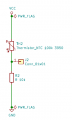
well that looks quite straightforward. However, a problem is that I'm measuring ambient (room) temperatures, and that based on the tables
https://www.tme.eu/Document/803044d5da776ac3c31dc4c407347b50/NTCM-HP-100K-1.pdf
(I worked that using Steinhart–Hart equation, and the values fall quite well within range)
https://en.wikipedia.org/wiki/Thermistor
the resistance change for every degree change at room temperatures is around 2k-5k ohms.
That translates to about 2-5% change in voltages for every degree change at the divider output.
20 deg C ~ 124k
25 deg C ~ 100k
30 deg C ~ 80k
so taking VCC = 3.3v, divider output
20 deg C ~ 0.24 v
25 deg C ~ 0.3 v
30 deg C ~ 0.36 v
well what a tiny change (0.12v) for a 'whopping' 10 deg C range. and at 0.3v add a long wire to the sensor it becomes an antenna, the radio waves alone picked up adds enough signals (noise) to exceed 0.3 v !
Then I went back to the 'flea markets' and got a bunch of transistors
https://www.aliexpress.com/w/wholesale-2n2222.html
(lots of fakes, I got lucky again and got working ones, I got 1 bag which is practically just plastic with 3 leads made to look like transistors, thrown away !)
the circuit becomes this
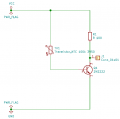
well, this works finally, components are 'cheap', but that it is a lot of effort *calibrating* that transistor, i.e. determine the Hfe / beta )
it is a bit of surprise that an accurately measured beta / Hfe of a 'flea market' BJT runs to around 336
I'd guess this beta / Hfe value would vary between transistors.
The circuit is highly determinant on beta / Hfe the current amplification of the BJT, the load resistance R1 100 ohm is determined based on the Beta of 336 such that around ambient 100k ohms Vce (at J1) runs around 2.5v. The high amplification beta 336 is the reason a low R1 of 100 ohms is used.
(another bad news is that beta is after all not a constant fig 3
https://www.onsemi.com/pdf/datasheet/p2n2222a-d.pdf )
the workings are like
ib = (Vcc - Vbe) / R(th1)
ic = beta x ib = beta * (Vcc - Vbe) / R(th1) = 336 * (3.3 - 0.7) / R(th1)
vout = vce = vcc - V(r1) = vcc - ic * r1 = vcc - beta * (Vcc - Vbe) * r1 / R(th1) = 3.3 - 336 * (3.3 - 0.7) * 100 / R(th1) = 3.3 - 87360 / R(th1)
so that works out like
20 deg C ~ 124k ~ 3.3 - 87.36 / 124 = 2.59 v
25 deg C ~ 100k ~ 2.42v
30 deg C ~ 80k ~ 2.2v
that gives a range of about 0.4 v for that 10 deg range
https://www.aliexpress.com/w/wholesale-thermistor.html
just about all of them claims NTC 3950 25degC with no datasheets in the tag
so I go about searching for datasheets and stumbled into one e.g.
https://www.tme.eu/Document/803044d5da776ac3c31dc4c407347b50/NTCM-HP-100K-1.pdf
I 'got lucky' and it seemed what I casually measured of a 'cheap flea market' 100k NTC thermistor conforms to the specs quite well.
(I've had once got a 3d printer in which a claimed 100k NTC thermistor measures 50k at 25 deg C ! and they 'casually' shipped that in the kit with the 3d printer, try to imagine just how wildly off plastic temperatures e.g. 200 deg C there are in the wild which accounts for the *millions* of 3d printing problems out there)
then I started with this 'naive' circuit:
well that looks quite straightforward. However, a problem is that I'm measuring ambient (room) temperatures, and that based on the tables
https://www.tme.eu/Document/803044d5da776ac3c31dc4c407347b50/NTCM-HP-100K-1.pdf
(I worked that using Steinhart–Hart equation, and the values fall quite well within range)
https://en.wikipedia.org/wiki/Thermistor
the resistance change for every degree change at room temperatures is around 2k-5k ohms.
That translates to about 2-5% change in voltages for every degree change at the divider output.
20 deg C ~ 124k
25 deg C ~ 100k
30 deg C ~ 80k
so taking VCC = 3.3v, divider output
20 deg C ~ 0.24 v
25 deg C ~ 0.3 v
30 deg C ~ 0.36 v
well what a tiny change (0.12v) for a 'whopping' 10 deg C range. and at 0.3v add a long wire to the sensor it becomes an antenna, the radio waves alone picked up adds enough signals (noise) to exceed 0.3 v !
Then I went back to the 'flea markets' and got a bunch of transistors
https://www.aliexpress.com/w/wholesale-2n2222.html
(lots of fakes, I got lucky again and got working ones, I got 1 bag which is practically just plastic with 3 leads made to look like transistors, thrown away !)
the circuit becomes this
well, this works finally, components are 'cheap', but that it is a lot of effort *calibrating* that transistor, i.e. determine the Hfe / beta )
it is a bit of surprise that an accurately measured beta / Hfe of a 'flea market' BJT runs to around 336
I'd guess this beta / Hfe value would vary between transistors.
The circuit is highly determinant on beta / Hfe the current amplification of the BJT, the load resistance R1 100 ohm is determined based on the Beta of 336 such that around ambient 100k ohms Vce (at J1) runs around 2.5v. The high amplification beta 336 is the reason a low R1 of 100 ohms is used.
(another bad news is that beta is after all not a constant fig 3
https://www.onsemi.com/pdf/datasheet/p2n2222a-d.pdf )
the workings are like
ib = (Vcc - Vbe) / R(th1)
ic = beta x ib = beta * (Vcc - Vbe) / R(th1) = 336 * (3.3 - 0.7) / R(th1)
vout = vce = vcc - V(r1) = vcc - ic * r1 = vcc - beta * (Vcc - Vbe) * r1 / R(th1) = 3.3 - 336 * (3.3 - 0.7) * 100 / R(th1) = 3.3 - 87360 / R(th1)
so that works out like
20 deg C ~ 124k ~ 3.3 - 87.36 / 124 = 2.59 v
25 deg C ~ 100k ~ 2.42v
30 deg C ~ 80k ~ 2.2v
that gives a range of about 0.4 v for that 10 deg range
Last edited: