semiconductors - current flow

Thread Starter

sharanbr123

Joined Sep 29, 2014
49
Hello,

I am aware that semiconductors do not obey Kirchoff's law per se.
But I want to know if basic electrical conduction properties that a circuit should be complete in order for current flow is true even for semiconductors also.

Thanks ...
 

Thread Starter

sharanbr123

Joined Sep 29, 2014
49
Dear Jony,

You are right. I was confusing Ohm's law with Kichoff's law.
My basic doubt on this topic came after seeing CMOS transistor.
Normally, the gate of the transistor is charged or discharged by drain or source but the other end of gate is not connected to either drain or source.
Hence my question & this still remains open ...
 

Jony130

Joined Feb 17, 2009
5,593
What you mean by saying that semiconductors do not obey the Ohm's law? How you understand it?
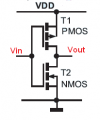
And there is no such thing as as "CMOS transistor". CMOS = P MOS + NMOS
Quote from wiki
CMOS is also sometimes referred to as complementary-symmetry metal–oxide–semiconductor (or COS-MOS).[1] The words "complementary-symmetry" refer to the fact that the typical digital design style with CMOS uses complementary and symmetrical pairs of p-type and n-type metal oxide semiconductor field effect transistors (MOSFETs) for logic functions.[2]

4.PNG
Normally, the gate of the transistor is charged or discharged by drain or source but the other end of gate is not connected to either drain or source.
What? Ccan you elaborate a bit more on this?
 

Thread Starter

sharanbr123

Joined Sep 29, 2014
49
Dear Jony,

What you mean by saying that semiconductors do not obey the Ohm's law? How you understand it?
I am pointing to an old thread -
But when you get to semiconductor devices, a transistor for example, you cannot apply Ohm's Law. That is because the device is non-linear, i.e. the current does not vary proportionately with applied voltage. Another way of looking at it, the resistance is not constant. The resistance changes with applied voltage.
What? Ccan you elaborate a bit more on this?
In typical CMOS designs, the circuits basically operate by charging or discharging the gate of next stage of the transistors. This effect of charging or discharging of gate of the transistor results in turning on or off of the transistor. And this in turn, again either charges or discharges next set of transistors.

If PMOS is turned on then gate of next stage is charged. If NMOS is turned on then gate of next stage is discharged. Frankly, I haven't brushed up CMOS design basics for a long time.
 

Jony130

Joined Feb 17, 2009
5,593
In typical CMOS designs, the circuits basically operate by charging or discharging the gate of next stage of the transistors. This effect of charging or discharging of gate of the transistor results in turning on or off of the transistor. And this in turn, again either charges or discharges next set of transistors.

If PMOS is turned on then gate of next stage is charged. If NMOS is turned on then gate of next stage is discharged. Frankly, I haven't brushed up CMOS design basics for a long time.
And the question is ?

As for the Ohm's law. How can you compare a transistor with resistor? For me Ohm's law always holds. Transistor is non linear device but we still can use Ohm's law when analyze the semiconductor circuit. We simply have to use the proper "model".
But if you treat the Ohms as a circuit property, that current must be proportional to the voltage then yes, the semiconductor do not follow this linear property.
Because for example the MOS transistors in saturation behavior more like a poor current source than a resistor. But in triode region the MOS act just like a poor man's voltage controlled resistor.
 
Last edited:

studiot

Joined Nov 9, 2007
4,998
I am aware that semiconductors do not obey Kirchoff's law per se.
But I want to know if basic electrical conduction properties that a circuit should be complete in order for current flow is true even for semiconductors also.
It would help you to tighten up on your terminology.

Semiconductors do not obey KCL or KVL per se. It just does not apply to them.

Semiconductor devices however, that's a different matter.

When we include semiconductor (or other advanced) devices in a circuit we replace the real object with a model, employing combinations of simpler circuit elements.
Some (most) of these models do indeed conform to Kirchoff's laws.

As to the completeness of a circuit, like Jony, I'm not sure what you mean.

However a purely voltage controlled device such as an igfet has parts of the circuit with no conductive path.
You should also realise that 'conductive' has a particular meaning in electricity.

Alternating current will pass a capacitor, direct current will not.
So separate circuit analyses are performed for DC and AC where these are present eg in transistor circuitry.
 

BR-549

Joined Sep 22, 2013
4,928
I think your problem is that you think there must be a complete circuit path for the input signal into the device. The input signal does have a complete path.......just NOT thru the gate. The device only needs to sense the voltage of the signal. It requires no current or power. In a sense it isolates the in from the out like a cap....but a cap has true current flow and can pass power. The gate can transfer only voltage and phase. The gate is only a charge sensor, it is not to be put "in" a circuit.
Think of it as monitoring the voltage of another circuit.
 

crutschow

Joined Mar 14, 2008
38,316
I think your problem is that you think there must be a complete circuit path for the input signal into the device. The input signal does have a complete path.......just NOT thru the gate. ...........................
That answer is inaccurate. :confused: The input signal does have a complete path through the gate capacitance to the source terminal, and the current to charge and discharge that capacitance must be supplied by the source (although there's no significant DC current through that path). If not, you couldn't control the transistor. It's the voltage between the gate and source that affects the MOSFET drain to source current.
 

BR-549

Joined Sep 22, 2013
4,928
crutschow, you are correct. I was trying to leave our manufacturing deficiencies out of the discussion.
Once transistor engineers learn the proper structure, we should see great improvement.
Imagine circuits and devices that only work with the electric and magnetic without any electron flow. Little heat and super quick. It will take a very fast and variable oscillator to adjust the size and position of particles. Once we do that, we can build custom materials for even better circuits.
 

WBahn

Joined Mar 31, 2012
32,703
I don't understand this claim that semiconductors don't obey KVL and KCL, they sure do in everything I do, and I design CMOS integrated circuits for a living.

When you talk about charging the gate, what you should be talking about is establishing a gate-source potential difference, which involves charging the gate-source capacitance (plus all other capacitances of which the gate plays a role, most notably the drain). When charge is pushed onto or pulled off of the gate, it is part of a complete circuit in which the corresponding charge is pulled off of or pushed onto something else. Hence KCL is obeyed. If you go around any closed path for that include the gate-source junction, KVL will be obeyed.
 
Top